
TL;DR:
- Paying more for chat management does not automatically increase earnings, and costly models can eat into creator profits.
- Understanding and negotiating between percentage-based, fixed, or hybrid pricing models helps creators optimize revenue and control costs effectively.
Paying more for chat management doesn’t automatically mean earning more. That’s the misconception that costs creators real money every month. If you’re already pulling in $3k or more, the pricing model you choose for fan chat management directly shapes your take-home revenue, your stress levels, and how fast you can scale. This guide breaks down every major pricing structure, what drives costs up or down, and how to negotiate terms that work in your favor so you stop leaving money on the table.
| Point | Details |
|---|---|
| Pick the right pricing model | Choose a structure that matches your revenue style for optimal profits and control. |
| Know your negotiables | Understand what really drives pricing so you capture value rather than overpay for extras. |
| Watch for hidden costs | Review contracts carefully to avoid surprise fees and maximize your take-home earnings. |
| Invest for growth | Strategic chat management isn’t an expense—it’s a lever to scale your brand and revenue. |
With the basics set, it’s crucial to break down exactly how pricing for chat management works in practice. There are three main structures you’ll encounter when shopping for a chat management agency, and each one has real implications for your bottom line.
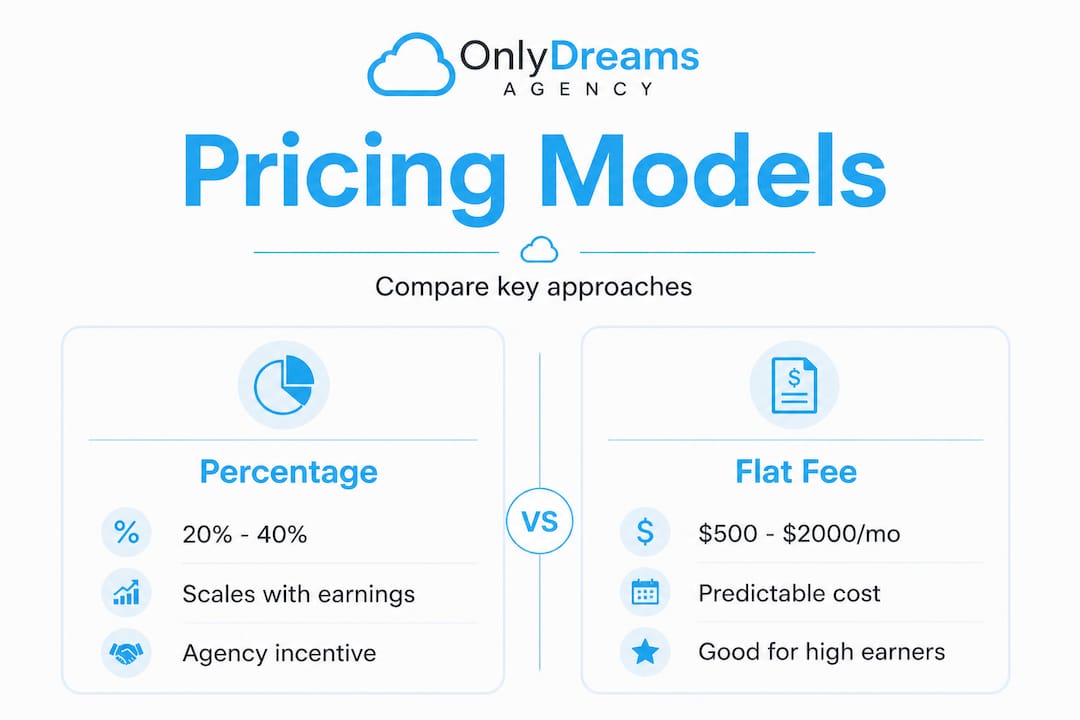
Percentage-based pricing is the most common model. The agency takes a cut of your chat revenue, typically ranging from 20% to 40%, according to agency pricing comparisons. The upside is that you only pay more when you earn more, which aligns incentives. The downside is that as your revenue climbs, so does your fee, sometimes dramatically.
Fixed fee pricing means you pay a flat monthly rate regardless of how much you earn. Rates vary widely, from around $500 to $3,000 per month depending on service scope, team size, and platform complexity. This model gives you predictable costs, which is great for budgeting, but it also means the agency’s incentive to push your revenue harder is lower.
Hybrid pricing combines both approaches, usually a lower percentage (10% to 20%) on top of a modest base fee. This model is increasingly popular because it balances risk between you and the agency. You get some cost predictability while the agency still has skin in the game.
| Pricing model | Typical range | Best for | Main risk |
|---|---|---|---|
| Percentage-based | 20% to 40% of chat revenue | Creators scaling fast | Fees balloon at high revenue |
| Fixed fee | $500 to $3,000/month | Stable, high earners | Agency lacks growth incentive |
| Hybrid | 10% to 20% + base fee | Mid-to-high earners | Complexity in tracking |
Here’s what to weigh when choosing:
Pro Tip: Ask any agency you’re evaluating to show you a sample earnings breakdown at three different revenue levels, say $5k, $10k, and $20k per month. That single exercise will reveal exactly how their pricing model scales with your success.
Strong chatting strategies for sales also matter here. The best pricing model in the world won’t save you if the team managing your chats doesn’t know how to convert fans into paying customers.
Now that you’ve seen the main pricing models, let’s get specific: what actually affects the cost you might pay? Pricing isn’t arbitrary. Agencies factor in several concrete variables when building your quote, and understanding them helps you negotiate from a position of knowledge.
Fan volume is one of the biggest drivers. Managing 200 active fans requires a very different workload than managing 2,000. Higher fan counts mean more simultaneous conversations, more relationship tracking, and more opportunities to upsell pay-per-view content or custom requests. Expect pricing to scale accordingly.

Platform complexity also matters. If you’re active on OnlyFans only, management is simpler. Add Fansly, Fanvue, or a private Telegram community, and the operational complexity increases. According to outsourced chat management data, platform count, fan volume, add-ons, and automation tools all directly affect what agencies charge.
Upselling and 1-on-1 messaging are premium services. If you want your chat team actively pitching pay-per-view content, custom videos, or exclusive bundles, that’s a higher-skill function than basic fan engagement. Agencies that specialize in revenue-generating chat will charge more, but the return on that investment is usually measurable.
| Pricing factor | Impact on cost | Notes |
|---|---|---|
| Fan volume (high) | +15% to +30% | More agents needed |
| Multi-platform management | +$200 to $800/month | Depends on platforms |
| Active upselling | +10% to +20% | Requires trained chatters |
| CRM and automation tools | +$100 to $500/month | Often bundled |
| Content creation add-ons | +$300 to $1,000/month | Varies by output volume |
| Marketing services | +$500 to $2,000/month | Social media scope |
Automation and CRM tools are worth a separate mention. Many agencies now use fan relationship management software to track conversation history, spending patterns, and engagement scores. This technology improves results but adds to your cost. The good news is that automation for high earners typically pays for itself through better fan retention and higher average spend per subscriber.
Service add-ons like social media marketing, content writing, or Instagram growth packages can significantly inflate your monthly bill. These aren’t always bad investments, but you should evaluate them separately from core chat management. A focused, excellent chat team often outperforms a bloated package that does everything at a mediocre level.
One practical move: audit your current fan engagement workflow before signing any contract. Tools that help with streamlining fan engagement can reduce the hours your agency needs to bill, which directly lowers your costs.
Understanding the price is only part of the puzzle. Next, you’ll see how that price interacts with your real monthly earnings, and why the wrong model can quietly drain your profits even when revenue looks healthy.
Let’s run through a concrete scenario. Say you’re earning $8,000 per month in chat revenue.
Now scale that to $15,000 per month in chat revenue:
The fee structure’s effect on take-home profits becomes dramatic at higher revenue levels. A percentage deal that felt reasonable at $5k per month becomes a serious cost center at $15k.
Key insight: At $15k/month chat revenue, the difference between a 30% percentage deal and a $1,500 flat fee is $3,000 per month. That’s $36,000 per year in additional take-home income.
Here’s a numbered breakdown of how to think about pricing impact at your current level:
Pro Tip: The best way to grow your creator revenue isn’t always to cut agency fees. Sometimes paying a premium for a team that actively upsells and retains fans returns far more than you’d save by going with the cheapest option.
Percentage deals reward agencies for helping you grow, which is genuinely valuable when you’re scaling. But once you hit a stable high-earning level, flat fees often make more financial sense. Knowing when to make that switch is one of the highest-value decisions you can make as a creator.
Armed with an understanding of impact, let’s get practical about how to avoid mistakes and secure great deals. Most creators overpay not because they chose the wrong model, but because they didn’t negotiate or didn’t know what to watch for.
Three pricing traps to avoid:
According to insights from top chatting agencies, veteran creators consistently flag these three areas as the most common sources of overpayment and frustration. The good news is that most agencies expect negotiation and will work with you if you come prepared.
“The contract you sign on day one is rarely the contract you have to live with. Every serious agency expects negotiation. Creators who don’t push back simply pay more for the same service.”
What to negotiate:
If you’re evaluating multiple vendors, it also helps to review chat platform alternatives so you understand the full landscape of tools and services available. The more options you know about, the stronger your negotiating position.
When to accept a higher rate: if an agency has a verified track record of growing creator revenue, strong chatter training, and transparent reporting, paying a premium is often worth it. Don’t let a 5% fee difference steer you away from a team that consistently delivers 30% more chat revenue.
Here’s the honest truth that most pricing guides won’t tell you: creators who obsess over minimizing fees often end up earning less overall. It’s a pattern we see repeatedly.
When you treat chat management as an expense to minimize rather than an investment to optimize, you end up with the cheapest option available. Cheap chat teams tend to have high turnover, inconsistent quality, and little incentive to push your revenue. The “savings” on fees get eaten up by lost upsell opportunities, lower fan retention, and the time you spend managing a team that isn’t performing.
The most successful creators we work with think about chat management the same way a business owner thinks about a sales team. They ask: what revenue is this team generating, and is the cost justified by the return? That’s a fundamentally different question than “how do I pay as little as possible?”
The metrics that actually matter are fan retention rate, average revenue per fan per month, and pay-per-view conversion rate. These numbers tell you whether your chat team is doing its job. A team charging 35% but driving a 60% pay-per-view conversion rate is worth far more than a team charging 20% with a 20% conversion rate.
Red flags that savvy creators watch for: agencies that can’t provide clear performance data, teams that use generic scripts rather than personalized engagement, and contracts that make it hard to leave. If an agency is confident in its results, it won’t need to lock you in with punitive exit terms.
The revenue-maximizing management practices that separate top earners from average ones almost always include a professional chat team operating with clear KPIs, regular reporting, and a genuine focus on fan relationship quality. That’s what you should be buying, not just hours of chat coverage.
If you’ve made it this far, you now have a clear picture of how pricing models work, what drives costs, and how to negotiate terms that protect your earnings. The next step is putting that knowledge into action with a partner who operates transparently.
At OnlyDreams Agency, we work exclusively with established creators who are serious about scaling. Our pricing is straightforward, our chat teams are trained to build genuine fan relationships and maximize revenue, and our reporting gives you full visibility into what you’re getting for your investment. Whether you’re looking for dedicated chat management, full account management, or AI-enhanced marketing support, we build solutions around your goals. Explore what we offer and see how professional management translates directly into revenue growth and less daily stress.
Most agencies charge between 20% and 40% of chat revenue, though the exact rate depends on contract terms, service level, and platform scope.
Some contracts include extra charges for add-ons like content writing or advanced marketing, so always read the full terms before signing.
Flat fees often deliver better value at higher revenue levels by capping costs, but percentage deals keep agencies motivated to grow your earnings.
Automation tools raise base costs but typically improve fan engagement and retention, making the added expense worthwhile for most high earners.
Yes, negotiation is standard in this industry. Focus your negotiation on clear deliverables, cancellation policies, and eliminating hidden fees before you sign.