
TL;DR:
- Operational management for creators involves designing systems, workflows, and financial structures to support sustainable growth. It reduces burnout and boosts revenue by automating tasks, building owned audience assets, and diversifying income sources. Implementing a Creator Operating System early enables scalable success and creative freedom.
Operational management for creators is defined as the strategic design and execution of systems, workflows, and infrastructure that align content creation with measurable business growth. Most creators treat it as an afterthought, but it is the single factor separating creators who scale from those who burn out. Tools like Notion for workflow management and ConvertKit for audience ownership are not optional extras. They are the backbone of a professional creator operation. Creators who understand what is operational management for creators and apply it consistently save over 10 hours weekly by automating production tasks and repurposing content across platforms.
Operational management for creators unites systems, workflows, and infrastructure to align content creation with business objectives. The industry term for this is the Creator Operating System (COS), and it goes far beyond posting schedules or content calendars.

A content calendar tracks what you post and when. A full operating model defines how content gets created, reviewed, published, and measured. It includes ownership roles, workflow stages, tool integrations, and performance metrics. That distinction matters because most creators build a calendar and call it a system. It is not.
The core components of a complete creator operation include:
Financial structure is one of the most overlooked parts of creator operations. Creators who treat income as personal spending money hit a ceiling fast. A proven model has creators reinvest 50–60% of net profit as a personal salary, allocate 30–40% toward business growth, and set aside 10–15% for taxes. That structure stabilizes cash flow and creates the financial runway to hire, invest in equipment, or weather slow months.
Pro Tip: Build your SOPs before you feel like you need them. If a task takes you more than 15 minutes and you do it more than once a week, document it. That document becomes your first hire’s training manual.
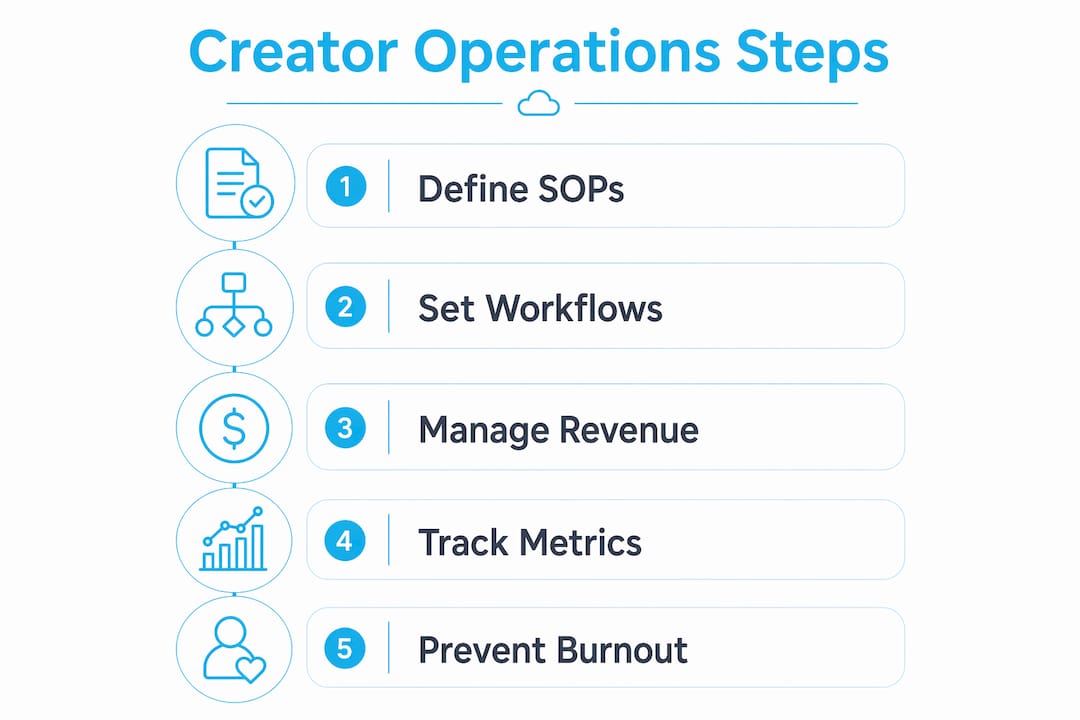
Burnout in the creator economy is less about workload and more about lacking operational boundaries and financial structure. That is a critical distinction. Adding more hours does not fix a broken system. Building the right system does.
Expert Liz Stapleton describes the Creator Operating System as a “hidden layer” that connects all tools and workflows, reducing cognitive load and daily decision fatigue. Decision fatigue is real. Every time you ask yourself “what should I post today?” or “should I respond to this DM now?”, you are spending mental energy that could go toward creative work.
Here is how a structured operational approach prevents burnout:
Industry experts consistently emphasize that sustainable growth comes from consistent, high-quality schedules rather than chasing posting frequency for the algorithm. Chasing the algorithm without a system underneath it is a fast path to exhaustion.
Pro Tip: Treat your weekly content schedule like a business meeting. Block the time, protect it, and show up prepared. Creators who schedule creation time the same way they schedule client calls produce more consistently and with less stress.
For a deeper look at how to structure your creator workflow from the ground up, the creator business operations guide at Only-dreams covers the full build-to-scale process.
Platform risk is the single biggest financial threat most creators ignore until it hits them. Algorithm changes, demonetization, and account restrictions can cut revenue overnight. The best practice for managing this risk is diversification, both of platforms and of revenue types.
The rule is clear: no single platform should generate more than 60% of your total revenue. That ceiling protects you when one platform changes its rules. Creators who violate this threshold are one algorithm update away from a financial crisis.
Platform Revenue Comparison
| Revenue Source | Resilience Level | Notes |
|---|---|---|
| Single platform ads | Low | Vulnerable to algorithm and policy changes |
| Sponsorships only | Medium | Dependent on brand budgets and market cycles |
| Owned products and memberships | High | Provides 5x greater resilience against demonetization |
| Email and SMS list monetization | Very High | Owned audience, platform-independent |
Owned audience assets are the most undervalued tool in creator operations. An engaged 10,000-subscriber email list is more valuable for business stability than 200,000 followers on a single platform. Followers are rented. Subscribers are owned. That difference defines your financial floor.
Revenue diversification for creators should include:
Revenue from owned products and memberships provides 5x greater resilience against platform demonetization than sponsorship-only models. That number should change how you prioritize your time and creative output.
The right tools for creator operations fall into three categories: workflow management, audience engagement, and analytics. The mistake most creators make is using tools in isolation. A unified Creator Operating System connects all three categories so information flows between them without manual effort.
Workflow management tools include Notion and Trello. Notion works well for creators who need flexible databases to track content pipelines, SOPs, and project timelines. Trello suits creators who prefer a visual board layout for simpler workflows. Both are free at the entry level.
Audience engagement tools include ConvertKit for email list management and ManyChat for automated DM responses on Instagram. ConvertKit is the preferred choice for creators building a direct-to-audience revenue channel because it supports tagging, segmentation, and automated sequences without requiring technical expertise.
Analytics tools include native platform dashboards on Instagram, TikTok, and YouTube, plus third-party tools like Sprout Social for cross-platform reporting.
The metrics that matter for creator operations are not follower counts. Top KPIs for creators include engagement rate, click-throughs, saves, and conversions. Follower count is a vanity metric. Engagement rate tells you whether your audience is actually paying attention. Conversion rate tells you whether they are taking action.
For a data-driven approach to tracking what actually moves revenue, the role of analytics in creator management breaks down exactly which numbers to watch and why.
Pro Tip: Start with two tools, not ten. Pick one workflow tool and one analytics dashboard. Master them before adding anything else. Tool overload creates the same decision fatigue you are trying to eliminate.
Operational management for creators is the foundation of every scalable, sustainable creator business, combining systems, financial discipline, and owned audience assets to reduce burnout and grow revenue.
| Point | Details |
|---|---|
| Define your Creator Operating System | Build SOPs, content workflows, and financial frameworks before you feel like you need them. |
| Protect against platform risk | Cap any single platform at 60% of revenue and build an owned email or SMS list immediately. |
| Batch and automate to prevent burnout | Schedule content in focused sessions and automate distribution to eliminate daily decision fatigue. |
| Track the right metrics | Prioritize engagement rate, click-through rate, and conversions over follower count. |
| Hire at the right time | Document your system and stabilize revenue before adding team members to avoid compounding stress. |
I have worked with creators at every stage, from those just hitting their first 1,000 subscribers to established names pulling six figures monthly. The pattern I see most often is the same: creators wait until they are overwhelmed to build operational systems. By then, the chaos is already expensive.
The creators who scale fastest are not always the most talented. They are the ones who treat their content business like a business from day one. They document their processes early, even when those processes are simple. They set financial rules before the money gets complicated. They build their email list when they have 500 followers, not 50,000.
What I find most counterintuitive is that adding structure actually increases creative freedom. When you are not making 40 micro-decisions a day about what to post, when to post, and how to respond, you have more mental space for the creative work that actually differentiates you. The system handles the repetitive. You handle the irreplaceable.
My honest recommendation: start with the smallest viable system. One SOP for your most repeated task. One financial rule for how you pay yourself. One metric you check every week. Build from there. You do not need a perfect system on day one. You need a working one.
— Gjon
Building and running a full creator operation takes real time and expertise. Only-dreams specializes in handling exactly that for established creators who want to scale without adding more to their plate.
Only-dreams provides dedicated account managers, 24/7 trained chat teams that build authentic fan relationships, and data-driven marketing strategies across Instagram, TikTok, and other platforms. The result is more revenue and more time for you to create. If you are ready to see what professional creator management looks like in practice, explore the full range of services at Only-dreams and find out how the team can take your operation to the next level.
Operational management for creators is the practice of building systems, workflows, and financial structures that align content creation with business growth. It includes SOPs, content pipelines, audience ownership assets, and performance tracking to enable sustainable scaling.
Creators who automate production tasks and repurpose content efficiently save over 10 hours weekly. Those hours go back into creative work or business development.
A Creator Operating System is a connected framework of tools, workflows, SOPs, and decision points that runs a creator business with minimal daily friction. Expert Liz Stapleton describes it as the “hidden layer” that reduces cognitive load across all creator operations.
Creators should cap any single platform at 60% of total revenue and build income from subscriptions, digital products, affiliate marketing, and owned audience channels like email lists. Owned products and memberships provide 5x greater resilience than sponsorship-only income models.
Engagement rate, click-through rate, saves, and conversions are the metrics that reflect real audience behavior and revenue potential. Raw follower count does not indicate whether your audience is engaged or likely to buy.