
TL;DR:
- Successful creators use a structured workflow with clear stages to increase engagement and revenue.
- Prioritizing quality over quantity and leveraging email marketing stabilizes income beyond social platforms.
- Tools like Notion and Asana help manage content schedules effectively, reducing reactive tasks and burnout.
You’re posting consistently, engaging with fans, and still feel like you’re spinning your plates without actually moving forward. That frustration is real, and it’s more common than you’d think among creators already earning $3k or more per month. The bottleneck usually isn’t your content quality. It’s your workflow. Without a clear system, you end up reactive instead of strategic, burning time on tasks that don’t directly grow your income. This guide breaks down the exact workflow stages, tools, benchmarks, and revenue channels that established creators use to scale fan engagement and earnings without burning out.
| Point | Details |
|---|---|
| Workflow stages matter | Mapping out each workflow stage helps maintain consistency and boost productivity. |
| Choose the right tools | Selecting digital platforms like Notion or Asana streamlines tracking and scheduling. |
| Quality over quantity | Posting less but more strategically increases fan engagement and avoids audience fatigue. |
| Diversify for stability | Building email lists and offering products significantly enhance revenue and reduce risk. |
| Use data to optimize | Monitoring platform benchmarks helps you refine your content for maximum engagement. |
Every successful creator operates on a repeatable system. Without one, you’re improvising every week, which leads to inconsistent posting, missed engagement windows, and revenue gaps. Mapping your workflow into defined stages is the first move toward fixing that.
According to content workflow research, the core stages of a content production workflow are: ideation, planning, pre-production, production, post-production, approval, publishing, distribution, engagement, and optimization. Each stage has a specific purpose, and skipping one creates gaps that hurt your output and income.

Here’s how a solo creator might structure a full week using these stages:
| Day | Stage | Task |
|---|---|---|
| Sunday | Ideation and planning | Brainstorm topics, write scripts |
| Monday | Production | Record content |
| Tuesday | Post-production | Edit videos, color grade |
| Wednesday | Pre-publish | Create thumbnails, write captions |
| Thursday | Publishing | Schedule and distribute content |
| Friday/Saturday | Engagement and optimization | Respond to fans, review analytics |
This kind of structure keeps you from reactive posting, where you’re scrambling to create something because you haven’t filmed anything in four days. Reactive posting is one of the biggest engagement killers for established creators.
For workflow management, two tools stand out:
Both platforms let you build a workflow board that mirrors the stages above. You can learn more about advanced social media tactics to layer on top of this foundation once your workflow is locked in. For deeper context on how these stages connect to your overall strategy, the mastering social marketing guide is a strong next read.
Pro Tip: Block specific days of your week for each workflow stage rather than trying to do all tasks daily. This prevents context-switching and helps you produce more content in less time.
With your stages mapped, the next step is choosing tools that fit your actual needs rather than just downloading whatever gets the most hype. The right tool reduces manual effort and creates predictability in your publishing schedule.
Here’s a quick comparison to help you decide:
| Tool | Best for | Scheduling | Analytics | Team collaboration |
|---|---|---|---|---|
| Notion | Solo creators, flexible systems | Manual reminders | Basic | Limited |
| Asana | Teams and agencies | Task-based | Reporting dashboards | Strong |
| Instagram Creator Studio | Instagram-focused creators | Native scheduling | Instagram insights | None |
| TikTok Scheduler | TikTok-first creators | Native scheduling | TikTok analytics | None |
To set up a practical workflow board, follow these steps:
For creators using AI tools to reduce workload further, AI workflow tools can automate caption writing, hashtag research, and even engagement responses. That’s a meaningful time save when you’re running a full-scale content operation.
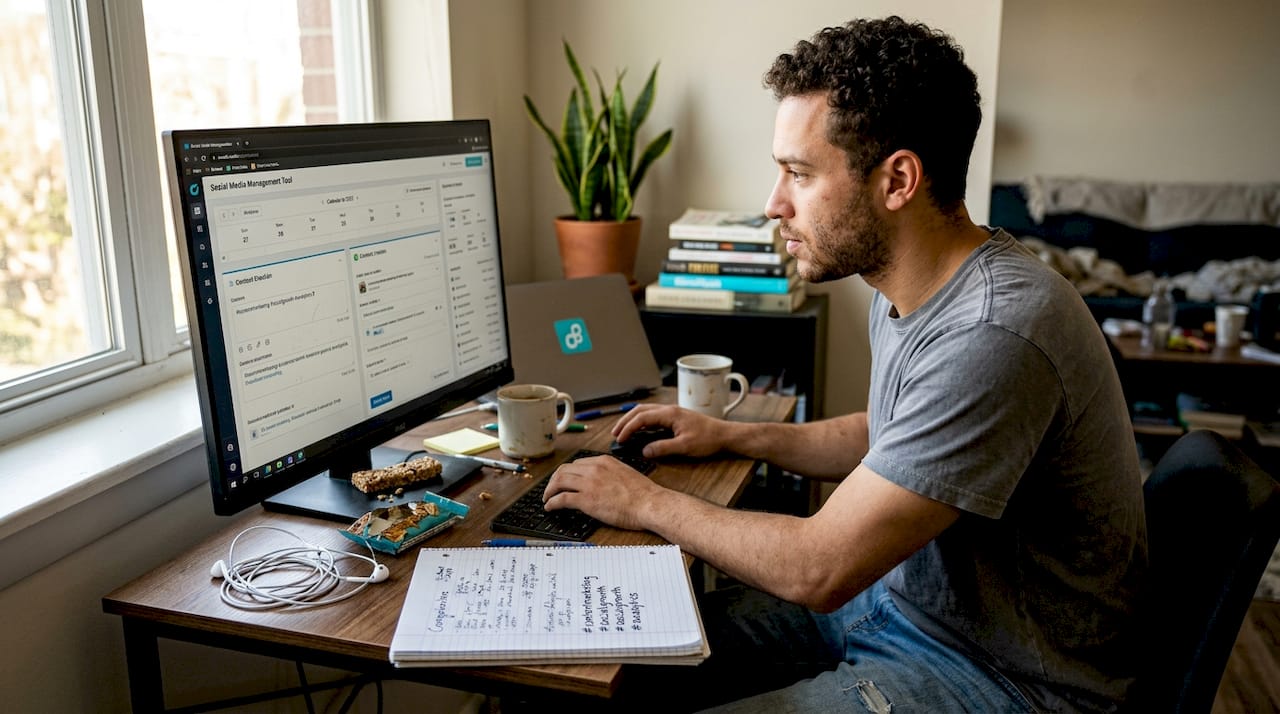
Pro Tip: Use batch publishing through a native scheduler or third-party tool so you’re not manually hitting “post” every single day. Schedule your week’s content on Thursday so your weekend stays free for engagement and planning.
Knowing your workflow is one thing. Knowing whether it’s working is another. Engagement rate is the clearest signal of how well your content resonates, and in 2026 the benchmarks vary significantly by platform.
2026 engagement data shows TikTok leads with a median engagement rate of 4.25%, while Instagram sits at 1.81%. That’s a meaningful gap if you’re trying to build a highly engaged audience quickly.
| Platform | Median engagement rate | Creator size advantage |
|---|---|---|
| TikTok | 4.25% | Nano creators perform strongest |
| 1.81% | Micro creators outperform mega |
Nano creators (typically under 10,000 followers) see 3 to 6 times higher engagement rates than mega creators. That’s not a consolation prize. It means authentic, niche content outperforms scale at the engagement level.
The education niche consistently shows some of the strongest fan interaction, with top engagement rates near 3.92%. Whatever your niche, applying teaching-style content (tutorials, walkthroughs, explainers) can meaningfully lift your engagement numbers.
“Over-posting kills engagement. Quality always wins over quantity, especially once you move past the nano tier.”
Here’s how to track and act on your engagement metrics:
For platform-specific strategies, the TikTok engagement tactics guide covers exactly how to push those numbers up. You can also review fan engagement insights to understand what drives fan loyalty beyond raw metrics.
Social platforms are powerful, but they don’t own your audience. Algorithm changes, account restrictions, or platform shifts can cut your reach overnight. Creators earning six figures know this, and they protect themselves accordingly.
Research on six-figure creator income shows that email converts at 15.22% for sales, compared to just 1.9% for social media. That’s roughly a 7x difference in sales conversion. Email also gives creators 45% more income and 68% greater revenue stability than social-only strategies.
Here are the top email platforms to consider:
Here’s how to integrate email and product offers into your weekly workflow:
For additional marketing approaches to amplify both your email and social reach, advanced marketing tips outlines what top creators are doing right now to extend their revenue beyond platform income.
Here’s the honest truth most workflow articles skip: the problem isn’t always doing too little. Sometimes it’s doing too much of the wrong things.
We’ve seen creators posting twice daily on TikTok and Instagram, burning through content ideas in six weeks, and watching their engagement drop because their audience simply got tired. Over-posting is a real threat, especially once you grow past the nano tier where engagement naturally compresses.
The creators who break and hold the $3k-plus threshold consistently aren’t just posting more. They’re protecting their energy, systematizing their workflow, and building revenue channels that social algorithms can’t touch. As the research confirms, social alone rarely creates stable, scalable income at that level.
The smarter move is to post strategically, engage deeply with a smaller volume of content, and let email and products carry more of the revenue weight. If you’re exploring ways to add professional support to that model, chatting strategies boost sales is worth reviewing as part of your revenue mix.
Pro Tip: Cap your posting frequency before you hit exhaustion. A sustainable schedule you stick to for 12 months beats an aggressive schedule you abandon in 60 days.
If you’re ready to take your workflow to the next level, seeing how other established creators have done it is one of the fastest ways to shortcut your learning curve.
At OnlyDreams Agency, we work directly with creators to handle the operational side of their business so they can focus on creating. From workflow strategy to fan engagement and revenue optimization, we’ve helped real creators build real results. Check out how Stellar Vibe Digital Media, The Discovery of Era, and Super Happy Fun Time each approached their workflow challenges and came out stronger. Their stories might spark the exact shift you’ve been looking for.
The core workflow stages are ideation, planning, pre-production, production, post-production, approval, publishing, distribution, engagement, and optimization. Running these in order keeps your content output consistent and intentional.
TikTok leads with a median of 4.25%, compared to Instagram’s 1.81%. For creators focused on building engaged audiences, TikTok currently offers a clear advantage.
Most prioritize building email lists and selling digital products alongside social content. Email converts at 15.22% for sales versus 1.9% for social, making it a far more reliable revenue engine.
Not typically. Over-posting reduces engagement for most creators, particularly those who have grown beyond the nano tier. Fewer, higher-quality posts consistently outperform high-volume schedules.
Notion and Asana are the top choices for workflow tracking and team collaboration, while TikTok Scheduler and Instagram Creator Studio handle native publishing without extra steps.