
TL;DR:
- Most business leaders underestimate the strategic role of account managers in driving revenue growth and client retention. These professionals own client relationships, execute upsell opportunities, and serve as the organization’s voice of the customer, directly impacting key metrics like Net Dollar Retention. Investing in structured onboarding, aligned incentives, and clear performance metrics transforms account management from reactive firefighting into a sustainable growth engine.
Most business leaders treat account managers as glorified customer service reps. That assumption is costing them serious revenue. The role of account managers extends far beyond answering client calls or sending renewal reminders. These professionals own the commercial health of client relationships, drive expansion revenue, and often determine whether a business grows or plateaus. Understanding what account managers actually do, how their performance is measured, and when to hire them is one of the most underutilized growth levers available to scaling organizations.
| Point | Details |
|---|---|
| AMs drive expansion revenue | 52% of new SaaS revenue comes from existing account expansion, which account managers own. |
| Retention is cheaper than acquisition | Acquiring new customers costs 5 to 7 times more than keeping existing ones. |
| Metrics define success | Net Dollar Retention and contraction rates are the core KPIs for measuring account manager performance. |
| AMs and team leads are not the same | Account managers own individual client portfolios; team leads coach and optimize team-wide performance. |
| Hire when knowledge is fragile | If only the founder knows key client details, it’s time to bring in dedicated account management. |
Account managers take ownership of the client relationship after the sale closes. That is the dividing line. Sales teams pursue new logos; account managers protect and grow the ones already in the portfolio. The distinction matters because the skills, tactics, and metrics are completely different.
On a day-to-day basis, account manager responsibilities include monitoring client health, identifying risks before they become churn events, and engineering the conditions for client success. They are the people who notice when a client’s product usage drops and reach out proactively, rather than waiting for a cancellation notice to arrive.
Here is what strong account management roles actually involve:
One thing that confuses many business leaders is the distinction between account managers and account executives. Account executives close deals. Account managers grow them. A company that blurs this line often ends up with neither role executing at full potential.
Pro Tip: Map your post-sale client journey before hiring. If there is no structured process from handoff to renewal, an account manager will spend most of their time firefighting instead of growing accounts.
Another critical function is acting as the voice of the customer inside the organization. Account managers hear patterns across their portfolio that product, marketing, and leadership teams simply do not. A client asking the same question repeatedly is a signal. An account manager who documents and escalates those signals creates compounding organizational value over time.
Understanding the importance of account managers means understanding how their work connects to business outcomes. The numbers make that connection concrete.
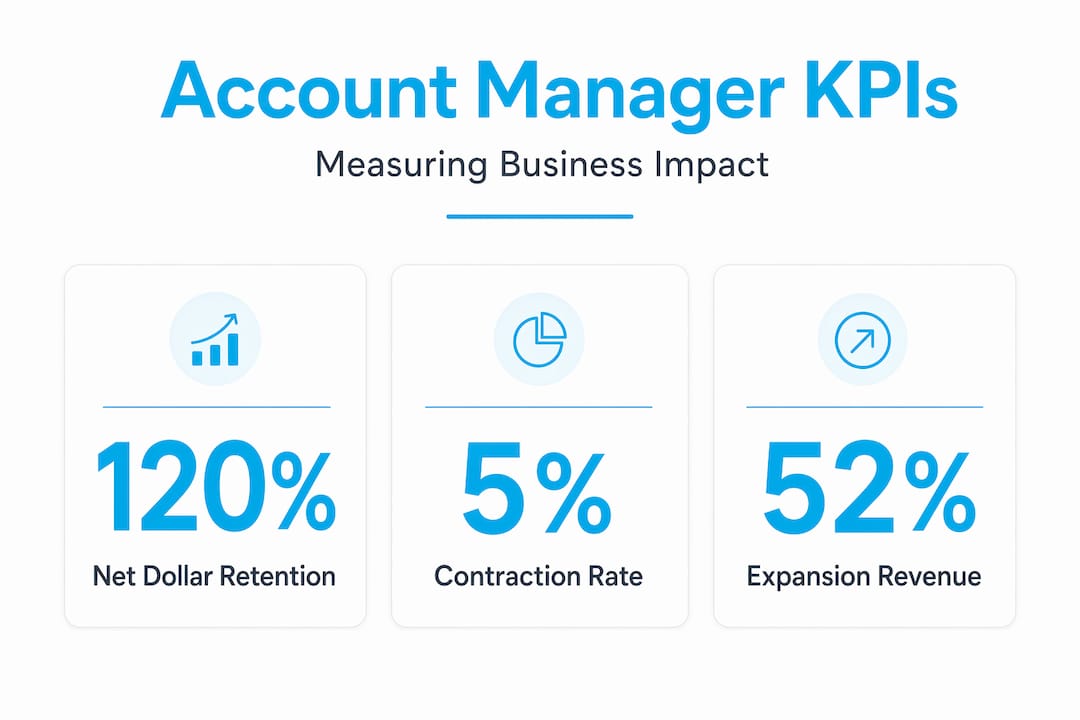
Net Dollar Retention (NDR) is the most telling metric. It measures how much revenue you retain and expand from existing customers over a set period, accounting for upgrades, downgrades, and churn. Healthy NRR sits at 100 to 110%, meaning the base is growing even without new customer acquisition. Best-in-class organizations hit 120% or above.
| Metric | Healthy Range | Why It Matters |
|---|---|---|
| Net Dollar Retention (NDR) | 100% to 120%+ | Shows whether existing accounts are growing or shrinking |
| Contraction Rate | Below 5% annually | Measures revenue lost from downgrades or partial churn |
| Logo Retention | Above 85% | Tracks how many clients renew contracts |
| Upsell/Cross-sell Rate | Varies by industry | Indicates how well AMs identify and convert expansion revenue |
A contraction rate above 8% annually is a warning sign of serious retention problems. Keeping it below 5% signals that account managers are doing their job at a high level. This is not a vanity metric. It directly tells you whether your account management function is healthy or hemorrhaging.
Pro Tip: Do not track these metrics in isolation. NDR without logo retention data can mask situations where a few large clients are growing while many smaller ones quietly leave.
The revenue math for account management is hard to ignore. 52% of new revenue for SaaS companies comes from expansion within existing accounts. That revenue belongs to account managers. Organizations that treat retention and expansion as operational disciplines with defined quotas and aligned compensation consistently outperform those that treat account management as an afterthought.
Compensation structure deserves specific attention here. When 40 to 60% of variable pay is tied directly to renewal and expansion outcomes, organizations see 25% better retention and nearly double the client satisfaction scores. The incentive model shapes the behavior. Build it intentionally.
Many organizations conflate the account manager job description with leadership roles, which creates confusion and accountability gaps. The roles are structurally different and require different mindsets.
An account manager is, fundamentally, a doer. They own their client portfolio directly, manage individual KPIs, and are accountable for outcomes within their specific book of business. Their time horizon is relationship-level: what does this client need today, this quarter, and at renewal?

An account management team lead, by contrast, manages the team’s collective performance. Their job is to coach account managers, remove process bottlenecks, and optimize the function as a whole. They are not primarily responsible for individual client outcomes. They are responsible for creating the conditions that allow their team to deliver those outcomes consistently.
| Area | Account Manager | Team Lead / Manager |
|---|---|---|
| Primary focus | Individual client portfolio | Team performance and enablement |
| Key metrics | NDR, contract retention, upsell | Team-wide KPIs, headcount productivity |
| Daily activities | Client calls, business reviews, risk management | Coaching, forecasting, process improvement |
| Success measured by | Client health scores, revenue retention | Team retention, consistency of outcomes |
| Career path | Leads to team lead or strategic accounts | Leads to VP of Account Management |
Career progression in account management roles typically flows from managing individual accounts to managing teams. But the transition is not automatic. Many excellent account managers struggle as team leads because the skills are genuinely different. Managing clients and managing people require different instincts.
If you are building an account management function, resist the urge to promote your best account manager into a team lead role just because the headcount grows. Assess whether they actually want to lead people. Some of your best revenue-producing account managers will be happiest staying in the individual contributor role, managing a portfolio of high-value accounts.
Recognizing the right moment to hire account managers is one of the most practical questions business leaders face. There are clear signals worth watching.
The founder holds all client knowledge. When only one person knows the relationship history, pricing context, and key contacts for a client, the business is fragile. Bringing in a dedicated account manager creates systematic knowledge transfer and reduces dependency on any single person.
Clients are churning for reasons you cannot diagnose. If clients leave without clear explanation and you have no structured process to catch dissatisfaction early, account managers provide the ongoing touchpoints that surface those signals.
Expansion revenue is being left on the table. If no one in your organization is actively identifying and executing on upsell opportunities within existing accounts, you are leaving growth behind.
Sales is handling renewals. Renewals managed by sales teams are often rushed or under-resourced because sales incentives favor new business. A dedicated account manager owns renewals as a primary function.
Client onboarding is inconsistent. Poor onboarding predicts churn. Account managers who own the post-sale experience dramatically improve client time-to-value and long-term retention.
Once you hire, onboarding the account manager well is just as important as hiring the right person. Structured remote onboarding programs with ongoing virtual check-ins improve account manager retention by 30% over two years. That investment pays back quickly when you consider the ramp time and client relationship continuity at stake. Pairing a new hire with a clear account management checklist from day one removes ambiguity and accelerates performance.
I have seen a consistent pattern across growing organizations. Leaders understand the importance of account managers in theory, but they underfund and understructure the function in practice. They hire one account manager, give them 80 accounts to manage, and expect magic. That is not account management. That is client firefighting with a fancy title.
What I have learned is that the real competitive advantage of account management is not the individual skill of any one person. It is the system around them. When account managers have clear metrics, structured onboarding, aligned compensation, and a consistent process for client reviews and escalation, results follow almost mechanically. Remove any one of those elements and performance becomes unpredictable.
The other thing I have seen get overlooked consistently is the role of the account manager as an intelligence asset. Every client conversation is market research. Account managers who are trained to document and synthesize what they hear feed an organization’s product and strategy with real-world data that no survey can replicate.
My honest take is this: if your account managers are spending more time reacting than proactively planning, you have a structural problem, not a people problem. Fix the system before you blame the team.
— Gjon
If this article has made the case that professional, structured account management is a growth driver rather than a support function, the next step is understanding what that looks like in practice. At Only-dreams, we bring that same discipline to creator account management, combining dedicated account managers with data-driven strategy and 24/7 engagement support. Whether you are scaling a content business or refining how your team handles client relationships, our account management approach is built to grow revenue, not just maintain it. Explore how Only-dreams structures its management model for sustained, measurable results.
Account managers own the client relationship after the sale closes. Their primary responsibilities include client retention, upsell and cross-sell execution, renewal management, and serving as the internal advocate for client needs.
Sales reps pursue and close new clients. Account managers protect and grow existing client relationships. The skills, metrics, and daily activities of each role are distinct, and combining them typically weakens both.
The most important metrics are Net Dollar Retention (NDR), contraction rate, logo retention, and upsell or cross-sell rate. Healthy NDR targets sit between 100% and 120%, signaling that existing accounts are growing in revenue value.
You need an account manager when your founder holds all client knowledge, churn is rising without clear cause, or renewal and expansion revenue is unmanaged. Acquiring new customers costs 5 to 7 times more than retaining existing ones, making account management one of the highest-ROI investments a scaling business can make.
Effective account managers combine relationship-building, commercial awareness, and proactive communication. They must identify risk early, execute on expansion opportunities, and translate client feedback into internal improvements that strengthen the overall product or service experience.