
TL;DR:
- Influencer management is a comprehensive process that treats creators as long-term assets, not just vendors. It involves six interconnected stages, from discovery and vetting to retention and performance tracking, emphasizing structured workflows and clear contracts. Effective IRM improves ROI, reduces costs, and fosters lasting creator relationships by integrating compliance, feedback, and strategic engagement.
Influencer management is the strategic, end-to-end process brands and creators use to identify, engage, contract, collaborate with, and retain influencers to produce measurable marketing outcomes. The industry term for its most mature form is influencer relationship management (IRM), and understanding the difference between basic campaign coordination and true IRM is what separates brands that get one viral post from brands that build lasting creator partnerships. Platforms like Emplifi, Salesforce, and Brandwatch have each built dedicated tools around this discipline, which tells you how seriously the marketing world now takes it. Whether you are a marketer building a creator program or a content creator looking to understand how brands want to work with you, this guide covers everything you need.

Influencer management covers the full influencer lifecycle from discovery through retention to achieve measurable marketing results. That definition matters because most people treat influencer marketing as a series of one-off deals. True management is a repeatable operational system, not a series of ad hoc decisions.
The lifecycle breaks down into six connected stages:
Pro Tip: Centralize all six stages in a single platform or shared workspace. When discovery data lives in one spreadsheet, contracts in another, and performance reports in a third, you create gaps where deliverables get missed and compliance errors slip through.
Traditional influencer marketing treats every creator engagement as a standalone transaction. You pay for a post, the post goes live, and the relationship ends. IRM treats those same creators as long-term assets, the same way a sales team treats key accounts.
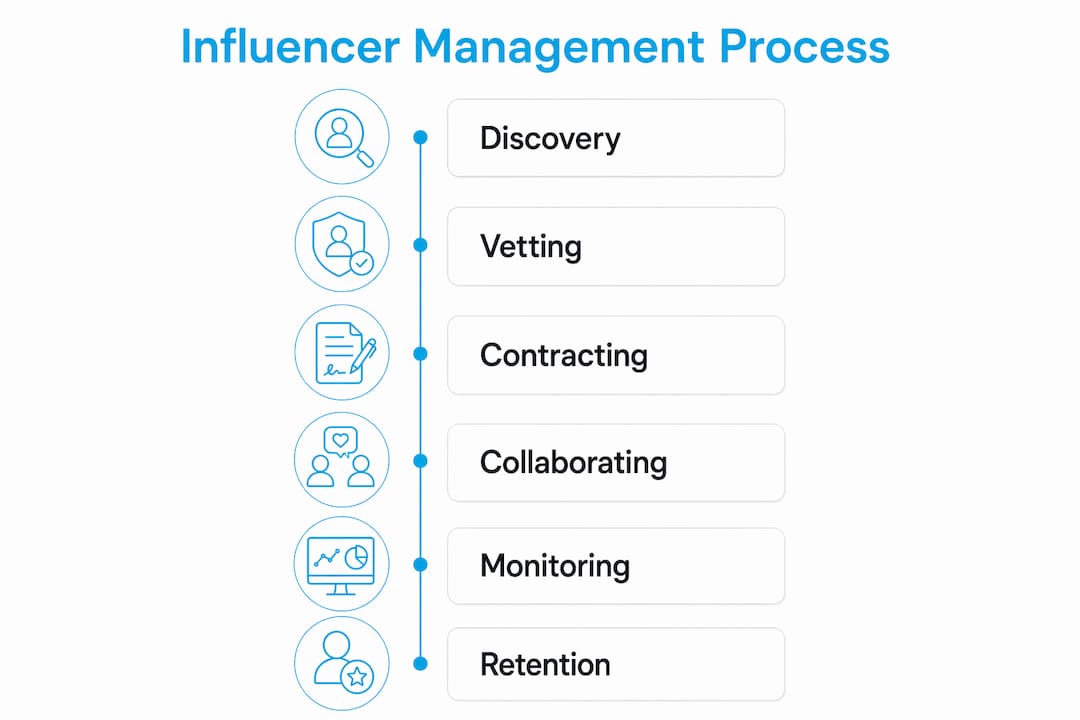
IRM explicitly includes a retention stage that distinguishes it from one-off campaign management. That single addition changes the economics of the entire program. A creator who has worked with your brand twice already understands your tone, your audience, and your approval process. Re-engaging them costs far less in onboarding time and produces better content because the relationship is already warm.
The table below shows where the two approaches diverge most sharply:
| Dimension | Traditional influencer marketing | Influencer relationship management |
|---|---|---|
| Partnership duration | One campaign or single post | Ongoing, multi-campaign partnerships |
| Creator selection | Reach and follower count | Audience fit, values alignment, past performance |
| Compensation model | Flat fee per post | Retainers, performance bonuses, co-creation deals |
| Performance review | Post-campaign report | Continuous KPI tracking and feedback loops |
| Creator status | Vendor | Brand ambassador or strategic partner |
| Budget planning | Per-campaign spend | Annualized creator investment |
Scheduling feedback loops and sharing outcomes converts one-off collaborations into ongoing brand ambassador relationships. This is not just a relationship-building nicety. Creators who receive performance data and honest feedback produce better content in subsequent campaigns because they understand what actually worked.
IRM shifts influencer partnerships from transactional costs to relationship assets, improving budgeting predictability and long-term outcomes. Brands that budget for IRM treat creator spend the way they treat customer success spend: as an investment in retention, not just acquisition.
The right technology removes the manual overhead that kills most influencer programs at scale. Emplifi’s platform centralizes influencer search, communication, brief sharing, payments, and analytics for ROI tracking. That kind of end-to-end visibility means your team spends time on strategy rather than chasing down screenshots and invoice approvals.
Here are the core capabilities to look for in any influencer management platform:
Compliance deserves its own focus. The FTC’s 2023 endorsement guide revisions require clear disclosure and broaden the definition of endorsement to include tagging. Brands and influencers must now make disclosures “clear and conspicuous,” which means visible without scrolling, not buried in a caption. FTC compliance is integral to influencer management, not optional. Embed disclosure requirements directly into your content brief template so creators cannot miss them.
Pro Tip: The most common compliance mistake is assuming the creator knows the rules. Write the required disclosure language directly into the contract and the brief. Do not leave it to interpretation.
Knowing the theory is one thing. Applying it to your actual program is another. Here is a practical sequence for building or improving your influencer management process:
The creators who become your best long-term partners are the ones you invest in early. Feedback, fair pay, and transparency are the three inputs that convert a one-time collaborator into a genuine brand ambassador. For a deeper look at keeping those relationships strong over time, the guide on creator retention strategies covers the specific practices that reduce churn and build loyalty.
Effective influencer management requires treating creators as long-term relationship assets, not one-off vendors, with structured workflows, clear contracts, and repeatable performance measurement at every stage.
| Point | Details |
|---|---|
| Define the full lifecycle | Influencer management spans discovery, vetting, contracting, execution, tracking, and retention. |
| IRM beats transactional marketing | Ongoing partnerships produce better content, lower onboarding costs, and more predictable ROI. |
| Centralize your workflow | Disjointed tools cause compliance errors and missed deliverables. Use one platform for all stages. |
| Compliance is non-negotiable | FTC 2023 rules require clear, conspicuous disclosures. Build them into every brief and contract. |
| Feedback drives retention | Sharing performance data with creators converts one-off deals into ambassador relationships. |
I have seen a consistent pattern across creator programs of all sizes: the brands that struggle are almost always running influencer marketing as a series of disconnected campaigns rather than as a managed program. They find a creator, run a post, see decent results, and then start the entire search process over again three months later. That is expensive and inefficient.
The shift that actually changes outcomes is treating your creator roster the way a good sales team treats its top accounts. You invest in the relationship between campaigns, not just during them. You share data. You ask what the creator needs. You pay on time and fairly. Those behaviors sound basic, but effective influencer management requires treating data, contracts, content approvals, and performance reports as an integrated workflow, and most brands are nowhere near that standard yet.
The compliance piece is also more serious than most marketers realize. The FTC’s updated endorsement rules are not a technicality. They are a genuine legal exposure, and the brands most at risk are the ones that leave disclosure decisions entirely to the creator. Your contract and your brief are your protection.
My honest recommendation: before you add more creators to your roster, fix the workflow for the ones you already have. Better systems with fewer creators will outperform chaotic systems with many. Once the process is solid, scaling is straightforward.
— Gjon
Managing influencers well takes time, structure, and the right operational support. Only-dreams is a US-based creator management agency that handles the full operational side of creator businesses, from fan engagement and revenue optimization to cross-platform growth strategies on Instagram, TikTok, and beyond.
If you are a content creator looking to scale your earnings without getting buried in the logistics, or a marketer who wants a proven management framework behind your creator program, Only-dreams offers dedicated account managers, trained chat teams, and data-driven marketing strategies built specifically for established creators. Explore what professional creator management looks like when it is done right.
Influencer management is the end-to-end process of finding, contracting, collaborating with, and retaining influencers to achieve specific marketing goals. It covers everything from initial creator discovery to post-campaign performance analysis and relationship maintenance.
Influencer account management refers to the day-to-day operational oversight of a creator’s brand partnerships, including communication, content approvals, payment tracking, and compliance. It is the hands-on execution layer within a broader influencer management strategy.
Influencer relationship management (IRM) focuses on building ongoing creator partnerships rather than running isolated campaigns. It includes a formal retention stage, continuous performance feedback, and structured re-engagement, which standard campaign-based influencer marketing does not.
Platforms like Emplifi centralize creator search, brief sharing, payments, and analytics in one place. Salesforce also offers influencer marketing workflow tools covering alignment, negotiation, collaboration, and performance tracking across campaigns.
The FTC’s 2023 endorsement guide updates require all sponsored content disclosures to be clear and conspicuous, including tagged posts. Brands that fail to embed disclosure requirements into their contracts and briefs face legal exposure and reputational risk.