
TL;DR:
- Multi-platform marketing involves adapting content for three or more channels to maximize reach and brand visibility. It differs from cross-posting and omnichannel strategies by emphasizing native content adaptation and targeted distribution. Implementing it effectively requires selecting relevant platforms, creating a core asset, native adaptation, coordinated scheduling, and performance tracking.
Multi-platform marketing is defined as the practice of publishing and promoting branded content across three or more platforms simultaneously, with each piece of content adapted to the native format, tone, and audience of that specific channel. The industry term for this practice is multichannel marketing, though “multi-platform marketing” is now widely used to describe the same coordinated distribution system. HubSpot defines it as publishing content across several platforms at the same time while optimizing format, length, and style per channel. For marketing professionals and business owners in 2026, this approach is no longer optional. Fragmented audiences, unpredictable algorithm shifts, and rising content competition make a coordinated multi-platform presence the most reliable path to sustained brand visibility.
Multi-platform marketing is frequently confused with cross-posting and omnichannel marketing. These are three distinct approaches, and mixing them up leads to wasted effort and poor results.

Cross-posting means publishing identical or near-identical content across platforms without adapting format, caption length, or messaging. Cross-posting triggers algorithm penalties on platforms like Instagram and TikTok because native signals such as aspect ratios, hashtag structures, and engagement patterns differ by channel. A LinkedIn post repurposed word-for-word on X (formerly Twitter) will underperform because the audience expectations and content norms are completely different.
Omnichannel marketing integrates all channels through unified customer data to deliver a seamless experience across touchpoints. Omnichannel prioritizes continuity of the customer journey, while multi-platform marketing prioritizes reach through channel-specific optimization. Omnichannel requires mature data infrastructure. Multi-platform marketing does not.
Single-platform mastery focuses all resources on one channel to maximize depth of engagement. It works well for early-stage brands but creates dangerous dependency on one algorithm.
The table below clarifies the core differences:
| Approach | Content format | Primary goal | Data requirement |
|---|---|---|---|
| Cross-posting | Identical across platforms | Efficiency | Low |
| Multi-platform marketing | Adapted per platform | Reach and visibility | Medium |
| Omnichannel marketing | Integrated across channels | Seamless customer journey | High |
| Single-platform mastery | Deep, channel-native | Engagement depth | Low to medium |
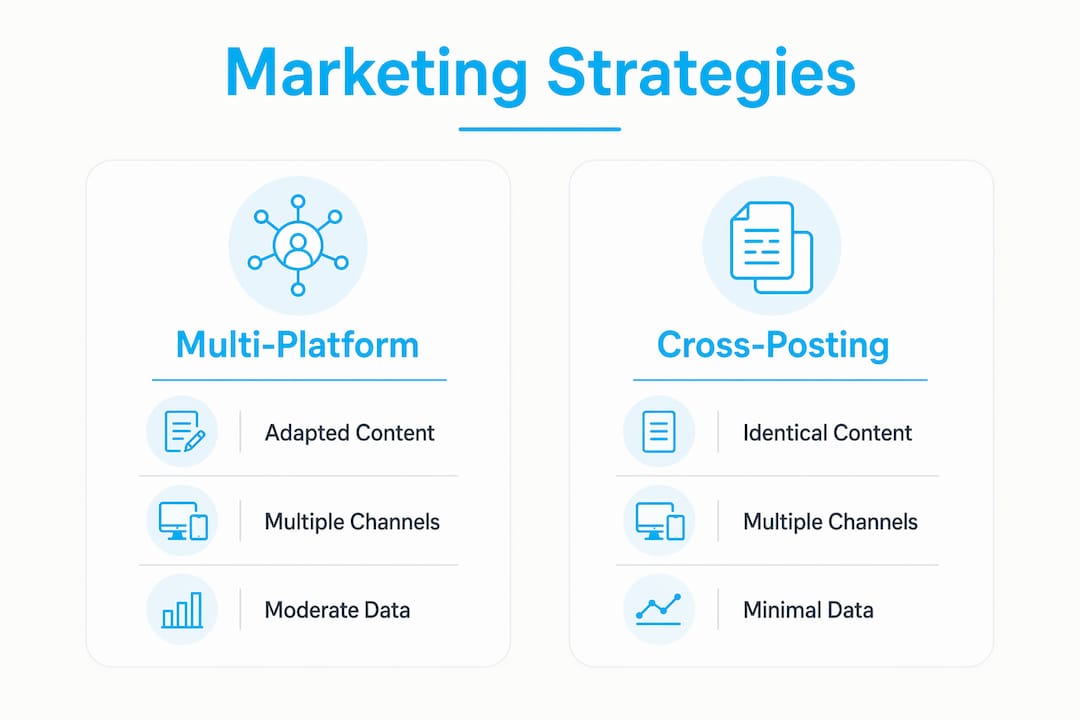
Multi-platform marketing sits in the practical middle ground. It delivers reach without requiring the data infrastructure of omnichannel, and it avoids the fragility of single-platform dependency.
A repeatable multi-platform workflow follows six clear steps. Skipping any one of them is where most campaigns lose momentum.
Select your platforms based on audience fit. Not every platform deserves your attention. Choose channels where your specific audience already spends time. A B2B software company belongs on LinkedIn and YouTube. A creator-driven brand belongs on Instagram, TikTok, and Pinterest. Start with three platforms maximum and expand once you have a working system.
Create one core content asset. Every campaign starts with a single high-quality piece of content: a long-form article, a video, a data report, or a detailed tutorial. This is your source material. Everything else is an adaptation of it.
Adapt the core asset natively for each platform. A 10-minute YouTube video becomes a 60-second TikTok clip, a carousel post on Instagram, a text thread on X, and a newsletter section. The message stays consistent. The format, caption style, and call to action change to match each platform’s norms.
Schedule with coordinated but flexible cadence. Coordinated publishing reduces operational chaos, but each platform has its own optimal posting frequency. Instagram rewards daily posting. LinkedIn performs well at three to four times per week. YouTube favors consistency over volume. Plan centrally, then adjust timing per channel.
Publish and monitor with unified analytics. Track performance across all platforms from one dashboard. Tools like HubSpot Content Hub or Sprout Social consolidate cross-platform data so you can see which formats and messages drive real results, not just impressions.
Iterate based on performance data. Cross-platform analytics are feedback loops, not report cards. If a carousel format outperforms video on Instagram but video dominates on TikTok, shift your adaptation effort accordingly. This is how multi-platform marketing compounds over time.
Pro Tip: Build your content calendar around the core asset first. Once the core piece is done, adapting it for three platforms takes a fraction of the time it would take to create three separate campaigns from scratch.
Multi-platform marketing delivers measurable advantages, but it also introduces real operational complexity. Understanding both sides helps you build a system that holds up.
Benefits:
Challenges:
AI tools are changing this calculus. PostKit automates content adaptation across multiple platform-native formats from a single business profile, which significantly lowers the production cost of running a true multi-platform system.
The right tool stack makes the difference between a multi-platform system that runs efficiently and one that burns out your team within 90 days.
Content creation and adaptation:
Scheduling and publishing:
Analytics and attribution:
Pro Tip: Do not buy tools before you have a workflow. Map your content process first, identify where the bottlenecks are, then select tools that solve those specific problems. Most teams need a scheduling tool and an analytics tool before anything else.
For creators specifically, advanced social media tactics that account for platform-specific algorithms are more effective than generic scheduling alone.
The most common mistakes in multi-platform marketing are predictable and avoidable. Here is what to watch for:
A practical 2026 workflow guide for cross-platform marketing covers how to build this repurposing system into your regular content process.
Multi-platform marketing works because it combines platform-native content adaptation with coordinated distribution to maximize reach, reduce algorithm dependency, and create compounding brand visibility.
| Point | Details |
|---|---|
| Define it correctly | Multi-platform marketing adapts content natively per channel, not just reposts the same asset everywhere. |
| Start with a core asset | Build one high-quality piece of content first, then adapt it for each platform to control production costs. |
| Use the right tools | Buffer, Hootsuite, HubSpot, and PostKit each solve different parts of the multi-platform workflow. |
| Measure conversions | Track UTM-tagged links and revenue attribution, not vanity metrics like total impressions. |
| Reduce algorithm risk | Distributing presence across three or more platforms protects brand visibility from single-platform volatility. |
After working with content creators and marketing teams across multiple industries, I have noticed a consistent pattern. Most multi-platform strategies collapse not because of poor content, but because teams treat distribution as an afterthought.
The real insight is this: content creation and distribution orchestration are two separate disciplines, and they require separate planning. When you conflate them, you end up either creating content that cannot be adapted efficiently, or distributing content that was never designed for the platforms you are using.
The brands and creators I have seen succeed with multi-platform marketing share one habit. They plan their content calendar around the core asset first, then map out the platform adaptations before a single piece of content is produced. This means the Instagram caption, the TikTok hook, and the LinkedIn angle are all decided before the camera turns on. That upfront planning is what makes the whole system scalable.
I also want to push back on the idea that more platforms always means more growth. Choosing the right model depends on your data maturity and operational capacity. Starting with three well-executed platforms beats spreading thin across seven. Pick the channels where your audience is most active, execute natively, measure rigorously, and drop the channels that do not convert. That discipline is what separates multi-platform marketing from multi-platform chaos.
— Gjon
If you are a content creator looking to put multi-platform promotion into practice without managing every moving part yourself, Only-dreams is built for exactly that. Only-dreams handles the operational side of your content business, from data-driven marketing strategies across Instagram and TikTok to AI-enhanced content distribution that reduces your workload and increases your reach.
The Only-dreams team manages cross-platform growth as a system, not a series of one-off posts. If you want to see what a professionally managed multi-platform strategy looks like in practice, explore what Only-dreams offers at only-dreams.com.
Multi-platform marketing is the practice of publishing adapted content across three or more platforms simultaneously to maximize brand reach and audience engagement. Each platform receives content tailored to its native format rather than identical posts.
Cross-posting uses the same content across all platforms without adaptation, which triggers algorithm penalties and reduces engagement. Multi-platform marketing adapts the message, format, and style for each channel while keeping the core brand narrative consistent.
The primary benefits are reduced algorithm dependency, amplified reach through multiple discovery points, and stronger brand recognition from consistent cross-platform presence. Brands active on three or more platforms also collect richer behavioral data than single-channel brands.
Buffer and Later work well for small teams managing scheduling across three to five platforms. Sprout Social and HubSpot Content Hub are stronger choices for teams that need advanced analytics, workflow management, and revenue attribution across a full multi-platform system.
Start by selecting three platforms where your audience is most active, create one core content asset, then adapt it natively for each channel before publishing on a coordinated schedule. Track conversions with UTM parameters from day one so you can iterate based on real performance data.