
TL;DR:
- Professional chat management combines human agents and AI automation to ensure consistent, timely responses at scale. It boosts creator revenue by improving fan retention and engagement while protecting brand voice and operational efficiency. Building a structured system first enhances scalability, reduces noise, and turns fan conversations into a reliable growth channel.
Professional chat management is defined as the organized process of handling live chat interactions using a mix of human agents, AI automation, and defined communication protocols to deliver timely, consistent, and high-quality engagement at scale. For content creators and social media managers, this is not a nice-to-have. It is the operational backbone that separates creators who grow sustainably from those who burn out trying to reply to every message manually. Understanding what is professional chat management gives you a clear framework for turning fan conversations into a real revenue engine.
Professional chat management integrates human agents, AI automation, and centralized software to maintain consistent brand voice and scalable response times across every platform you operate on. The industry term for this practice is “live chat orchestration,” and it covers everything from queue design to escalation protocols. Both terms describe the same discipline, and you will see them used interchangeably across creator management and customer support contexts.

The numbers behind this practice are hard to ignore. Teams using structured communication complete projects 23% faster, and a 5% improvement in customer retention can boost profits by up to 95%. Those figures apply directly to creator businesses, where subscriber retention and messaging revenue are the two primary income levers.
Professional chat management also protects your brand voice. When fans receive inconsistent replies, they lose trust. A structured system gives every agent, human or AI, a clear playbook so your tone stays recognizable whether a fan messages at 2:00 PM or 2:00 AM.
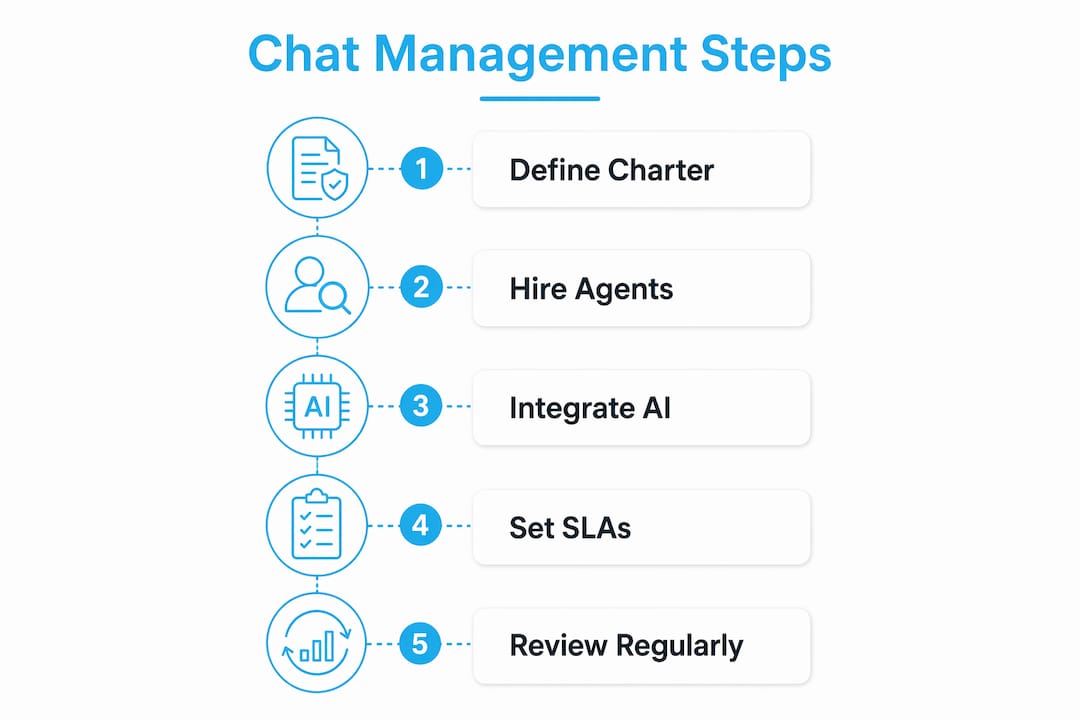
A well-built chat management system has four core elements working together. Each one handles a specific failure point that creators and social media managers run into when they try to manage conversations without structure.
Pro Tip: Write your communication charter before you hire your first chat agent. Retrofitting structure onto a chaotic system takes three times longer than building it right from the start.
The benefits of chat management go well beyond faster replies. Structured chat management changes how fans experience your brand, how your team operates, and how much revenue your messaging generates.
Improved audience engagement is the most visible benefit. Fans who receive timely, personalized responses are more likely to renew subscriptions, purchase pay-per-view content, and refer new subscribers. Proactive chat engagement nudges fans toward purchases and helps agents make decisions independently, which raises both satisfaction and revenue without requiring your direct involvement.
Retention is where the financial impact compounds. A 5% retention gain can produce up to a 95% profit increase, which means every improvement to your chat system has an outsized effect on your bottom line. Creators who treat chat as a sales channel rather than a support function consistently outperform those who treat it as a chore.
Operational efficiency is the third major gain. Proper chat guidelines correlate with 40% fewer misunderstandings and 35% higher job satisfaction among chat teams. A more satisfied team produces better conversations, which feeds directly back into fan retention.
Managing chats professionally requires a system, not just effort. These practices give you a repeatable framework that scales as your audience grows.
Write clear guidelines before you scale. Chat management guidelines should cover response expectations, channel usage, escalation procedures, and review schedules. Teams that implement these guidelines improve communication efficiency and output quality over time. Review your guidelines every quarter as your team and platform mix evolve.
Set concurrency limits by contact type. Agents managing sensitive or high-value fan conversations should handle no more than 2 chats at once. Agents on transactional or general queries can handle 3–4 simultaneously without quality loss. Concurrency limits are a structural design decision, not a staffing preference. Getting this wrong is the primary cause of service degradation.
Use AI for triage, not for relationship-building. Deploy AI to answer FAQs, send welcome messages, and route chats to the right agent. Reserve human agents for conversations that require empathy, upselling, or nuanced brand judgment. This split keeps your cost per conversation low while protecting the fan relationship.
Implement automated archival for inactive threads. Channel descriptions and naming conventions are living infrastructure that require active management. Archiving inactive channels automatically reduces noise and keeps your team focused on active conversations.
Mark outputs clearly in every chat. Label decisions and tasks with tags like DECISION] or [ACTION] inside your internal chat tools. [Structured marking practices prevent buried decisions and keep your team accountable without requiring long status meetings.
Pro Tip: Audit your chat channels every 30 days. Delete or archive anything inactive for more than two weeks. Channel bloat is one of the fastest ways to lose 2.5 hours of team productivity per day.
Most chat management problems look like staffing problems. They are almost always structural problems. Recognizing the difference saves you from hiring your way into a system that still does not work.
The fix for all four challenges is the same: build the architecture first, then add people and tools. Structure does not slow you down. It is what makes speed possible.
Professional chat management is the structured combination of human agents, AI automation, and defined protocols that turns fan conversations into a reliable, scalable revenue channel for creators.
| Point | Details |
|---|---|
| Define structure before scaling | Write communication charters and SLAs before hiring chat agents or deploying AI. |
| Set concurrency limits by query type | Cap agents at 2 complex chats or 3–4 transactional chats to protect quality. |
| Use AI for triage only | Reserve human agents for high-value, relationship-driven fan conversations. |
| Archive inactive channels regularly | Automated archival prevents the 2.5 hours per day lost to disorganized chat systems. |
| Treat retention as a revenue metric | A 5% retention improvement can increase profits by up to 95%, making chat a direct income driver. |
I have worked with creators who were spending four to six hours a day in their DMs and still losing subscribers. The problem was never their dedication. It was that they had no system. Every conversation started from zero, tone varied depending on who was online, and there was no way to track which messages led to purchases.
The shift that changes everything is treating chat as infrastructure, not as a task. When you build the architecture first, including the SLAs, the concurrency rules, the escalation paths, and the communication charter, your team can operate without you in the room. That is when chat stops being a drain and starts being a growth channel.
I also see creators over-index on AI too early. AI works best when it handles the predictable 60% of conversations so your human team can focus on the 40% that actually moves revenue. The step-by-step approach to chat management that works is always architecture first, automation second, and people third. Not the other way around.
The creators who build this correctly do not just save time. They build a fan experience that feels personal at scale, and that is the real competitive edge.
— Gjon
Only-dreams builds and runs the entire chat management system for established creators who want to grow without spending their day in a message queue.
The Only-dreams team brings trained chat agents, defined SLAs, AI-assisted triage, and a communication charter built specifically for your brand voice. You get professional chatters growing your revenue while you focus on creating content. The agency handles fan engagement, escalation protocols, and cross-platform consistency across Instagram, TikTok, and subscription platforms. If you are weighing whether to build this in-house or hand it off, the agency vs. self-managing comparison lays out exactly what each path costs in time and revenue. Ready to put a real system behind your fan conversations? Explore Only-dreams and see what structured chat management looks like in practice.
Professional chat management is the organized system of handling fan or customer messages using human agents, AI tools, and defined protocols. The goal is consistent, timely, and on-brand responses at any volume.
Structured chat management improves fan retention and drives pay-per-view purchases through proactive, personalized messaging. A 5% improvement in retention alone can increase profits by up to 95%.
Agents handling complex or high-value conversations should manage no more than 2 chats at once. Agents on general or transactional queries can handle 3–4 simultaneously without quality loss.
AI handles repetitive, low-complexity questions and routes chats to the right human agent. It should not replace human agents for relationship-driven or high-value fan conversations.
Chat guidelines should be reviewed at least quarterly to reflect team growth, platform changes, and shifts in fan behavior. Teams that update guidelines consistently improve communication efficiency over time.