
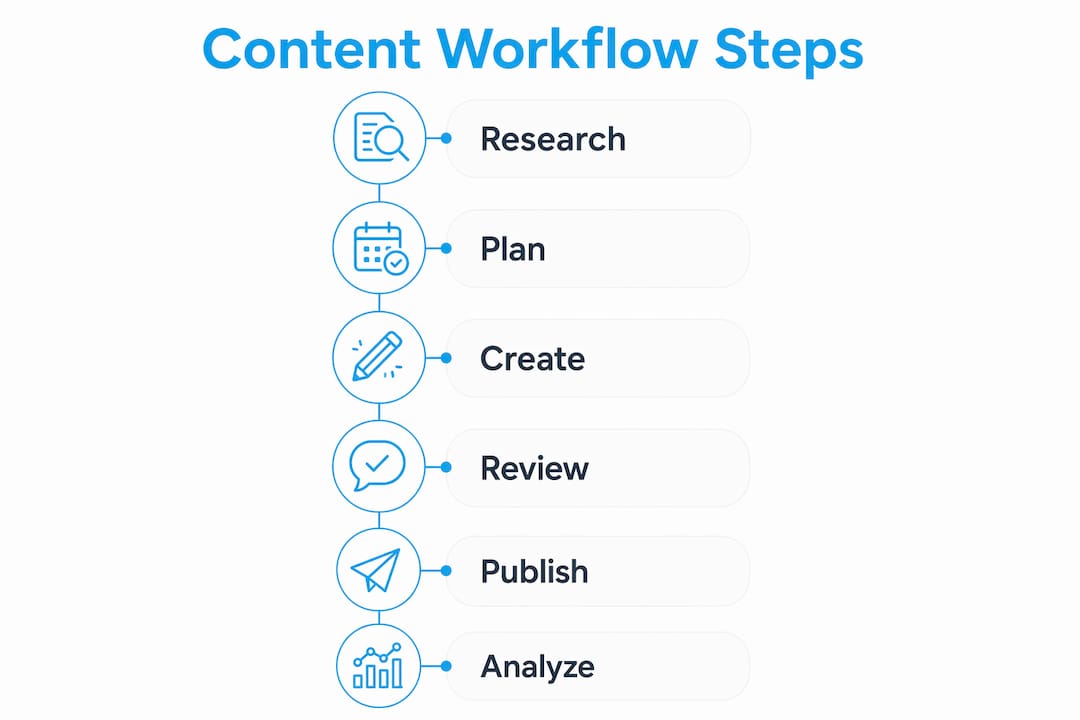
The most effective content creation workflow for professional social media creators is a documented, 7-stage production process that moves every piece of content from topic validation to measurement without stalling. Teams that follow this structured workflow publish 3 to 5 times more articles monthly with fewer revision cycles than teams without one.
Here are the seven stages every creator’s production process needs:
This framework also integrates two workflow management models (task-based and status-based), governance rules that prevent content clutter, and automation tools that compress the production cycle. The result is a repeatable system, not a one-time sprint.
Content managers distinguish task-based workflows as sequential task completion systems, while status-based workflows emphasize overall project stage visibility for team coordination. Both serve different needs, and knowing which to use saves real time.
Task-based workflows work best when your content type has clearly defined steps. Each task has one owner, one output, and a clear handoff. A solo creator scripting, filming, and editing in sequence runs a task-based workflow naturally.
Status-based workflows suit teams with multiple contributors and complex interdependencies. Instead of tracking individual tasks, everyone sees where a project sits in the pipeline (in draft, in review, approved, scheduled). This visibility reduces bottlenecks when several people touch the same piece.
Pro Tip: If your team has more than two contributors on a single piece of content, add a status layer on top of your task list. Without it, handoffs get lost and revision cycles multiply.
Governance is critical to prevent chaotic accumulation of redundant content. Without clear rules for updating, pruning, and managing what you publish, your content library becomes a liability instead of an asset.
The Nielsen Norman Group frames governance as the policies that determine when content is maintained, updated, and removed. For creators, this translates directly into protecting your brand consistency and search authority over time.
Practical governance steps to put in place now:
Governance is not a one-time setup. Build it into your quarterly calendar so it runs automatically alongside production.
Most creator “workflows” are glorified checklists. They track task completion but ignore the connections between strategy, production, and performance data. That disconnect is where creator burnout starts.

An integrated workflow system links ideation, production, and analytics into a single loop. When your brief template pulls from keyword research, your editing stage references the brief, and your 30-day performance review feeds back into your next topic validation, you stop making decisions from scratch every time.
Automation accelerates this significantly. The biggest bottlenecks in content workflows sit at the editing and SEO polish stages, where unclear feedback and rushed timelines cause projects to stall. Automating brief creation and SEO polish removes those failure points and compresses what would otherwise be a 10–15 hour production cycle into a single review step.
Statistic callout: Teams with a documented production workflow publish 3 to 5 times more articles monthly with fewer revision cycles than those without one.
Publishing isolated posts is the slowest path to authority. Building topic ecosystems, where every piece of content connects to a central pillar and supports related subtopics, compounds your reach across search and social platforms simultaneously.
A topic ecosystem starts with one broad pillar (say, “content monetization for creators”) and branches into clusters covering subtopics like pay-per-view strategy, subscriber retention, and pricing models. Each cluster piece links back to the pillar, and the pillar links out to the clusters. This structure builds topical authority faster than scattered standalone posts.
Steps to build your first topic ecosystem:
Repurposing is built into this model. One well-researched pillar piece generates weeks of derivative content across Instagram, TikTok, and long-form channels without starting from zero each time. For content scaling strategies that go deeper on this approach, the framework applies directly to managed creator accounts.
Only-dreams Agency handles the operational side of a creator’s business so you can stay focused on creating. That means fan engagement, revenue optimization, and cross-platform marketing are managed by a dedicated team, not added to your already full production schedule.
Here is what the managed service includes:
Pro Tip: Confusing content production with content operations is one of the fastest routes to burnout. Only-dreams separates the two: your team handles creation, and the agency handles operations.
For creators ready to scale their creator business without adding operational overhead, Only-dreams provides the infrastructure to do it.
Ready to hand off the operational work and focus on what you do best? Only-dreams manages your workflow, fan engagement, and growth strategy so you can create without distraction.
Measuring workflow efficiency goes beyond counting published posts. The right KPIs tell you where your process is healthy and where it is leaking time or quality.
Track these metrics consistently:
Review these figures monthly and tie them back to specific workflow stages. If revision cycles are high, the problem is usually in the brief or the editing stage, not the draft itself.
Scaling content volume without scaling chaos requires systems, not just more effort. The content production process that works at five posts per month breaks down around fifteen without structural changes.
The key moves when scaling:
Scaling is not about working faster. It is about building a system where more output does not require proportionally more of your time.
Quality control is not a single review at the end. It is a series of gates built into each stage of the production process that catch problems before they compound.
Build these controls into your workflow:
Risk in content workflows usually comes from skipping gates under deadline pressure. The fix is not more discipline. It is making the gates fast enough that skipping them is never tempting.
A documented 7-stage content production workflow is the single most reliable way for professional social media creators to publish consistently, reduce revision cycles, and build sustainable growth across platforms.
| Point | Details |
|---|---|
| 7-stage workflow drives output | Teams with a documented workflow publish 3 to 5 times more articles monthly with fewer revision cycles. |
| Hybrid workflow models work best | Combine task-based and status-based approaches to get both sequential clarity and team-wide visibility. |
| Governance prevents content clutter | Quarterly audits, ownership assignments, and removal criteria keep your content library healthy and on-brand. |
| Topic ecosystems compound authority | Pillar-and-cluster content structures build search and social authority faster than isolated posts. |
| Operations belong in a managed system | Separating content production from operational tasks like fan engagement prevents burnout and supports scale. |