TL;DR:
- A content monetization workflow is a systematic process that turns content into predictable subscription and paid messaging revenue. Building this system improves team clarity, boosts income, and allows scalable growth through automation and optimized pricing strategies.
A content monetization workflow is a repeatable, closed-loop system that converts one core asset into predictable subscription and paid-messaging revenue, then scales it. When built correctly, it tells every team member exactly what to do, when, and how to measure success. Gjon and the team at Only-dreams have helped established creators implement this exact system to grow monthly earnings without burning out.
TL;DR: Your 5-step workflow at a glance
Each stage has a primary job, a set of KPIs, and a clear handoff point.
Acquire focuses on reach and click-through rate. Your manager schedules posts on Instagram and TikTok, monitors algorithm performance, and triggers a DM automation when a follower comments or reacts. The handoff to Convert happens the moment a follower shows intent.
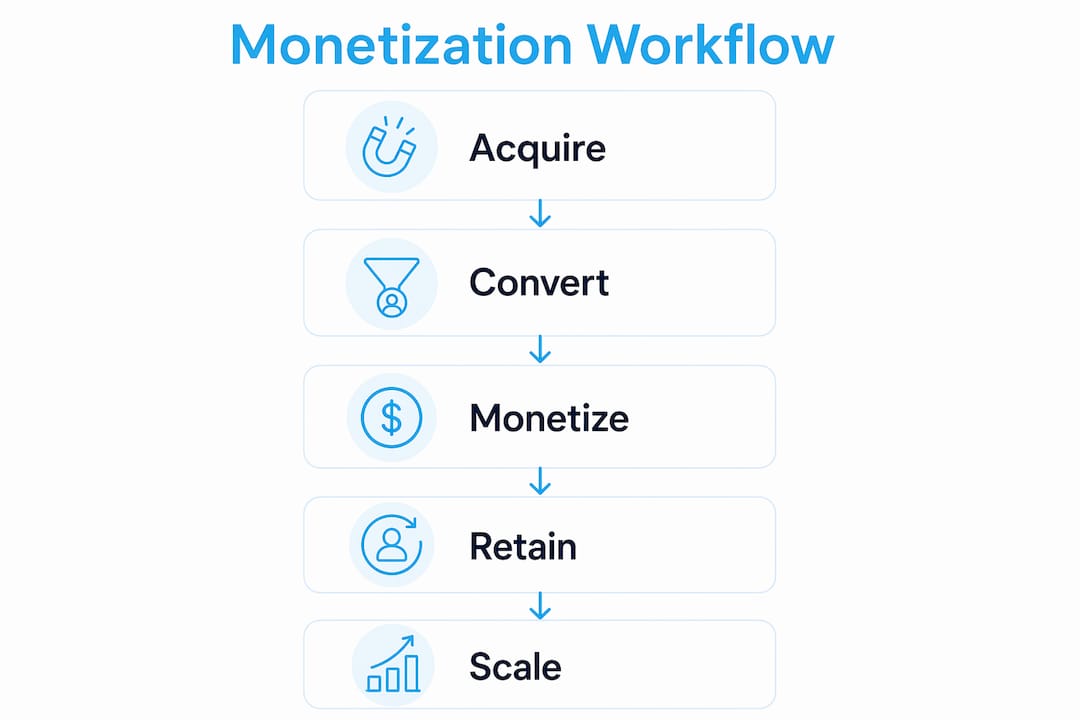
Convert is where most income leaks. Reducing friction at the moment of intent, such as sending a direct link inside a DM rather than pointing fans to a link-in-bio, lifts conversion rates significantly. Industry-reported conversion rates show that link-in-bio funnels typically convert at around 2–5%, whereas direct DM delivery can convert at approximately 12–28% — a substantial uplift worth optimizing for. The manager owns this stage; the chat team executes.
Monetize covers tiering, PPV pricing, and paid DM flows. Subscription-first revenue creates predictable, owned income that ad-based models cannot match. The chat team handles fulfillment; the manager sets pricing rules.
Retain is about content cadence and community warmth. The manager maintains a publishing calendar; the chat team handles daily fan touchpoints.
Scale is where automation and repurposing pay off. A single long-form video can become threads, short clips, a newsletter excerpt, and a PPV teaser, with marginal cost approaching zero as the system matures.
Pro Tip: Master one monetization stream completely before adding a second. The effort-to-income ratio is the metric that separates creators who scale from those who spin their wheels.
Rank your first streams by effort-to-income, not by potential ceiling. For established creators already earning $3K+ per month, the fastest path to higher average revenue per user (ARPU) runs through subscriptions and paid messaging, not ad revenue.
| Revenue Stream | Effort Level | Time to First Dollar | Scalability |
|---|---|---|---|
| Subscription tiers | Low (set once) | Immediate | High |
| Paid DMs / PPV | Medium (chat ops) | Same day | High |
| Digital products | Medium (build once) | Days–weeks | Very high |
| Affiliate links | Low | Days | Medium |
| Ad revenue | High (volume needed) | Weeks–months | Low for new creators |
Ad revenue thresholds make ads a slow path to predictable income. Direct monetization and paid messaging get you to first dollars faster.
Tier template to start with:
Price anchoring works because showing three tiers makes the mid-tier feel like the obvious value choice. Launch with subscriptions first, validate your conversion rate, then layer in PPV and paid DMs as a second stream. Creators who build a portfolio of 3–5 revenue streams achieve more stable income than single-stream creators, but only after mastering the first one.
Start with one core asset per week, then repurpose it into 4–6 micro-assets. This is the AI income flywheel in practice: one high-value piece drives every downstream distribution touchpoint.
Weekly publishing checklist:
Sample post flow: Hook (first 3 seconds or first line) → engagement trigger (question or poll) → DM trigger (“Reply ‘VIP’ for exclusive access”) → conversion path (direct link to subscription page).
Use scheduling tools like Later or Buffer for free-platform posts. For advanced distribution tactics across Instagram and TikTok, a manager can handle this entirely, freeing you to focus on filming. Validate demand with a low-priced offer before building anything large; a phased launch approach reduces risk significantly.

Chat is a sales funnel, not a support inbox. Treat it that way and it becomes one of your highest-margin revenue streams.
SOP for paid DMs and PPV:
Message templates for key revenue flows:
For 24/7 coverage, a dedicated chat team is the only realistic option. One person cannot sustain round-the-clock engagement without quality dropping. Only-dreams provides trained chat agents who build authentic fan relationships, not scripted replies. See chatting strategies that increase sales for deeper SOP examples.
Fraud prevention basics: Require platform-native payments only. Log every transaction. Flag accounts that dispute charges more than once. Chargebacks on digital content are common; document delivery (screenshots of sent content) is your primary defense.
Pro Tip: Never deliver custom content before payment clears. Set this as a non-negotiable rule in your chat team SOP from day one.
| Metric | What It Measures | Target Range |
|---|---|---|
| ARPU | Avg. revenue per subscriber per month | Improve month-over-month |
| Churn rate | % of subscribers who cancel monthly | Lower is better; track trend |
| Visit-to-subscribe rate | % of profile visitors who subscribe | Benchmark against your own baseline |
| DM conversion rate | % of DM conversations that result in a purchase | Industry benchmarks suggest 12–28% with direct delivery |
| LTV | Total revenue per subscriber over their lifetime | Compare across tiers |
| Effort-to-income | Hours spent per revenue unit | Decrease over time |
A/B testing plan (4-step):
Your manager’s minimum dashboard needs: daily subscriber count, daily revenue, DM conversion rate per agent, and churn by tier. Tools like Google Sheets with manual daily inputs work at early scale; dedicated creator analytics platforms add automation as volume grows.
| Role | Weekly Responsibilities | Est. Hours/Week |
|---|---|---|
| Creator | Film core asset, approve content calendar, review weekly report | — |
| Account manager | Schedule posts, run A/B tests, update analytics dashboard, handle escalations | — |
| Chat agents | Handle all inbound DMs, execute PPV delivery, log transactions | — |
| Analytics owner | Pull weekly metrics, flag anomalies, prepare monthly pricing review | 3–5 hrs |
Monthly checklist:
Use the creator monetization checklist to keep your monthly review on track.
Three clear triggers: you’re earning $3K+ per month, you’re spending more than 15 hours per week on operations, or your revenue has plateaued for 60+ days despite consistent posting.
A professional team handles content scheduling, 24/7 chat, A/B pricing tests, analytics reporting, ad spend management, and platform compliance monitoring. That last one matters more than most creators realize. OnlyFans terms of service change, and a manager who tracks policy updates protects your account.
For ROI expectations: a conservative ramp takes 60–90 days to break even on management fees as the chat team builds fan relationships and pricing tests settle. An aggressive case, with strong existing traffic and a responsive audience, can show measurable ARPU improvement within 30 days. The KPIs a manager should deliver in the first 90 days: higher DM conversion rate, lower churn, and at least one validated pricing improvement.
Onboarding checklist:
Questions to ask any prospective agency:
Red flags: Vague KPI language in the contract, requests for full account credentials upfront, no documented fraud prevention protocol, and no clear escalation path. For the first 30 days, expect onboarding and baseline data collection. Days 31–60 should show first pricing tests and chat SOP implementation. By day 90, you should have a clear revenue trend and a documented workflow. Understanding why agencies prioritize fan engagement helps you evaluate whether a prospective partner is genuinely engagement-focused or just filling a seat.
A repeatable content monetization workflow built on five stages, clear role splits, and data-driven pricing is the fastest path from a plateau to consistent revenue growth.
| Point | Details |
|---|---|
| Start with one stream | Master subscriptions or paid DMs before adding a second revenue stream. |
| DM delivery converts better | Direct DM links convert at 12–28%, much higher than the 2–5% seen with link-in-bio funnels. |
| Role clarity drives results | Assign creator, manager, chat team, and analytics owner with defined weekly hours. |
| Test prices monthly | Run one A/B pricing test per month; revert if conversion drops more than 15%. |
| Only-dreams manages the full workflow | Only-dreams provides account management, 24/7 chat, and analytics so creators can focus on content. |
Most creators hit a ceiling not because their content gets worse, but because their operations don’t scale. Ad-hoc monetization, where you reply to DMs when you remember, post when you feel inspired, and price by gut feel, works fine at $1K per month. It breaks down completely at $5K and above.
What actually moves ARPU is the boring stuff: a consistent chat SOP, a weekly pricing review, a content calendar that feeds every funnel stage. The creators who grow past $10K per month aren’t necessarily producing better content. They’ve built a system where every fan interaction has a defined next step, and someone is accountable for executing it.
The workflow in this guide isn’t theoretical. It’s the operational layer Only-dreams implements for every managed creator. The measurable difference shows up in DM conversion rates, churn reduction, and ARPU growth over a 90-day window. Creators who hand off operations to a professional team consistently report more time for content creation and less time firefighting.
Only-dreams maps the five-stage workflow into a fully managed service: a dedicated account manager owns your strategy and analytics, a trained chat team runs 24/7 fan engagement and PPV delivery, and a data cadence keeps pricing and content decisions grounded in real numbers, not guesswork.
Engagement models are flexible. Only-dreams works on a revenue share or fixed retainer basis depending on your current earnings and goals. There’s no one-size-fits-all contract. A discovery call takes about 30 minutes and covers your current revenue baseline, where the biggest leaks are, and what a realistic 90-day improvement looks like for your account. If you’re earning $3K+ per month and spending too many hours on operations, that call is worth your time. Start the conversation with Only-dreams today.