
TL;DR:
- Creator business operations involves establishing systems, workflows, and KPIs that enable scalable and sustainable growth. It replaces manual management with documented processes, connecting content, engagement, revenue, and team coordination seamlessly. Building a Creator Operating System and regular KPI review are essential for avoiding burnout and maximizing revenue.
Creator business operations is defined as the structured systems, workflows, and processes that organize every function of a content creator’s business, from production and fan engagement to revenue tracking and team management. Without these systems, even talented creators hit a ceiling where growth stalls, burnout sets in, and revenue becomes unpredictable. The industry term for this operational layer is “creator ops,” and it covers everything a Creator Operating System (COS), standard operating procedures (SOPs), and KPI tracking touch. Paid community models can generate 10 to 100x more revenue per 1,000 fans compared to ad-supported platforms, but capturing that upside requires operational infrastructure, not just great content.
Creator business operations is the engine behind a creator’s output. It is the set of repeatable systems that determine how content gets made, how fans get engaged, how revenue gets collected, and how the business grows without the creator personally managing every detail.

Most creators start by doing everything manually: filming, editing, posting, replying to messages, tracking income in a spreadsheet. That works at a small scale. Once you cross a threshold of consistent subscribers, multiple revenue streams, or a team of even two people, manual management creates chaos. Missed messages cost revenue. Inconsistent posting drops algorithmic reach. Untracked expenses erode profit margins.
Fragmented tools create friction causing unpredictable revenue and burnout. That is not a warning for large teams only. Solo creators with three platforms and a part-time editor face the same fragmentation risk. Creator ops solves this by replacing reactive, ad-hoc decisions with documented, repeatable processes.
Creator business operations breaks into five interconnected systems. Each one handles a distinct function, but they share data and feed into each other.
| Component | What it covers | Example tools |
|---|---|---|
| Content system | Production workflow from idea to publish | Notion, Trello, CapCut |
| Planning and prioritization | Editorial calendar, campaign scheduling | Airtable, Google Calendar |
| File and information management | Asset storage, naming conventions, version control | Google Drive, Dropbox |
| Promotion and distribution | Cross-platform posting, audience growth | Later, Buffer, TikTok |
| Review and maintenance | Performance audits, SOP updates, burnout checks | Looker Studio, manual reviews |
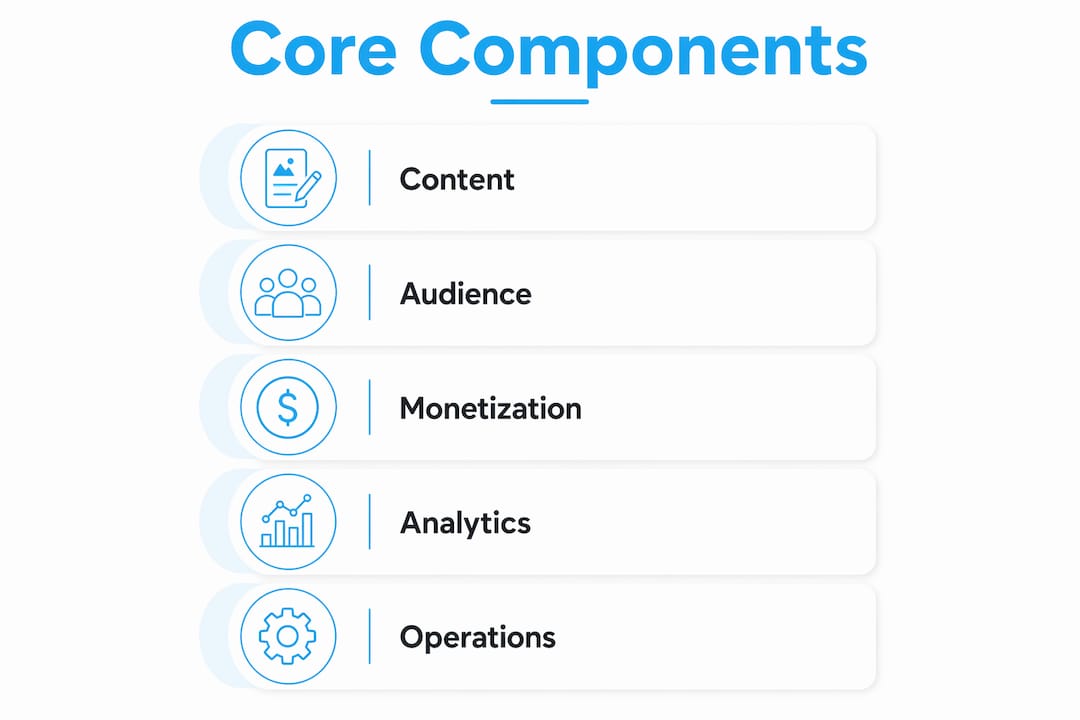
Standardize file naming, automate repetitive tasks, and centralize trusted data to reduce chaos and enable sustainable growth. This is enterprise-grade thinking applied to creator businesses, and it works at any size.
The content system is where most creators start, and rightly so. Documenting how a piece of content moves from concept to published post, who approves it, where the file lives, and how performance gets logged creates the foundation everything else builds on.
Pro Tip: Start by mapping your current content production process on paper before touching any tool. You cannot systematize what you have not yet observed.
A Creator Operating System is not a single app. A COS connects inputs, systems, and outputs to reduce mental load and increase consistency across every business function. Think of it as the operating logic that sits above your individual tools and tells them how to work together.
The practical difference between a COS and a collection of tools is decision elimination. Without a COS, you decide every day: What do I post? Who handles this message? Where does this file go? With a COS, those decisions are made once, documented, and followed by anyone on your team, including future hires.
“A Creator Operating System is the foundation of a creator’s business operations, not just a productivity tool. It reduces daily decision fatigue and creates clarity for sustainable output.” — creatoropshub.com
The benefits of a functioning COS are concrete:
An integrated creator OS that unites content, analytics, workflows, and audience experience enables scalable growth by aligning business functions rather than working in silos.
Pro Tip: Build your COS in phases. Start with one documented workflow, run it for 30 days, then add the next. Trying to systematize everything at once creates the same chaos you are trying to escape.
Scaling a creator business is not just a logistics challenge. Hiring and delegation are identity decisions in creator scaling and require documented systems before they succeed. Most creators underestimate this complexity because they conflate “getting help” with “scaling.” They are not the same thing.
When you hire a chat manager, an editor, or a social media assistant without documented workflows, you are not scaling. You are outsourcing chaos. The new hire has no reference point, makes decisions inconsistently, and you end up re-doing their work or micromanaging, which defeats the purpose entirely.
Building a burnout prevention system and delegation plan before scaling is critical. This means writing down how things get done before you hand them off. It also means accepting that your role shifts from creator to operator, and eventually to business owner.
The four operational lanes every scaling creator needs to manage:
Tool sprawl and unmanaged delegation are top operational failure points. Adding a new tool for every problem without documenting how it connects to existing workflows creates a system no one fully understands, including you.
Pro Tip: Before hiring anyone, write a one-page role description that includes the three workflows they will own. If you cannot write it, you are not ready to hire.
Revisit your operations plan quarterly tracking KPIs like launch-to-cash velocity and conversion rates. This is creator business optimization in practice: measuring what matters, not just what is easy to measure.
Operations that do not connect to monetization are comfort tools, not levers for revenue. That distinction separates creators who build sustainable businesses from those who stay busy without growing income.
The KPIs that actually move the needle for creator businesses:
| KPI | What it measures | Why it matters |
|---|---|---|
| Launch-to-cash velocity | Days from idea to revenue | Faster cycles accelerate growth |
| Subscriber conversion rate | Visitor-to-subscriber ratio | Reveals marketing effectiveness |
| Message-to-purchase rate | Chat conversations that generate sales | Measures fan engagement quality |
| Churn rate | Monthly subscriber cancellations | Flags content or retention issues |
| Revenue per fan | Average income per active subscriber | Tracks monetization improvement |
For tracking, tools like Looker Studio, Google Sheets with automated imports, or platform-native analytics dashboards work well. The method matters less than the habit: review these numbers weekly, not monthly.
The biggest operational mistake creators make is adding tools before documenting workflows. The minimum viable enterprise mindset focuses on documenting one major workflow first, then building from there.
Here is a practical sequence for building creator ops from the ground up:
Creators who develop systems and SOPs avoid the Year 2 slump burnout and grow successfully by relying on repeatability and accountability rather than heroic individual effort. Year 2 failure is mostly operational, caused by lack of system bandwidth, not lack of ideas. That is a fixable problem, and it starts with documentation.
Pro Tip: Use a simple shared Google Doc for your first SOP. You do not need specialized software to start. You need the habit of writing processes down.
You can explore creator operations workflow guidance specifically built for creators who want to build scalable systems without the corporate overhead.
Creator business operations is the structured layer of systems, workflows, and KPIs that separates creators who scale sustainably from those who burn out at capacity.
| Point | Details |
|---|---|
| Define your COS first | A Creator Operating System unifies tools and workflows to eliminate daily decision fatigue. |
| Document before delegating | Write workflows before hiring; undocumented delegation creates chaos, not scale. |
| Track revenue-linked KPIs | Metrics like launch-to-cash velocity and message-to-purchase rate connect operations directly to income. |
| Audit tools regularly | Tool sprawl is a top failure point; consolidate and document how each tool fits your workflow. |
| Review operations quarterly | Quarterly KPI reviews catch problems early and keep your business plan aligned with actual performance. |
Most creators I work with resist the word “operations.” It sounds corporate, rigid, and the opposite of creative. That resistance is understandable, and it is also the reason so many talented creators plateau at the same income level for years.
What I have seen consistently is this: the creators who build the most creative freedom are the ones who invest earliest in operational structure. When your content production runs on a documented system, you stop spending mental energy on logistics and start spending it on ideas. When your fan engagement is handled by a trained team following clear guidelines, you stop feeling guilty about unanswered messages and start seeing revenue grow without your direct involvement.
The uncomfortable truth is that operations are not the enemy of creativity. Chaos is. A creator who wakes up every day deciding what to post, who to message, and how to price their content is not free. They are reactive. A creator with a functioning COS, documented workflows, and a team that knows their roles is genuinely free to create.
The mindset shift is from “I need to do everything” to “I need to build systems that do everything.” That shift is harder than it sounds, especially for creators whose identity is tied to their personal output. But it is the only path to a business that grows without burning you out in the process.
— Gjon
Only-dreams is a US-based creator management agency that handles the operational side of your business so you can focus entirely on content. The agency provides dedicated account managers, trained 24/7 chat teams that build authentic fan relationships to maximize subscription and messaging revenue, and data-driven marketing across Instagram and TikTok. Every service is built around the operational frameworks covered in this article: documented workflows, KPI tracking, and revenue optimization strategies that connect directly to your income. If you are ready to stop managing logistics and start scaling, explore creator management with Only-dreams or visit only-dreams.com to learn how the agency can take operations off your plate.
Creator business operations is the set of systems, workflows, and processes that manage how a creator’s business runs, covering content production, fan engagement, revenue tracking, and team coordination. It replaces manual, reactive management with repeatable, documented processes.
A Creator Operating System (COS) is an integrated framework that connects a creator’s tools, workflows, and outputs into one unified system. It reduces daily decision fatigue and creates consistent, predictable business performance.
Start by documenting one workflow completely, such as your content production process from idea to published post. Once that is documented and running consistently, add the next workflow and build from there.
Launch-to-cash velocity, subscriber conversion rate, message-to-purchase rate, churn rate, and revenue per fan are the metrics most directly linked to creator business growth and revenue optimization.
Hire when you have documented workflows ready for someone else to follow. Hiring before documentation exists transfers chaos rather than creating scale, which is the most common and costly mistake in creator business growth.