
TL;DR:
- Mastering creator industry terminology enhances negotiation, contract clarity, and platform strategy within the creator economy. It helps creators communicate precisely, differentiate roles, and maximize monetization opportunities for sustainable growth. Ultimately, language proficiency is essential for scaling a professional creator business effectively.
Creator industry terminology is the specialized vocabulary used within the creator economy to define roles, monetization strategies, content practices, and business relationships between creators, brands, and platforms. Mastering this language is not optional if you want to grow professionally. The creator economy now includes over 200 million people globally, with 2 million working full-time and nearly 47 million part-time. That scale means the industry has developed its own precise language, and creators who speak it fluently negotiate better deals, build stronger partnerships, and scale faster than those who don’t.
Creator industry terminology refers to the shared professional vocabulary that powers communication across the creator economy. It covers everything from platform mechanics to contract language, audience classification, and revenue models. Think of it as the difference between showing up to a business meeting speaking the room’s language versus guessing at what the other side means.
Platforms like YouTube, TikTok, Instagram, Patreon, and Substack each have their own operational logic, and the terms that describe that logic are not interchangeable. When a brand manager asks about your “whitelisting policy” or a platform rep references your “RPM,” you need to respond with precision. Vague answers signal inexperience and cost you money.
Correct use of terminology aligns expectations between creators and brands on campaign goals, compensation, and content scope. That alignment prevents the kind of miscommunication that derails campaigns and damages long-term relationships. Knowing the language is, practically speaking, a professional credential.
Pro Tip: Keep a personal glossary document and update it every quarter. Creator economy language evolves fast, and staying current signals to brands and agents that you treat your work as a business.
The core vocabulary of the creator economy covers five categories: roles, platforms, audience, content, and monetization. Here is a breakdown of the terms you will encounter most often.
Roles and identity
Platform and distribution
Monetization
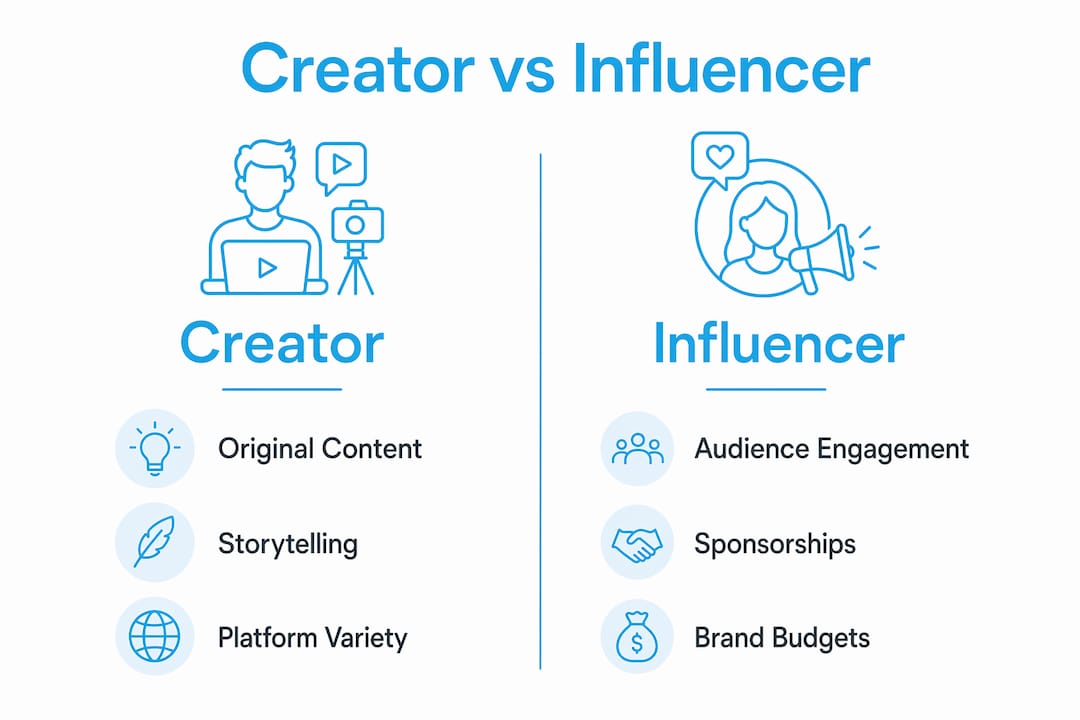
| Factor | Creator | Influencer |
|---|---|---|
| Primary output | Original content (video, writing, art) | Audience reach and persuasion |
| Value to brands | Content quality and storytelling | Consumer behavior change |
| Monetization focus | Subscriptions, licensing, UGC | Sponsored posts, affiliate deals |
| Follower dependency | Lower (UGC works without audience) | Higher (reach is the product) |
The distinction matters because brands approach creators and influencers with different budgets, briefs, and expectations. Knowing which category you occupy helps you pitch yourself accurately and avoid mismatched partnerships.
Monetization is where terminology knowledge translates directly into dollars. Creators who understand the mechanics behind revenue models negotiate from a position of strength. Those who don’t often leave significant money on the table.

Start with the CPM and RPM gap. YouTube takes approximately 45% of ad revenue, which means if a brand pays a $10 CPM, your RPM is closer to $5.50. Setting your income expectations based on CPM figures rather than RPM is one of the most common financial mistakes new creators make. Knowing the difference lets you calculate realistic monthly earnings and set appropriate rates for direct brand deals.
Monetization density is a concept that reshapes how you think about audience value. It refers to the economic value extracted per user, and it matters more than raw follower count for sustainable income. A creator with 10,000 highly engaged subscribers on Patreon or Substack can earn 88 to 95% of subscription revenue and generate more stable income than a creator with 500,000 passive followers on a platform that controls the monetization. Many creators fall into the “Asset-Rich, Income-Poor” trap: large audiences but insufficient monetization infrastructure, which creates financial instability despite apparent success.
Common monetization strategies you should know and use:
Pro Tip: Always negotiate usage rights separately from content creation fees. Brands that want to run your content as paid ads for six months should pay a licensing fee on top of your base rate. Most creators don’t ask because they don’t know the term.
The industry uses these three terms with specific meaning, and conflating them signals inexperience to brands and agents. 62% of creators prefer long-term partnerships over one-off campaigns, which reflects a creator mindset focused on sustained relationships rather than transactional reach. Influencers, by contrast, are often engaged for campaign-specific reach and conversion goals.
Influencer tiers further define how brands allocate budgets:
Influencer tiers directly impact engagement rates, sponsorship rates, and brand budget allocation. A nano-influencer in a specific fitness niche may deliver better conversion for a supplement brand than a mega-influencer with a general lifestyle audience. Knowing your tier and its implications helps you pitch to the right brands at the right price.
“Talent” is the term agents and management agencies use internally. If you are represented, you are talent. This matters because it signals a professional structure around your business, which increases brand confidence and often unlocks higher-budget campaigns.
Knowing the vocabulary is step one. Applying it to your daily operations is where the real advantage appears. Creators who outsource to agents, strategists, and software scale their operations more efficiently than those who try to manage every function solo. Understanding the terminology around each role makes that outsourcing more effective because you can brief collaborators precisely and evaluate their work accurately.
Here is how to put terminology to work across your business:
Creators rarely manage all facets of their business alone. Outsourcing is common and critical for scaling successfully. The creators who grow fastest are the ones who build a team around their strengths and use precise language to manage that team. You can explore how creator business operations scale effectively when the right structure is in place.
Creator industry terminology is the professional foundation that separates creators who scale from those who stagnate. Mastering it improves every aspect of your business, from brand negotiations to fan revenue.
| Point | Details |
|---|---|
| Terminology is a business skill | Knowing creator economy language improves negotiation, contracts, and brand relationships directly. |
| CPM vs. RPM distinction | RPM is what you actually earn; CPM is the advertiser’s rate. Never confuse the two when forecasting income. |
| Monetization density over follower count | Economic value per user matters more than audience size for sustainable, stable creator income. |
| Creator vs. influencer is not interchangeable | Each term signals a different value proposition to brands, affecting budget, brief, and expectations. |
| Outsourcing requires precise language | Delegating effectively to agents and strategists depends on knowing the exact terms for each role and function. |
Most creators I work with underestimate how much vocabulary shapes their outcomes. Early in my experience with the creator space, I watched talented people lose brand deals not because their content was weak but because they couldn’t hold a professional conversation about usage rights or engagement benchmarks. The brand rep would use a term, the creator would nod along, and the contract would come back with terms the creator never intended to agree to.
The shift from “influencer” to “creator” is not just semantic. It reflects a genuine change in how the industry values content as an asset rather than a promotional vehicle. Creators who adopted that framing early positioned themselves for licensing deals, UGC contracts, and long-term partnerships that influencers chasing one-off sponsored posts never accessed.
My honest observation is that the creators who grow fastest in 2026 are not necessarily the most talented. They are the ones who treat their business like a business. That means learning the language, building a team, and communicating with precision. Terminology is the entry point to all of that. Start there, and the rest of the professional infrastructure becomes much easier to build.
— Gjon
Understanding creator industry terminology is the foundation. Building the systems around it is what drives real income growth. Only-dreams specializes in exactly that: professional account management, 24/7 chat teams, and data-driven marketing strategies that handle the operational side of your business so you can focus on creating. Whether you want to maximize subscription revenue, improve fan engagement, or grow across Instagram and TikTok, the team at Only-dreams brings the expertise and the vocabulary to move fast. Explore CREATOR STORY NO.2 to see how professional creator projects come together, and check out the creator monetization guide to take your next step.
Creator industry terminology is the specialized vocabulary used within the creator economy to describe roles, platforms, monetization models, and business practices. It includes terms like CPM, RPM, whitelisting, UGC, and influencer tiers.
CPM is the rate advertisers pay per 1,000 impressions, while RPM is what creators actually receive after the platform takes its revenue share. On YouTube, that share is approximately 45%, making RPM significantly lower than CPM.
The terms signal different value propositions to brands. Creators are valued for content quality and storytelling; influencers are valued for audience reach and purchasing influence. Using the correct term sets accurate expectations and attracts the right partnerships.
Monetization density measures the economic value extracted per user rather than total follower count. A smaller, highly engaged audience on a subscription platform often generates more stable income than a large passive following on an ad-supported platform.
Precise terminology lets you brief agents, chat managers, and strategists accurately and evaluate their performance against clear benchmarks. Creators who outsource effectively scale faster, and that process starts with speaking the same professional language as your team.