TL;DR:
- Most marketers mistakenly believe that copy-pasting messages across channels constitutes cross-platform marketing, which limits reach and revenue. Effective cross-platform strategy requires unified customer data and journey mapping to orchestrate personalized, behavior-driven campaigns. Proper operational governance and unified measurement ensure campaigns are coordinated, relevant, and accurately attributed across all channels.
Most marketers assume a cross-platform marketing process means copying the same message across every channel they run. That assumption costs them reach, engagement, and revenue. The real goal is unified journey orchestration: building context across touchpoints so each message moves the customer forward, not sideways. This guide breaks down the full workflow, from consolidating your customer data and mapping journeys to orchestrating campaigns, managing creative QA, and measuring attribution accurately. Whether you run a lean team or manage multiple brands, what follows gives you a repeatable process you can apply immediately.
| Point | Details |
|---|---|
| Unify your data first | Consolidate CRM, social, web, and app data into a single customer profile before building any campaign. |
| Map journeys before messaging | Define the paths customers actually take across channels before writing a single line of copy. |
| Use behavior-driven triggers | Replace manual sends with if/then logic so your campaigns adapt to real customer actions. |
| Creative QA is a pipeline stage | Treat compliance and format review as a gate that blocks content pre-publish, not an afterthought. |
| Attribution requires identity stitching | Platform dashboards report in silos. Unified data pipelines give you accurate CAC and ROAS numbers. |
The first mistake most teams make is jumping straight to campaign execution. Before you write a single ad or schedule a single post, you need two things in place: a unified customer profile and a clear map of how customers move between your channels.
Your CRM knows purchase history. Your social analytics tool knows engagement rates. Your website analytics knows time on page. None of these systems talk to each other by default. That gap is where your strategy breaks down.
Building a unified customer view means pulling data from every source into a single profile: CRM records, app behavior, web activity, social interactions, and point-of-sale data if you have it. This is the foundation that unified journey orchestration depends on before any personalization or channel coordination becomes possible.
When that unified profile exists, you stop guessing. You know that a customer who clicked your Instagram ad yesterday also opened your email last week and browsed your product page three times. That context changes how you speak to them.
A customer journey map is not a sales funnel diagram. It is a blueprint showing the actual paths customers take, including the detours. A prospect might discover you on TikTok, research on Google, compare on your website, get retargeted on Instagram, and convert through an email offer. That is a real, fluid path.
Here is what a practical journey mapping exercise covers:
Documenting these paths for your top two or three customer segments gives you a clear picture of where to invest and how to connect each channel’s messaging to the next logical step.
Pro Tip: Don’t build journey maps from assumptions. Pull session data and attribution reports to see which channel sequences actually produce conversions. Real paths often look nothing like what your team imagines.

Once your foundation is in place, you design the actual workflow. This is where a multi-channel marketing strategy becomes an integrated marketing approach with real logic behind it.
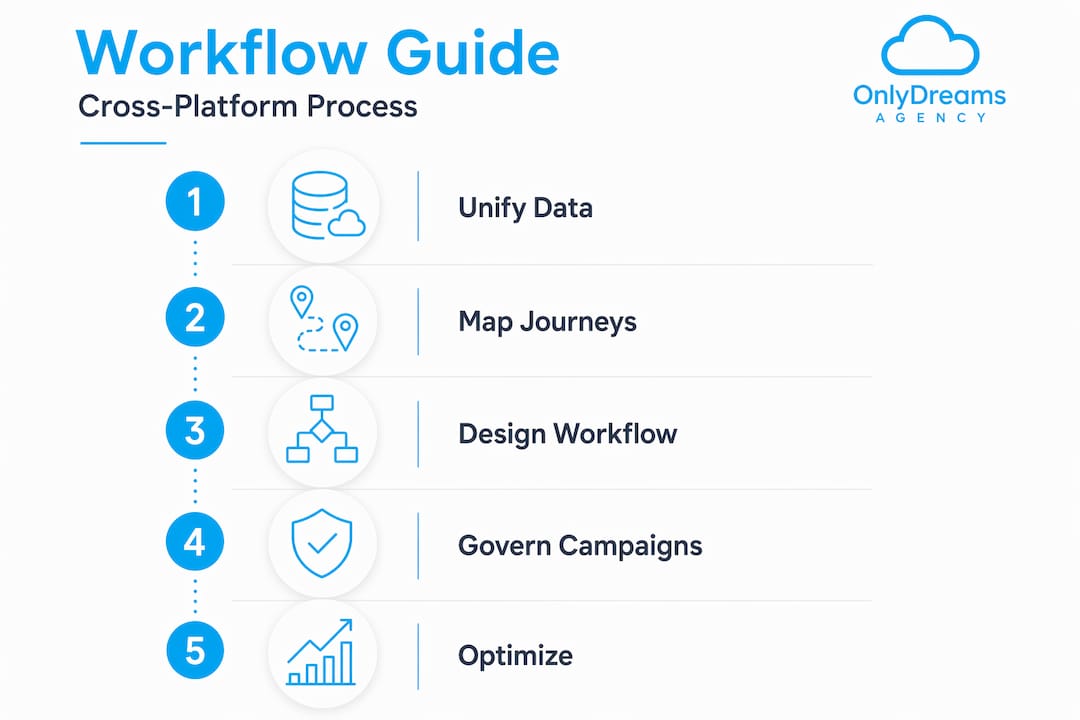
Marketing workflow architecture runs in three distinct layers: engagement (delivery of messages), orchestration (the logic and triggers that decide what gets sent and when), and intelligence (measurement and attribution). Understanding these layers helps you build a modular process where changing one part does not break everything else.
Here is how to design your cross-platform promotion workflow from scratch:
Select your channels and define their roles. Not every channel does the same job. Instagram builds awareness and desire. Email drives conversion and retention. SMS handles urgency. Push notifications handle re-engagement. Assign a primary role to each channel before you build campaigns.
Define your triggers. Event-driven triggers fire based on customer behavior: opening an email, abandoning a cart, completing a purchase. Time-based triggers fire after a set interval. You need both in a mature workflow.
Build branching logic. A welcome journey with conditional logic might send an onboarding email on day one, then check after two days: if the email was opened, continue to email; if unopened, trigger an SMS follow-up. That kind of if/then structure prevents message overlap and keeps the experience relevant.
Centralize coordination in one platform. Managing triggers and messaging across five platforms without a centralized tool creates chaos. A cross-channel orchestration platform lets you see all active journeys, their current state, and their performance in one place.
Define journey exit criteria. Explicitly set the conditions under which a customer leaves a journey. Without clear exit points, customers can receive overlapping messages from multiple active sequences, which degrades their experience and makes debugging nearly impossible.
Pro Tip: Start with one or two journeys and get them performing well before you build more. A lean, well-tuned welcome series and a cart abandonment flow will outperform ten half-built journeys every time.
Execution is where most cross-platform marketing workflows fall apart. The strategy looks clean on paper, then four teams push conflicting creative, someone forgets to QA the mobile format, and the brand shows up differently across every channel.
Operational governance prevents that. Here is what a practical governance system covers:
| Governance element | What it prevents |
|---|---|
| Unified scheduling calendar | Message overload and team conflicts |
| Pacing dashboard | Frequency gaps and overexposure |
| Creative version control | Wrong assets published on wrong channels |
| Compliance audit gate | Policy violations and brand inconsistency |
Solid content approval workflows also apply here. When multiple people contribute to a campaign, you need a clear sign-off chain so nothing goes live without the right eyes on it.
Pro Tip: Assign one person as the cross-platform calendar owner. When no one owns the master schedule, things get missed. One owner who reconciles all channel inputs weekly prevents most coordination failures.
Running campaigns across multiple channels without unified measurement is like driving with five separate speedometers that each show a different speed. Each platform’s dashboard reports its own metrics in its own way, and none of them account for the customer who touched three of your channels before converting.
The fix is a unified data pipeline that pulls performance data from every channel into a single reporting layer. From there, you apply identity stitching to link campaign exposure across platforms to individual user activity, giving you actual cost per acquisition and return on ad spend numbers you can trust.
One of the most common attribution failures comes from misconfigured conversion events. If your unified profile does not have conversion events defined as entity variables with explicit timestamps (for example, first_order_date as a tracked entity variable), your attribution reports will show incomplete data even when you have full platform coverage.
Get this right before you run any major budget through the system.
| Metric | What it measures | Why it matters |
|---|---|---|
| CAC by channel sequence | Cost to acquire a customer via a specific path | Shows which channel combinations are worth investing in |
| ROAS by journey | Revenue generated per dollar spent across a journey | Reveals true campaign efficiency, not channel-level vanity |
| Assisted conversions | Touchpoints that contributed but did not close | Prevents you from defunding channels that actually drive results |
| Frequency by channel | How often a customer sees messaging per channel | Identifies overexposure before it causes unsubscribes |
Once you have clean data flowing, run weekly budget reviews. Set guardrails: for example, if a channel’s CAC exceeds a set threshold for two consecutive weeks, pause spend and reallocate. That kind of systematic review loop keeps your budget working where it performs, not where it was originally planned.
Pro Tip: Do not wait for end-of-month reports to catch problems. Build a live dashboard that flags underperforming channels in real time. Early signals give you room to adjust without wasting significant budget.
For creators managing promotion across social platforms, these same measurement principles apply. Knowing which platform drives real fan engagement versus surface-level impressions changes how you allocate your time and content.
I have worked through enough multi-channel campaigns to know that the technology is rarely the bottleneck. The bottleneck is almost always organizational. Teams working in silos, channel owners who treat their platform as independent, and leadership that evaluates performance by channel rather than by journey. No orchestration platform fixes that.
What I have found is that the teams with the most effective cross-channel advertising are not always using the most sophisticated tools. They have a clear internal agreement on what success looks like across the whole journey, not just at the channel level. That alignment has to come before any workflow gets built.
The other thing I would push back on is the instinct to over-engineer the process from the start. I have seen teams spend months designing a 12-step journey with 40 branching conditions before they have validated a single assumption about their audience. Start lean. A two-step welcome journey and a solid cart abandonment flow, measured rigorously, will teach you more in four weeks than a complex process ever will in theory.
The direction I am genuinely excited about is AI-native orchestration. Not AI as an add-on that writes your subject lines, but AI that monitors journey performance in real time and adjusts branching logic without human intervention. That is where the efficiency gains will come from in the next two to three years. Build your process with clean, structured data now so you are ready for it.
— Gjon
Building a cross-platform marketing workflow from scratch takes time, coordination, and the right operational support. Only-dreams helps creators and businesses do exactly that, managing social media strategy across Instagram, TikTok, and beyond while handling the day-to-day execution that most teams struggle to keep up with.
Whether you need content promotion strategies that work across channels or hands-on support with fan engagement and revenue optimization, Only-dreams brings the structure your marketing operation needs. From dedicated account managers to data-driven cross-platform growth strategies, the team handles the operational side so you can focus on creating. Visit Only-dreams to learn how professional creator management translates directly into measurable growth.
A cross-platform marketing process is the structured workflow for planning, executing, and measuring marketing campaigns across multiple channels. It centers on unified journey orchestration rather than simply repeating the same message everywhere.
Customers move across channels before they convert, so a single-channel approach misses critical touchpoints. A coordinated multi-channel strategy builds context at each stage and increases the likelihood of conversion by meeting customers where they are.
A practical checklist covers: unified customer data setup, journey mapping by segment, channel role definition, trigger and branching logic configuration, creative QA and compliance review, unified scheduling, and a measurement framework with identity stitching and defined conversion events.
Accurate measurement requires unified data pipelines that stitch identity across channels and define conversion events with timestamps. Platform-specific dashboards report in silos and routinely misattribute results.
Omni-channel marketing focuses on creating a consistent customer experience regardless of channel, with a strong emphasis on in-store and digital integration. Cross-channel advertising focuses on coordinating messaging and data across digital platforms specifically, though in practice the two terms are often used interchangeably.