
If you create paid content on OnlyFans while based in Germany, you are almost always treated as a commercial creator with real tax, youth protection, and data protection duties. The deutsche Rechtslage OnlyFans creators face boils down to three moves: register with your Finanzamt and likely your Gewerbeamt, declare your income before the tax office finds it through platform reporting, and lock down your content and privacy protections before you ever need them.
TL;DR:
- Creators must register as a trade (Gewerbe) in Germany and file income tax and possibly trade tax only if profits exceed €24,500 annually.
- VAT obligations are shifted to OnlyFans under the Fenix ruling, but creators still need proper invoicing, a Steuernummer, and accurate bookkeeping.
- Platform reporting under the PStTG means tax authorities often receive your income data before you file, emphasizing the importance of timely registration and compliance.
- Civil and criminal protections for content leaks include immediate evidence preservation, swift takedown requests, and criminal complaints under §201a StGB for unauthorized distribution of intimate images.
- Age verification must meet Germany’s KJM standards, requiring robust methods such as digital ID checks or video verification, not just simple birthdate entries.
You’re a business owner the moment you accept your first tip on OnlyFans, at least in the eyes of the Finanzamt. German tax law doesn’t care that your “storefront” is a subscription platform instead of a shop. It cares whether you’re acting with intent to profit, on a recurring basis, offering a service. Check those three boxes, and you’re commercial.
Most creators fall into Gewerbe (trade) status rather than freelance (freiberuflich) classification, because freelance status in Germany is reserved for specific catalog professions like doctors, lawyers, journalists, and certain artists. Content creation selling subscriptions and pay-per-view media typically doesn’t qualify, so you register a Gewerbe and calculate profit using the Einnahmen-Überschuss-Rechnung (EÜR), a simplified income-minus-expenses method. Deductible expenses commonly include camera gear, editing software, a portion of your internet bill, and props tied directly to your content.
Two tax layers apply once you’re registered:
VAT is where things get genuinely interesting. In the Fenix case, the European Court of Justice ruled that a platform like OnlyFans acts as the VAT supplier for the full fan payment, not just as a payment processor for the creator. Practically, that means the platform typically handles VAT on subscriptions and tips, and creators invoice OnlyFans itself under the reverse-charge mechanism for the commission or service fee OnlyFans deducts. You still need correct invoicing, and if your turnover is low enough, the Kleinunternehmerregelung (small business VAT exemption) may apply to your own invoices. A deeper walkthrough of this mechanism, including how to structure your invoices, is available in Only-dreams’ guide to VAT for OnlyFans income in Germany.
Pro Tip: Don’t assume Fenix means “VAT is someone else’s problem.” It shifts where VAT lands on subscription revenue, but you still need a Steuernummer, proper bookkeeping, and correct invoices for your own share of earnings.
Here’s the part that catches people off guard: under Germany’s PStTG (Platform Tax Transparency Act), which implements the EU’s DAC7 directive, platforms are required to report creator earnings to German tax authorities. Practical tax guidance for creators confirms that the Finanzamt often already has your income data before you file anything. Skipping registration isn’t a gray area anymore. It’s a paper trail waiting to be matched against your name.
You have exactly one month from the start of commercial activity to notify the Finanzamt, so don’t let this slide to “next quarter.” Here’s the sequence that actually works:
Pro Tip: If you have cross-border payments, income from multiple platforms, or months of undeclared earnings sitting behind you, hire a Steuerberater before you file anything. A voluntary disclosure done correctly is far cheaper than an audit triggered by mismatched PStTG data.
You own the copyright to your content the moment you create it, under Germany’s Urheberrechtsgesetz (UrhG). That ownership gives you real civil tools: injunctions to force removal, damages claims against whoever leaked or resold your material, and legal standing against fake profiles impersonating you.
There’s also a criminal law angle that many creators don’t realize applies to them. §201a StGB criminalizes the unauthorized recording or distribution of intimate images, and it exists independently of copyright law. Legal analysis of OnlyFans creators’ protections under German law confirms both civil copyright remedies and criminal complaint options are available, and they can run in parallel.
When content leaks, move through this sequence:
Pro Tip: Report to the platform and pursue German legal channels at the same time. OnlyFans’ internal terms of service don’t override your rights under German law, and waiting for platform support before acting legally often costs you the window where evidence is easiest to preserve.
Germany treats adult content access as a youth protection issue, not just a platform feature. Under the Jugendmedienschutz-Staatsvertrag (JMStV), adult content must sit behind a closed user group, and the KJM (Coordination Office for Media Self-Regulation) evaluates verification systems against its AVS raster, a checklist of what counts as sufficiently robust.
A simple age checkbox or entering a birthdate doesn’t meet the German standard. The KJM raster generally expects verification approaches like these:
The EU’s age-verification framework encourages privacy-friendly, minimal-data verification approaches across member states, and Germany’s KJM raster reflects that same direction: strong initial checks, but not indefinite storage of sensitive ID documents. Credit card checks alone, according to detailed breakdowns of how German age verification law actually works, don’t satisfy the KJM standard, since a card doesn’t reliably prove the cardholder is the person accessing the content.
As a creator, you’re largely relying on OnlyFans’ own AVS implementation, but you carry reputational and sometimes legal exposure if minors demonstrably access your content through weak verification. Push your platform toward KJM-positive approaches where you have any influence over settings, and avoid promoting your content through channels that bypass age gates entirely.
The moment you collect subscriber data, process payments, or run a fan chat, GDPR (DSGVO) applies to you as a data controller. That means a clear legal basis for processing, a privacy notice subscribers can actually find, and honoring deletion or access requests when they come in.
Commercial creators generally need a business Impressum on any linked page, website, or landing page tied to their OnlyFans activity, since German law requires this for anyone offering commercial services online.
A few practical moves cut your exposure fast:
Pro Tip: A five-point DSGVO checklist for creators running fan chats is worth working through line by line before your subscriber count grows past a few hundred, because retrofitting privacy compliance after a data complaint is far harder than building it in early.
A suspended account is a revenue emergency, but panicking rarely gets it resolved faster. Move methodically:
Pro Tip: Diversify while you wait. Keep backups of your content library and, where platform rules allow, a record of your subscriber base, so a suspension on one platform doesn’t erase your entire business overnight.
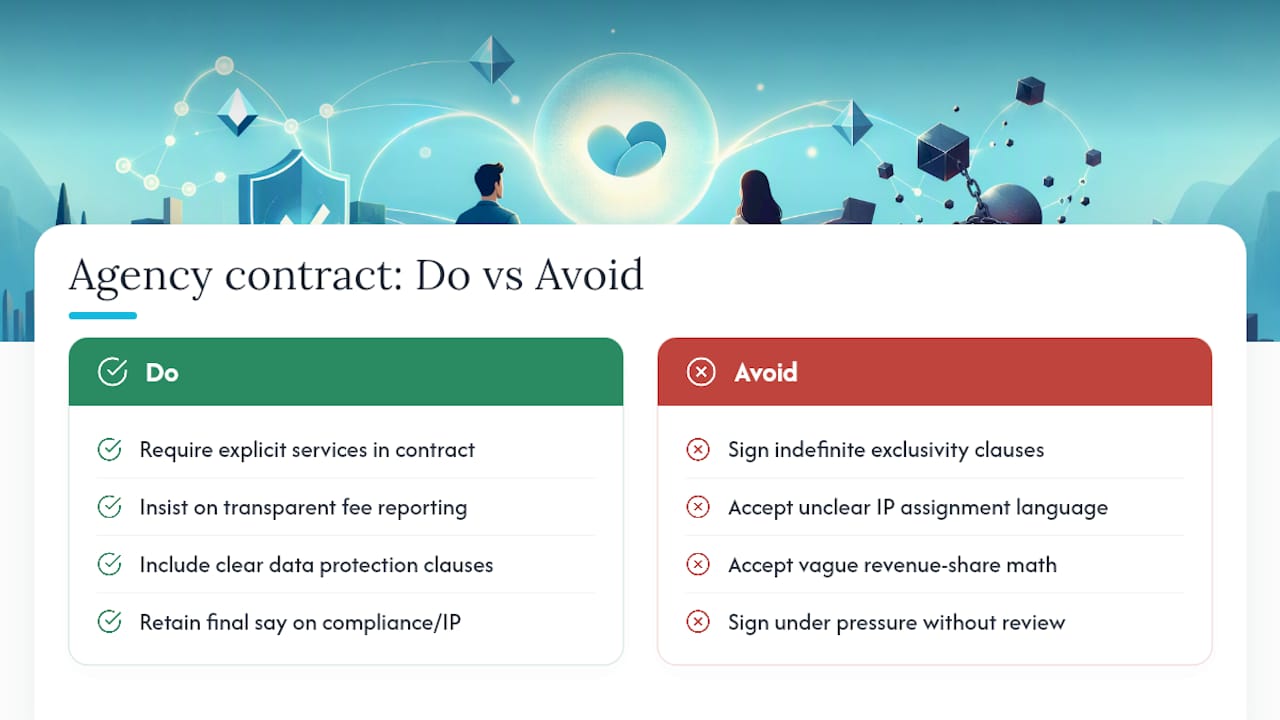
Read the exclusivity clause first. If it locks you into one manager or platform indefinitely with no clean exit, that’s a red flag before you look at anything else. Watch closely for unclear IP assignment language, vague revenue-share math you can’t independently verify, automatic renewal clauses, and termination terms written to favor the agency.
A fair contract spells out services explicitly, gives you transparent fee reporting you can check against your own platform dashboard, and includes real data protection clauses covering how your subscriber data gets handled. You should retain final say over legal compliance decisions like tax filings and IP enforcement, and never sign away moral rights to your own likeness or content. A closer look at common OnlyFans agency red flags walks through the clauses worth flagging for a lawyer before you sign anything.
Pro Tip: If an agency pressures you to sign quickly without time for legal review, that pressure itself is the red flag, not the contract terms alone.
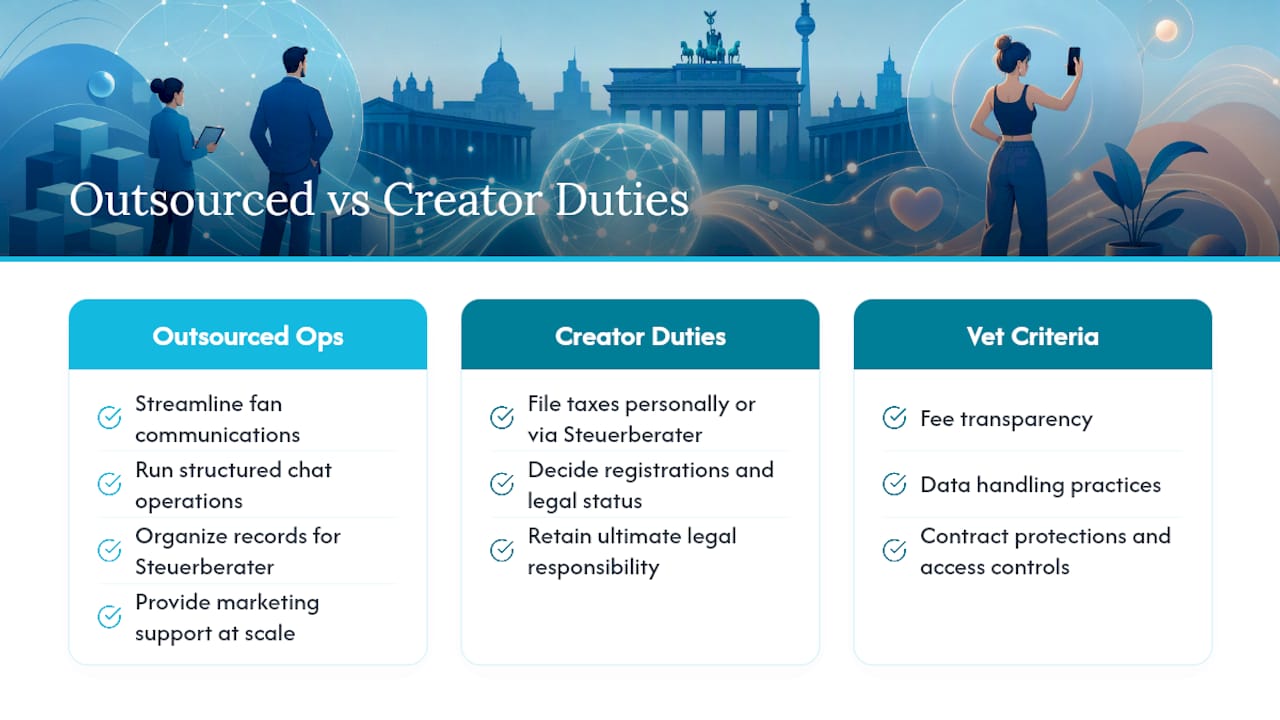
Operational support can lighten your workload, but it doesn’t replace your legal responsibilities. A management team can streamline fan communications, run structured chat operations, and help you organize the records your Steuerberater needs. Some agencies offer account management, trained chat teams, and marketing support built for that kind of scale. What it can’t do, and what no agency should claim to do, is file your taxes or make your registration decisions for you. Vet any manager on fee transparency, data handling, and contract protections before handing over access.
Most advice on this topic treats German OnlyFans compliance as a single decision: register or don’t. That framing misses where the real risk sits. The Fenix ruling didn’t remove your VAT obligations, it relocated part of them, and creators who assume the platform “handles everything” are the ones most likely to get an unpleasant letter from the Finanzamt.
The bigger blind spot is timing. PStTG reporting means your income data often reaches tax authorities before you’ve decided whether to declare it, which flips the usual advantage of waiting. On the content-protection side, too many creators treat platform reporting tools as their only recourse against leaks, when German copyright and §201a StGB give you faster, more enforceable options the platform can’t override.
If you take one thing from this, prioritize registration and evidence habits over perfecting your tax strategy. A messy but registered business is defensible. An unregistered one, discovered through DAC7 data, is not.
— Gjon
Everything above covers what you’re legally required to handle yourself: registration, tax filings, IP enforcement, and compliance decisions. None of that goes away no matter who helps you run your account. But the day-to-day grind of chat replies, fan engagement, and content scheduling is exactly the kind of workload that eats the hours you’d rather spend on either content or your own compliance paperwork.
Some agencies work as operational partners rather than legal ones, with account managers and trained chat teams to handle fan engagement and messaging revenue so creators don’t personally answer every message at midnight, while creators keep full control over their tax filings, contracts, and IP enforcement decisions. Before signing with any management partner, check their fee transparency, how they handle subscriber data, and what the contract actually says about termination. If offloading the chat and content-strategy workload sounds like the missing piece, see how Only-dreams structures its account management services and get a sense of whether it fits your current setup.
This article is general information, not a substitute for advice from a qualified lawyer. Consult a qualified legal professional about your own circumstances before acting on anything here.