
If you want to raise DM revenue, build a four-stage funnel: Hook, Qualify, Offer, Follow-up. Layer pipeline KPIs on top (DM start rate, qualified rate, purchase rate) and run it through trained chat operations. That combination is what moves the needle, not more messages or longer shifts.
Do these four things this week:
Write one standardized welcome DM and send it to every new subscriber within minutes.
Define three qualification signals (reply depth, expressed desire, tipping history) that trigger an offer.
Track DM start, qualified, and purchase rates in a simple spreadsheet.
Set a follow-up cadence for anyone who goes quiet after seeing an offer.
Top creators already pull 40 to 60 percent of their revenue directly from DM conversations through PPV, tips, and custom orders. The chat is not a side channel. It’s the sales floor.
Raising DM revenue requires a phase-based funnel, tracked pipeline KPIs, and trained chat operations working together, not any single tactic alone.
| Point | Details |
|---|---|
| Run the four-stage funnel | Hook, Qualify, Offer, and Follow-up each have a distinct job; skipping one breaks the sequence. |
| Track the pipeline, not vanity metrics | Measure DM start rate, qualified rate, purchase rate, and Revenue Per Message weekly. |
| Fix your biggest leak first | Diagnose whether you’re selling too early, under-qualifying, skipping follow-up, or replying too slowly. |
| Segment and personalize offers | Match offers to spend tier and stated preference instead of mass-messaging everyone the same pitch. |
| Scale with a managed team when volume outpaces you | OnlyDreams Agency provides 24/7 chat management, KPI tracking, and persona-consistent training for creators ready to outsource. |
Random chatting doesn’t scale. A phase-based funnel does, because it turns every conversation into a repeatable sequence with a clear job at each stage.
Hook. This is the first message a new subscriber gets, and it carries more weight than almost anything else you’ll send them. About 70 percent of subscribers never message first, so if you wait for them to open the conversation, you’re leaving most of your audience silent. Send a warm, personalized welcome within minutes of a new sub or follow, use their name if you have it, and end with a question that’s easy to answer.
Qualify. Before you sell anything, find out what this person actually wants. Ask about preferences, gauge how fast they reply, and watch for tipping or past purchase history. A fan who answers in one word is not ready. A fan who asks follow-up questions is.
Offer. Once you see buying signals, present the PPV, bundle, or custom content that matches what they told you. Selling before this point reads as pushy; waiting too long reads as disinterest.
Follow-up. Most creators stop here. Don’t. A short, low-pressure check-in two or three days after an unanswered offer often converts fans who simply got busy.
Pro Tip: Save your best-performing welcome message and qualifier as templates, but tweak the first line for each fan. A copy-paste opener with zero personalization kills reply rates before the funnel even starts.
You can’t fix what you don’t measure, and DM volume alone tells you nothing useful. Track the pipeline as a single flow so you can see exactly where fans drop off.
A structured pre-sale funnel on warm inbound traffic typically converts around 30 percent, though that ceiling drops on cold or low-intent traffic.
Not every fan who replies is ready to spend. Watch for these signals before you pitch anything:
Three templates to adapt today:
For delayed buyers, run a three-message follow-up: a light check-in on day two (“Still thinking about it? No pressure!”), a value nudge on day four (“This one’s getting a lot of love, wanted to make sure you saw it”), and a final low-pressure close on day seven (“Last call before I archive this one”). Unlock rates on well-targeted DM offers commonly run 15 to 30 percent, well above cold mass messages.
Scaling DM revenue past a certain point isn’t a content problem. It’s a staffing problem. You need defined roles: a welcome specialist to handle first contact fast, closers who present offers, a CRM manager who logs fan notes and preferences, and a data lead who watches the KPIs weekly.
Professional chatter management treats chat like a real sales function. That means KPI tracking, persona integrity training, permissioned access, and a fan CRM are baseline requirements, not extras. Daily transcript reviews and coaching loops are what separate a chat team that plateaus from one that keeps improving RPM per shift.
The gap between a mediocre chat team and a great one usually isn’t talent. It’s whether anyone reviews their actual conversations and coaches specific moments, not general feedback.
Outsourcing tends to make sense once you’re managing more volume than one person can qualify and follow up on daily, once response times start slipping past a few minutes, or once you simply want faster growth without hiring and training internally. This is exactly the gap OnlyDreams Agency fills for creators past that threshold.
Most revenue leaks trace back to one of four failure modes. Diagnose which one you have before changing anything else.
You don’t need a full quarter to see movement. A focused week gets you real data.
Blasting the same offer to every subscriber wastes your best content on the wrong audience. Segment fans by spend history first: whales who buy regularly, mid-tier fans who buy occasionally, and free followers who haven’t converted yet. Each group needs a different message.
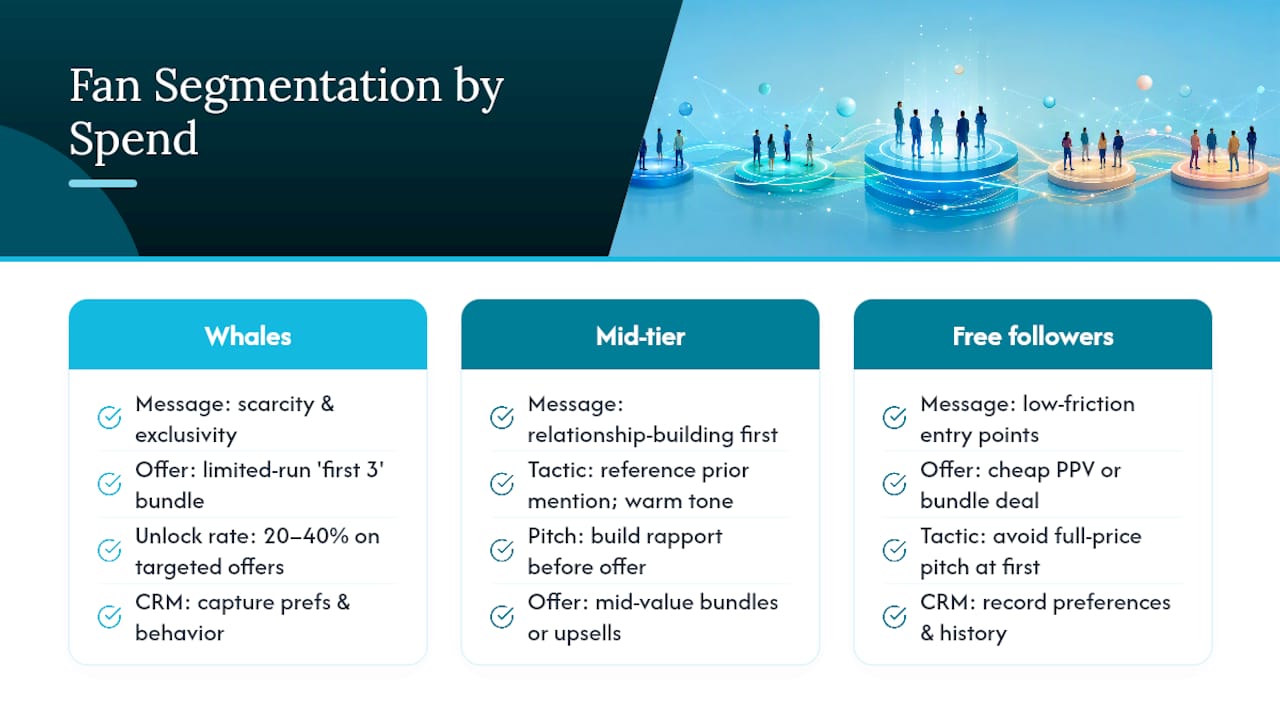
High-spenders respond to scarcity and exclusivity. A limited-run custom or a “first three people only” bundle plays directly to that instinct, and unlock rates on targeted high-value offers with real scarcity can run 20 to 40 percent, well above a generic mass message.
Mid-tier fans respond better to relationship-building before a pitch. Reference something they mentioned before, keep the tone warm, and don’t rush the offer.
Free or low-engagement followers need a lower-friction entry point, like a cheap PPV or a bundle deal, before you ever try a full-price custom.
Beyond spend tier, segment by stated preference (themes, fetishes, content style) and by behavior (fast repliers versus slow repliers, active tippers versus non-tippers). Your CRM notes should capture all of this so any chatter picking up the conversation can personalize instantly instead of starting cold. This is where a documented fan CRM stops being a nice-to-have and becomes the thing that makes segmentation actually usable at scale, not just a spreadsheet nobody updates.
The platform itself (OnlyFans, Fansly, or similar) gives you basic messaging, mass DM sends, and PPV unlock tracking. That’s the floor, not the ceiling. What separates a high-performing chat operation is what sits on top of that: a fan CRM to log preferences and purchase history, a tagged media vault for instant fulfillment, and a shared tracking sheet or dashboard for the KPIs covered above.
Mass messaging tools built into the platform work fine for broad segmented sends, but they convert far lower than one-on-one DM offers. Mass PPV unlock rates commonly land around 4 to 9 percent, compared to 15 to 30 percent for a personalized offer inside an ongoing conversation. That gap alone is the argument for investing in real one-to-one chat quality over blasting the same message to everyone.
If you’re running this solo, keep it simple: a spreadsheet for KPIs, a folder system or tagging convention for media, and a notes field for every fan you talk to regularly. If you’re scaling past what you can track manually, that’s usually the point where a managed chat team with its own CRM and reporting system starts paying for itself, because the tooling matters less than whether anyone is disciplined enough to use it every day.
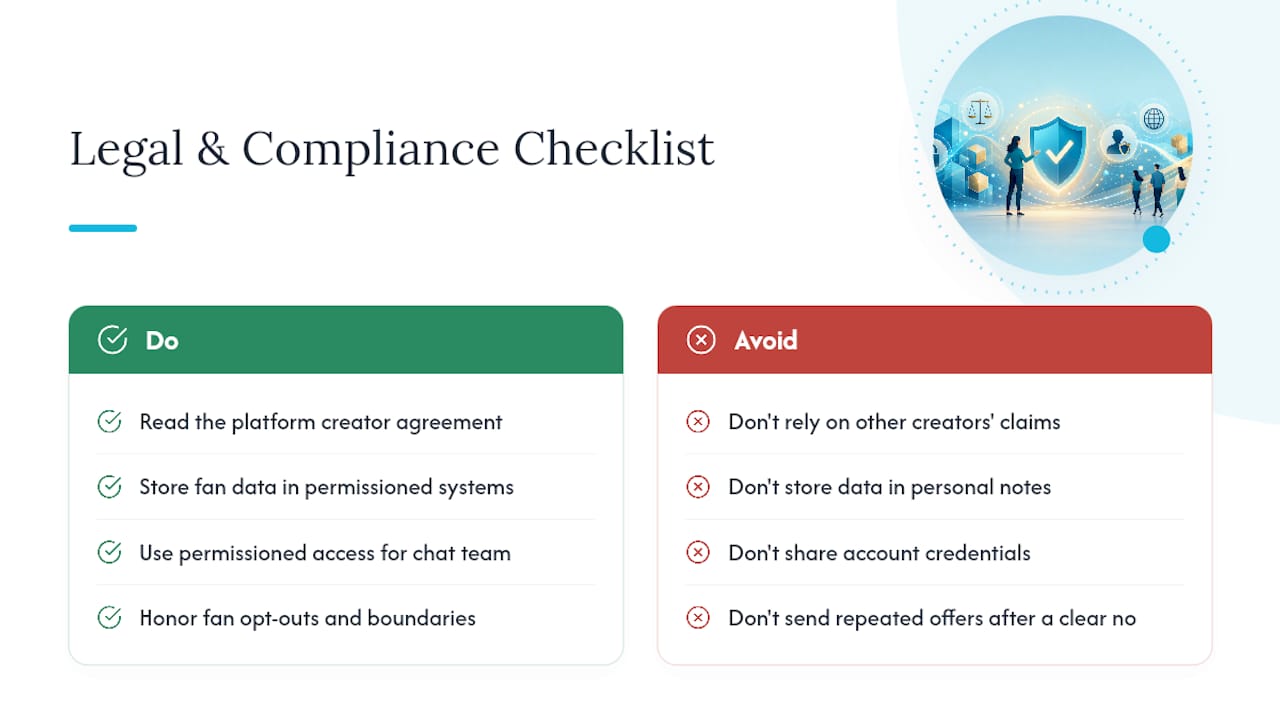
Selling through DMs puts you in direct contact with paying fans, which means the platform’s own terms of service govern what you can and can’t send, how you price content, and how you handle refunds or disputes. Read your platform’s creator agreement closely rather than relying on what other creators say is allowed, since enforcement and rules shift over time.
Privacy matters here too. Any fan data you or your chat team collect (preferences, purchase history, personal details shared in conversation) should stay inside a secured, permissioned system rather than scattered across personal notes or shared logins. If you work with a chat team, permissioned access is a baseline safeguard: chatters should see what they need to do their job, not your full account credentials or unrelated fan data.
Unsolicited messaging is generally less of a legal risk on creator platforms than it is on general messaging apps, since fans have already subscribed or followed you. Still, respect a fan’s stated boundaries. If someone says they’re not interested in a type of content or asks to stop receiving offers, honor that. Aggressive or repeated selling after a clear “no” damages trust and increases the odds of a complaint to the platform.
None of this is legal advice specific to your situation. If you’re running a larger operation with contractors or a formal chat team, it’s worth having a professional review your contracts and data-handling practices.
A single PPV sale is nice. A fan who buys from you every month for a year is worth far more, and that’s where lifetime value (LTV) becomes the metric that actually matters for sustainable DM revenue.
Track LTV by logging every transaction per fan: content ID, price, date, and outcome. This granular ledger does double duty. It stops pricing contradictions (charging one fan $15 for something you sold another fan at $25), and it flags fans who’ve gone quiet after a strong purchase history so you can re-engage them before they churn entirely.
Post-purchase follow-up is where most creators leave money on the table. A fan who just bought a PPV is warm, not done. A simple upsell message right after fulfillment (“Glad you loved that! I actually have a follow-up piece if you want more”) captures interest while it’s highest. Bundling related content together after an initial purchase also lifts per-transaction revenue without requiring new content.
The fans worth the most attention are the ones with a pattern: recurring tips, repeat customs, consistent replies. Treat them differently. A quick personal check-in, first access to new content, or a small discount on a bundle keeps a high-LTV fan feeling prioritized instead of treated like every other subscriber in your inbox.
Engagement in DMs comes down to making a fan feel like they’re talking to a real person who’s actually paying attention, not reading from a script. Reference something specific they said earlier in the conversation. Ask a genuine question instead of only pitching. Use their name.
Response speed matters more than most creators assume. Fans lose momentum fast when a reply takes too long, and staffing your chat coverage around your actual peak activity hours (not just when it’s convenient for you) keeps conversations moving instead of going cold.
Voice notes, custom selfies, or a quick personalized photo response tend to outperform plain text replies because they feel harder to fake and more intimate. Save these formats for fans who are already engaged rather than every single message; overusing them dilutes the impact.
Timing your outreach matters too. A well-placed check-in during a fan’s typical active hours (evenings, weekends, whatever your data shows) gets a faster response than a message sent when they’re asleep or at work. If you’re tracking DM start rate as a KPI, you’ll notice it climbs when your welcome and follow-up messages land inside a fan’s active window instead of hours later.
Most objections in DM sales aren’t a hard no. They’re a signal that something in the conversation didn’t land emotionally, not that the fan isn’t interested at all.
“That’s too expensive” often means the fan doesn’t yet see enough value to justify the price, not that they can’t afford it. Instead of dropping the price immediately, remind them what makes the content specific to them: “This one’s exactly what you told me you wanted.” A small bundle or add-on sometimes works better than a discount, since it preserves your pricing and gives them more for the same spend.
“I need to think about it” is usually hesitation, not rejection. Don’t chase immediately. Give it a day, then send a light, no-pressure follow-up rather than repeating the same pitch.
Silence after an offer is the most common “objection” of all, and it’s not really an objection. It’s a delay. This is exactly what the follow-up sequence covered earlier is built to handle: a soft check-in, a value nudge, then a final low-pressure close.
The underlying principle across all of these: sell the feeling and the connection, not just the content description. Fans who feel a genuine connection are far more forgiving of price and far less likely to disappear after a “maybe.”
Your inbox stops running your day. Instead of chatting for hours, you get a daily recap: what sold, what fans said, what needs your voice specifically.
You still control pricing, your voice, and how VIP fans get treated. The team handles volume, timing, and follow-up execution.
A typical handoff looks like a short morning report (overnight sales, flagged fan questions) and an evening summary (KPIs, anything needing your input) so you’re never out of the loop, just out of the grind.
Everything in this article, the funnel, the KPIs, the scripts, works best when someone is executing it consistently, every shift, every day. That’s the part most creators struggle with once volume grows past what they can personally chat through.
OnlyDreams Agency runs 24/7 chat management built around exactly this framework: dedicated account managers, trained chatters who follow the Hook to Qualify to Offer to Follow-up sequence, and daily coaching loops that keep Revenue Per Message climbing instead of plateauing. Persona integrity stays intact because chatters work from documented fan notes and permissioned access, not guesswork, so your voice stays consistent even when you’re not the one typing. The result creators see most often is faster reply times, merit-based chatter performance tied to actual KPIs, and a chat operation that scales without you drowning in your own inbox. If you’re past the point where you can personally qualify and follow up on every fan, reach out to OnlyDreams Agency to see what a managed chat team could do for your account.