Creator burnout is prevented by three things working together: operational systems (batching, boundaries, templates), income diversification across multiple revenue streams, and delegation to professional management. Financial instability accounts for a 55% severity ranking as a cause of creator burnout in a 2026 industry report. YouTube’s own guidance recommends limiting daily connectivity to specific windows. Start here before you read further.
Your 7-day action snapshot:
Pro Tip: Set a phone alarm labeled “Engagement Window” for the same time each day. When it goes off, you engage. When it ends, you stop. That single habit reduces decision fatigue faster than almost anything else.
The goal here is measurable friction reduction in 30 days, not a lifestyle overhaul.
Week 1: Stop-checks and boundaries (15–30 min each)
Week 2: Batching and templates (60–90 min blocks)
Week 3: Income quick-wins (45–60 min)
Week 4: Delegation pilots (60–90 min)
Pro Tip: When announcing a break to your audience, keep it simple: “Taking a planned week off to recharge — content resumes [date].” Pre-schedule posts to run during the break. Audiences respond well to honesty, and your momentum stays intact.
Burnout rarely arrives as a single crash. It builds through a chain reaction of compounding pressures.
Financial instability is the most severe cause of creator burnout, accounting for a 55% severity ranking in a 2026 industry report, a single algorithm update can cut income by 40% in a week, keeping creators in a low-grade stress state that is metabolically close to burnout over time. That financial anxiety then pushes creators to post more frequently, which multiplies micro-decisions (scheduling, captions, thumbnails), which accelerates decision fatigue, which degrades creative quality, which increases algorithm pressure. The cycle feeds itself.
Constant connectivity amplifies every other driver. When your phone is also your studio, your storefront, and your inbox, there is no natural off-switch. Admin overload (fan messages, file management, invoicing, analytics) adds hundreds of micro-decisions daily that have nothing to do with creative work. Identity slip is the final stage: you stop being a person who creates and become a creator who happens to exist.
Early warning signs to monitor:
Recovery timelines range from 8–12 weeks for mild cases to six months or longer for severe burnout. Early intervention is the only cost-effective option.
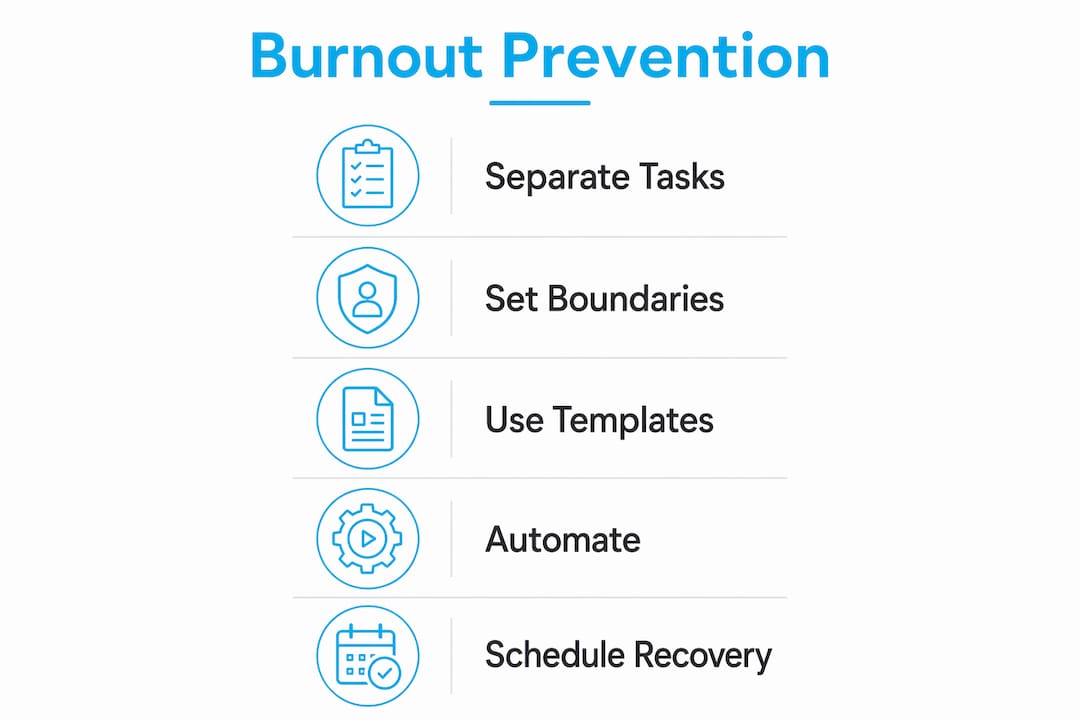
The core principle: separate high-brain-load creative work from repeatable production tasks, then automate or delegate the repeatable layer.
Boundaries and engagement windows
Set two fixed daily windows: 30 minutes for analytics review and one 45-minute community engagement block. Outside those windows, creator apps stay closed. No morning analytics before a no-screen ritual of at least 60 minutes. This one structural change protects creative energy before the workday starts.

Batching and templates
The 4:1 rule is the practical ceiling: four short-form videos per 90-minute session, one session per week. Beyond that, on-camera energy declines and the content shows it. Pair batching with a social media workflow that separates creation days from production days (editing, captions, scheduling) and business days (analytics, brand deals, admin).
Automation
Use schedulers for cross-platform distribution, unified analytics dashboards instead of five separate logins, and macro-editing tools for repetitive cuts. Automation protects quality when it removes repetitive tasks. It accelerates burnout when it just creates room for more output without adding recovery time.
Income diversification
Full-time creators average multiple income streams, and no single source should exceed roughly 50% of total earnings. That threshold is the point where one algorithm change becomes a financial crisis. Practical first steps:
Mental health and recovery as operational requirements
Schedule recovery days with the same rigidity as campaign deadlines. One content-free day per week is the minimum. Quarterly breaks of five to seven days, with content pre-scheduled, prevent the fatigue accumulation that shorter pauses cannot offset. Therapy is a legitimate business expense that protects your most valuable asset.
Pro Tip: Build a comment-response template for your five most common questions. Copy, paste, personalize one word. You save 20–30 minutes daily and your audience gets a faster, more consistent response.
| Role | What they own | Immediate burnout impact |
|---|---|---|
| Account manager | Strategy, posting schedule, platform admin | Removes daily scheduling decisions |
| Chat/community team | Fan messages, DM responses, subscriber retention | Eliminates the biggest daily time drain |
| Editor/producer | Video cuts, captions, thumbnails | Frees creation days from production tasks |
| Analytics operator | Reporting, performance tracking, weekly summaries | Replaces compulsive dashboard checking |
| Paid-ads specialist | Paid growth campaigns, audience targeting | Removes a high-skill task from the creator’s plate |
| Admin/operations | Invoicing, file management, brand deal logistics | Clears the lowest-value, highest-friction tasks |
Start with whichever role covers your lowest-energy task from the Week 4 checklist above. That is the role generating the most daily friction.
30-day onboarding checklist for any new hire or agency:
Typical time-to-impact for a chat or community hire is two to four weeks. For an account manager or agency engagement, expect meaningful workload reduction within 30 days and measurable revenue impact within 60–90 days. Monthly cost bands vary widely by scope: freelance editors run $300–$1,500/month; full-service agency engagements typically start at $1,000–$3,000/month depending on platform coverage and team size. See the creator workload reduction guide for a detailed delegation playbook.
The operational model at Only-dreams illustrates what a managed engagement actually removes from a creator’s daily plate.
When a creator hands off fan engagement, revenue reporting, and content scheduling to a dedicated team, the number of daily micro-decisions they face drops from hundreds to dozens. That reduction is where burnout prevention actually happens.
Only-dreams provides dedicated account managers, trained 24/7 chat teams, revenue optimization, and cross-platform marketing across Instagram, TikTok, and other platforms. The creator keeps creative control. The agency owns the operational layer.
Months 1–3 timeline:
Managed accounts stabilize revenue by building predictable fan relationships and subscription retention, which directly addresses the 55% severity ranking of financial instability as a driver of creator burnout.
Use this rubric before signing anything.
Decision checklist — necessary capabilities:
Interview questions to ask:
Red flags to walk away from:
Pro Tip: Always run a 30-day paid pilot before committing to a longer engagement. Any reputable agency will offer one. If they won’t, that tells you everything you need to know about how they handle accountability.
Three-dimension fit rubric:
Burnout prevention for creators comes down to three moves: build operational systems that reduce daily micro-decisions, diversify income so no single platform controls your stability, and delegate the operational layer to professionals.
| Point | Details |
|---|---|
| Financial instability is the top driver | At 55% severity, income diversification is the highest-leverage burnout prevention move according to a 2026 industry report. |
| Batching protects creative energy | The 4:1 rule (four videos per 90-minute session, once weekly) prevents on-camera energy decline. |
| Delegation starts with your lowest-energy task | Identify tasks scoring below 4/10 on energy and outsource those first for fastest friction reduction. |
| Recovery is an operational requirement | Schedule one content-free day weekly and a 5–7 day quarterly break with content pre-scheduled. |
| Only-dreams handles the operational layer | Account managers, chat teams, and revenue ops remove 10+ hours of weekly friction so you keep creating. |
Most creators wait too long to delegate. They treat it as an admission that they can’t handle the workload, when the reality is the opposite: the creators who build lasting careers are the ones who recognize early that operational friction is a business problem, not a personal failing.
What agencies like Only-dreams actually do day-to-day is less glamorous than it sounds. It’s answering fan messages at 2 AM, pulling weekly revenue reports, adjusting posting schedules based on platform data, and managing the hundreds of small decisions that accumulate into burnout. When a creator hands that layer off, they typically reclaim 10 or more hours per week within the first month. Those hours go back into creative work, recovery, or both.
Treating recovery as an operational requirement, not a luxury, is the mental shift that makes everything else sustainable. Schedule it. Protect it. Don’t negotiate it away when a deadline appears.
Only-dreams is the operational partner for established creators who want to keep creating without managing everything themselves.
The agency’s core services cover the exact tasks that drive burnout: dedicated account managers handle strategy and platform admin, trained chat teams manage fan engagement around the clock, and revenue optimization specialists track and grow subscription and messaging income. AI-enhanced marketing is available as an add-on for creators who want expanded reach without expanded workload.
A discovery call typically reviews your current platform setup, revenue mix, and the specific operational tasks draining your time. From there, month one focuses on onboarding and immediate workload transfer. By month three, most creators see measurable revenue growth alongside a significantly reduced daily task load.
If you’re ready to hand off the operational layer and get back to creating, start with a discovery conversation at Only-dreams.
| Source | What you’ll find | Best used for |
|---|---|---|
| NetInfluencer — 2026 industry report | Financial instability severity data (55%) and burnout prevalence statistics | Benchmarking your burnout risk and justifying income diversification |
| Miraflow — 5-Pillar system | Batching frameworks, 4:1 rule, production cycle templates | Building your content batching and scheduling system |
| Promote — Creator burnout prevention | Recovery timelines, repurposing strategies, prevalence data | Understanding severity and planning a recovery timeline |
| CreatorTribune — 30-day recovery plan | Phased recovery plan with diagnostic scorecard | Structured recovery if you’re already experiencing burnout |
| YouTube Help — Creator burnout tips | Platform-level guidance on boundaries and engagement limits | Validating daily engagement window strategies |
| Carve the Path — Burnout prevention systems | Systems-first framework, identity separation, recovery as operational requirement | Designing sustainable creative workflows |
Mental health resources: If you’ve experienced burnout symptoms for more than three months, or if your burnout has triggered anxiety or depression, consult a licensed mental health professional. The 988 Suicide and Crisis Lifeline (call or text 988) is available 24/7 in the United States. Therapy is a legitimate business expense and a professional decision, not a last resort.
This article is general information, not professional medical or financial advice. Confirm any significant business or health decisions with a qualified professional for your specific situation.