
The most reliable massen nachrichten strategie (mass messaging strategy) for established creators isn’t choosing between bulk sends and personal DMs. It’s running both at once: segmented mass messages to warm and high-value fans, feeding a parallel 1:1 conversation funnel your chat team manages by hand. This hybrid model consistently outperforms either tactic alone.
Three benchmarks tell you if it’s working:
Pro Tip: If your mass-send unlock rate is healthy but revenue per message is flat, the problem is usually pricing, not the message. Fix the offer before you rewrite the copy.
A hybrid strategy combining segmented mass messages with a managed 1:1 chat funnel consistently outperforms either tactic run alone for established creators.
| Point | Details |
|---|---|
| Run a hybrid funnel | Use mass sends to surface interest, then route warm replies into 1:1 chat for higher-ticket closes. |
| Segment before scaling | Define past purchasers, new subscribers, repliers, whales, and dormant fans before increasing send volume. |
| Cap general cadence | Keep general sends at 2 to 3 per week and add one extra weekly touch for high-value fans only. |
| Watch three KPIs weekly | Track reply rate, PPV unlock rate, and revenue per message; act when any one drops past baseline. |
| Get expert help managing chat | Only-dreams provides trained 24/7 chat teams and account managers who run this exact segmented, benchmark-driven approach. |
Every campaign needs a defined objective before you write a single message. Are you chasing a revenue spike this week, re-engaging fans who’ve gone quiet, or protecting retention on a subscriber who’s about to churn? Each goal calls for a different offer, tone, and cadence, and conflating them is the fastest way to burn out your list.
Mass sends work best as a funnel entry point, not the final sale. Their job is to surface interest cheaply across your whole audience, then route the fans who respond into 1:1 conversations where your chat team closes higher-ticket sales. That’s where the real money sits, since chat-driven revenue can represent 40% to 80% of monthly income for creators running strong chat operations.
Five core segments should anchor your strategy:
Segmenting this way lets you match each message to where the fan actually is, rather than blasting one offer at everyone and hoping something lands.
Vague cadence rules are how creators either annoy their list or leave money on the table. Use concrete thresholds instead.
Pro Tip: Track your mute rate weekly, not monthly. A spike after one campaign tells you exactly which message caused the drop off, while monthly tracking buries the signal in noise.
When two or more warning signals appear together, pull back frequency before revenue does the talking for you. A list that feels overmessaged stops replying long before it unsubscribes.
Every successful mass messaging campaign follows a four-stage arc, whether the conversation lasts three messages or thirty.
Mass message templates should stay short, carry exactly one personalization token, and always include a low-friction offer for warm segments. Overloading a mass send with multiple asks dilutes all of them.
The skill that separates a $2,000-a-month chat operation from a $20,000-a-month one is knowing exactly when a warm reply is ready to escalate into a premium pitch, and having a chatter trained to make that call in real time rather than following a rigid script.
When a fan replies warmly to a mass send, your chat team’s job is to move them into a genuine 1:1 exchange, not to paste a bigger price tag into the same thread. The best chatting strategies for OnlyFans treat that transition as a distinct skill, separate from writing the original mass message.
Pricing structure matters as much as message timing. A flat $20 PPV price for every fan leaves money on the table with your whales and creates friction with your teaser buyers.
Four tiers cover most creator catalogs:
Bundles extend average order value without new content. A value bundle (three related pieces at a discount) works well mid-funnel, exclusive early access suits your high-value segment before a general release, and archive packs give dormant fans a reason to spend without requiring fresh production. Effective monetization models generally follow an 80/20 balance: 80% of messages build the relationship, only 20% actually pitch. Early access should go to whales first, and every purchase deserves an immediate follow-up upsell while the fan is still in a buying mindset.
Staffing follows a predictable arc: solo creator, then a part-time chatter or two covering peak hours, then a rotating team providing 24/7 coverage. Revenue-share arrangements (commonly a percentage of chat-driven sales) or flat retainers are the two common cost models, and the right choice depends on your message volume and how much control you want over fixed costs.
Four documents make or break an outsourced chat operation:
Pro Tip: Calculate revenue per chatter hour by dividing total chat revenue by hours worked. It’s the single number that tells you whether outsourcing chat is actually cheaper than doing it yourself.
Privacy, refund policy, and consent guardrails belong in training from day one, not as an afterthought once a complaint arrives. Set clear rules for account management best practices around what chatters can promise, refund, or negotiate without escalating.
Five numbers tell you whether your operation is healthy or quietly leaking revenue.
Run each A/B test across at least three comparable campaigns before drawing conclusions. One strong or weak send is noise, not a pattern.
Build a weekly checklist around three questions:
Any negative answer triggers an immediate review of frequency, offer, or segment targeting before the next send goes out.
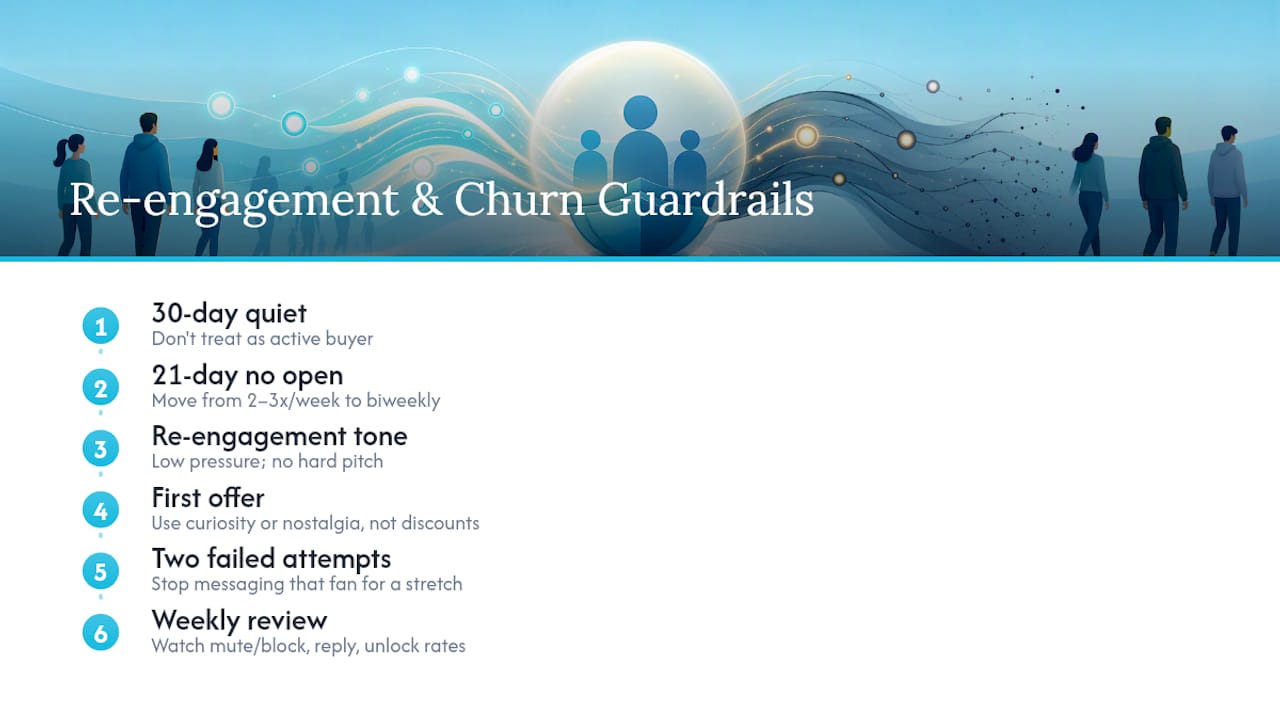
A fan who’s gone quiet for 30 days isn’t lost yet, but treating them like an active buyer is a mistake most creators make. Re-engagement messaging needs a distinct tone: lower pressure, no hard pitch, and a clear signal that you noticed the silence without guilt-tripping them for it.
The strongest re-engagement offers lean on curiosity or nostalgia rather than discounts. Save discounts for a second follow-up if the first message gets no response.
Churn guardrails work best as thresholds, not gut calls. If a subscriber hasn’t opened a message in 21 days, move them out of the general 2 to 3 times weekly cadence and into the biweekly re-engagement track. If two re-engagement attempts get no response, stop messaging that fan entirely for a stretch. Continuing to message someone who’s clearly disengaged does more damage to your account health metrics than the occasional lost sale would.
Watch mute and block rates as your earliest churn signal, since they move before cancellation numbers do. A rising mute rate on a specific segment tells you that group is oversaturated well before your subscriber count reflects it. Building this feedback loop into your weekly review, alongside reply and unlock rates, keeps churn manageable rather than reactive. Retention tactics that reinforce this rhythm are covered in more detail in this guide on subscription retention for creators.
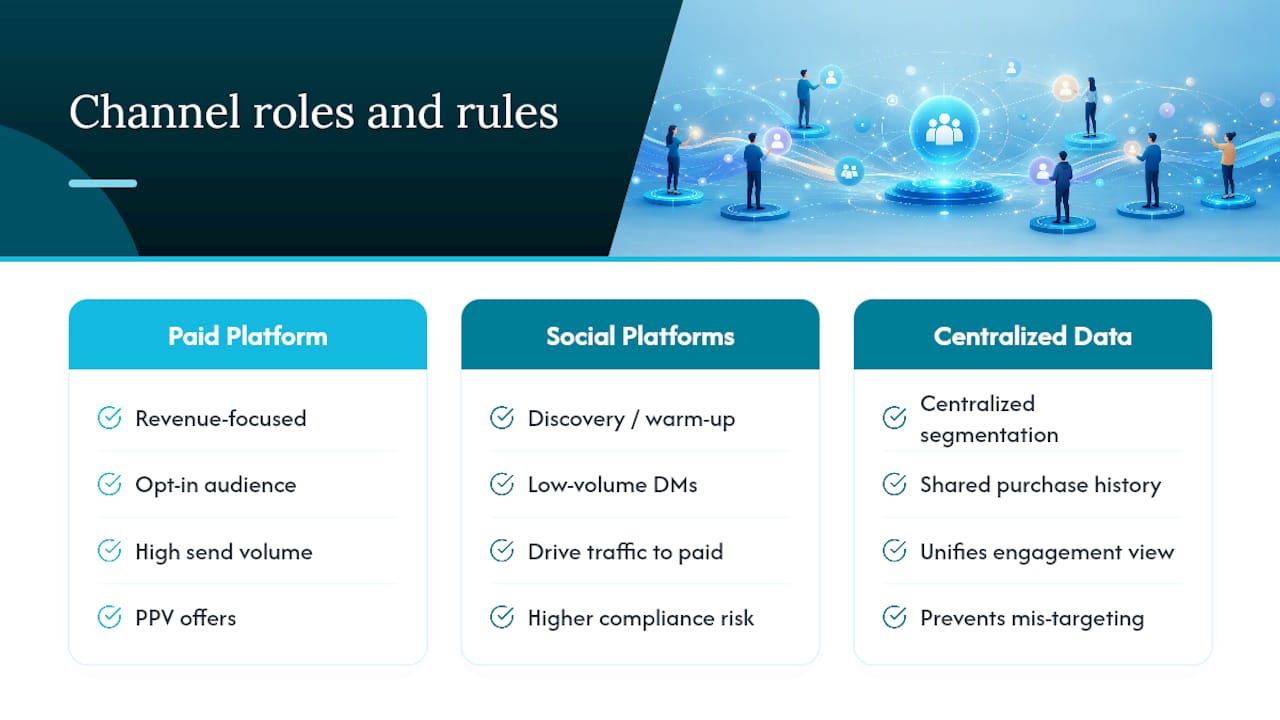
Not every platform deserves the same messaging strategy, and treating them identically wastes both content and chat-team hours. Your primary paid platform (OnlyFans or a comparable subscription service) should carry the bulk of your revenue-driving mass sends and PPV offers, since that’s where fans have already demonstrated buying intent.
Instagram, TikTok, and Threads play a different role. They’re discovery and warm-up channels, not conversion channels. Paid chat platforms are discovery-poor; they monetize audiences you’ve already built rather than reliably finding new ones. That means your social platforms should funnel attention toward your paid channel, not attempt to replicate its messaging cadence.
Direct messaging on social platforms carries real compliance risk if it starts to resemble unsolicited bulk outreach, so keep those touchpoints personal, low-volume, and focused on driving traffic rather than pitching offers. Save the structured, segmented cadence for the platform where fans opted in specifically to hear from you.
If you’re running a white-label or multi-platform operation, centralize your segmentation data in one system so a fan’s purchase history and engagement level travel with them across channels. Fragmented data across platforms is the single biggest reason mass messaging campaigns underperform, since chatters end up guessing who they’re talking to instead of working from real history. Building your fan engagement strategy around one unified view of each fan solves this before it becomes a revenue problem.
Most advice on this topic treats mass messaging and personal chat as competing tactics, forcing creators to pick a lane. That framing is wrong, and it costs money. The data on unlock rates alone makes the case: mass sends converting at 4% to 9% versus 15% to 30% for DM offers isn’t an argument against mass messaging. It’s an argument for using each channel for what it’s actually good at.
What’s overrated is the personalization arms race, the idea that every message needs deep, individualized crafting. Fans can tell the difference between genuine attention and a mail-merge token, but they can’t tell the difference between a well-timed segment-based offer and a fully custom one, provided the offer fits where they are in the relationship. Segmentation does more work than personalization ever will.
What creators should prioritize first isn’t better copy. It’s building the segmentation system and the voice document before scaling send volume. Without those two things, more messages just means more noise, faster burnout for your chat team, and a mute rate climbing ahead of your revenue.
— Gjon
Only-dreams runs the exact hybrid model this article describes: segmented mass sends managed by trained chatters, backed by a parallel 1:1 funnel that converts warm replies into premium sales, without you writing a single message yourself.
Our 24/7 chat teams work from your voice document and segmentation data from day one, so fans get consistent, authentic conversation whether it’s 2 PM or 2 AM. Dedicated account managers oversee pricing tiers, cadence, and campaign testing, while optional AI-enabled workflows cut manual busywork further without replacing the human judgment that turns a warm reply into a high-ticket close. If you’re already earning $3,000 or more a month and want your chat revenue managed by people who track reply rate, unlock rate, and revenue per message weekly, start a discovery call with Only-dreams to see how onboarding works and what a managed rollout looks like for your account.