
The fastest, most reliable way to scale a creator support team is a three-stage Diagnose → Prove → Scale loop that ties every hiring or automation decision to unit economics: Creator CPA, content efficiency ratio, and creator LTV. Skip the diagnosis and you’ll overstaff before you know what’s actually converting. Skip the pilot and you’ll scale a broken funnel faster.
Before you add a single chatter or account manager, run this checklist:
Pro Tip: Run this checklist even if you already have a support team. Retroactive diagnosis catches the leaks that got buried under “we’re too busy to fix it.”
This mirrors the approach outlined in Influencer Revenue Growth: A 2026 425% Playbook, which recommends diagnosing leaks, testing in small measurable batches, then scaling only once the unit economics repeat. Only-dreams has built its entire operating model around this sequence, which is also why it works as well for a solo creator crossing $10,000 a month as it does for an agency managing forty accounts.
Scaling a creator support team works only when hiring and automation decisions follow proven unit economics rather than guesswork or vanity metrics.
| Point | Details |
|---|---|
| Diagnose before hiring | Audit Creator CPA, content efficiency ratio, and churn before adding chatters or managers. |
| Prove with a winner rule | Run a 4-week pilot with a defined CPA threshold across at least two creators. |
| Staff to real ratios | Target one account manager per 5 to 8 creators and one dedicated chatter after three professional accounts. |
| Standardize contracts early | Lock commission triggers, usage rights, and exclusivity terms before scaling headcount. |
| Partner for faster execution | Only-dreams applies this Diagnose → Prove → Scale model directly through dedicated account management and 24/7 chat teams. |
Diagnosis means auditing what’s true right now, not what you assume is true. Most creators who come to Only-dreams believe their chat team is the bottleneck. Usually, it’s the offer, the content cadence, or a persona that drifted from what originally attracted subscribers.
Run this audit before touching headcount:
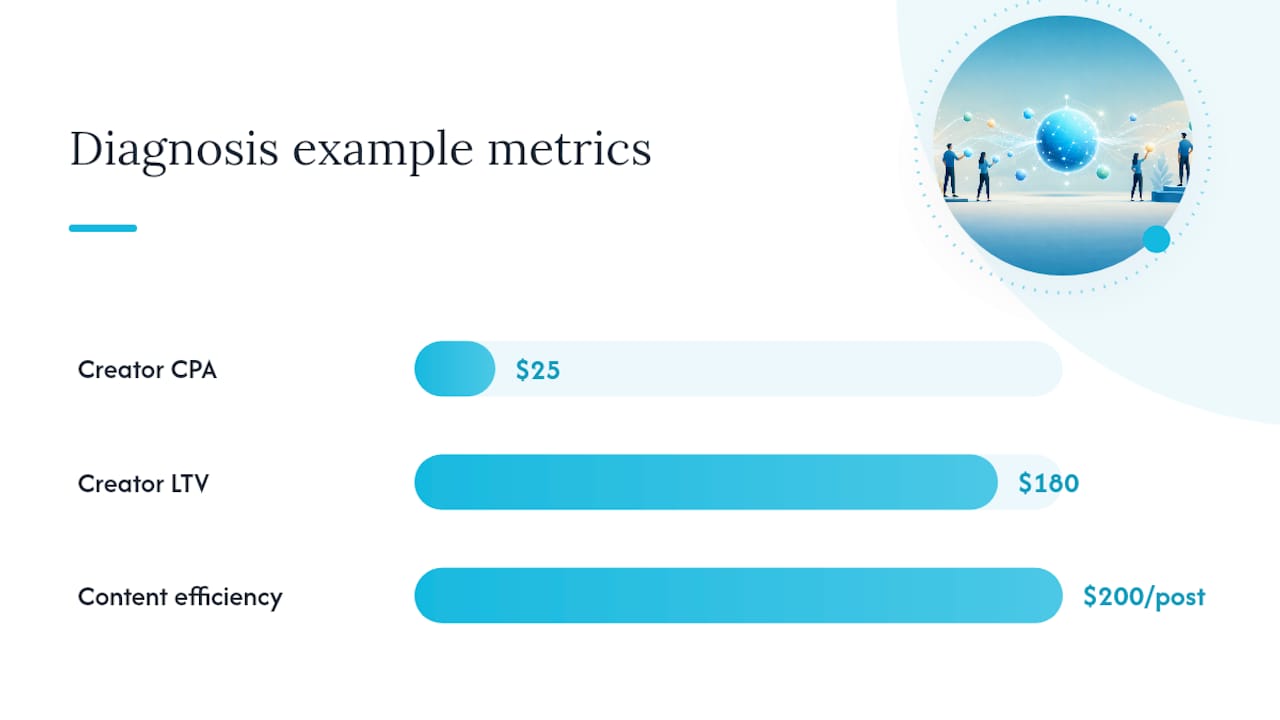
Three numbers make this audit concrete instead of a gut check.
| Metric | Formula | Example |
|---|---|---|
| Creator CPA | Total spend to acquire a paying subscriber ÷ new paying subscribers | $2,000 spend ÷ 80 subscribers = $25 CPA |
| Content efficiency ratio | Revenue generated ÷ pieces of content published | $8,000 revenue ÷ 40 posts = $200 per post |
| Creator LTV | Average monthly revenue per subscriber × average retention months | $30/month × 6 months = $180 LTV |
A Creator CPA above your creator LTV is a warning sign, not a scaling opportunity. If a $25 CPA is chasing a $180 LTV, you have room to invest in support staff. If CPA and LTV are close, fix the funnel before you fix staffing. The Team & Hiring Master Guide puts a hard number on this: most operators need a dedicated chatter once they manage more than three professional-level accounts, regardless of how good their content looks on paper. Understanding this math in more depth is worth a look at how to measure creator performance before you build a staffing plan around assumptions.
Proving a model means running a pilot small enough to fail cheaply and structured enough to produce a clear yes-or-no answer. Skip this stage and you’re betting payroll on a hunch.
A four-week pilot template looks like this:
| Week | Activity | Owner | Deliverable |
|---|---|---|---|
| Week 1 | Define winner rule and scale budget | Account manager | Written success criteria |
| Week 1 to 2 | Run pilot chat coverage on 2 creator accounts | Chat lead | Daily conversion logs |
| Week 3 | Test 2 content posts per creator against baseline | Content lead | UTM-tagged performance report |
| Week 4 | Compare pilot CPA against target threshold | Analyst | Go/no-go recommendation |
A concrete winner rule matters more than most pilots realize. One workable version: scale only if Creator CPA stays under $25 across two creators and two posts each, with conversion rate holding steady rather than spiking on one lucky post. The 425% Playbook research is explicit on this point: greenlight scale when conversion is stable across multiple creators and posts, and pause when click-through is high but conversion is weak. High CTR with weak conversion usually means the offer, not the chat team, needs work.
Your measurement stack for this stage needs three things at minimum: UTM-tagged links on every trackable post, a post-purchase survey asking new subscribers how they found the creator, and a link-management tool that ties clicks back to specific content pieces. Brands winning in 2026 lean on exactly this combination, according to guidance on building profitable influencer programs, which also flags whitelisting and tiered creator programs as the difference between guessing and knowing.
Pro Tip: Never let a pilot run longer than four weeks. A longer window invites seasonal noise and gives you an excuse to keep tweaking instead of deciding.
A scaled support operation needs five distinct roles working from a shared SOP library: chatter, shift lead, QA lead, account manager, and analyst. Skipping any one of these creates a single point of failure, usually the founder, who ends up doing everyone’s job at 2 a.m.
Here’s a workable ratio structure:
| Role | Typical ratio | Primary responsibility |
|---|---|---|
| Chatter | 1 per 1 to 2 creators (depending on volume) | Real-time DM engagement, PPV pitching |
| Shift lead | 1 per 4 to 6 chatters | Coverage handoffs, escalation triage |
| QA lead | 1 per 8 to 10 chatters | Scorecard reviews, persona audits |
| Account manager | 1 per 5 to 8 creators | Strategy, revenue reporting, creator relationship |
| Analyst | 1 per team | Attribution, KPI dashboards, pilot design |
That account manager ratio isn’t arbitrary. The Team & Hiring Master Guide sets it at 5 to 8 creators per manager, stretching to 12 only when chatters absorb most direct message volume independently.
For coverage, three shift patterns cover almost every agency need:
Every shift needs the same SOP backbone: response time targets, escalation triggers for angry or high-spend fans, a defined PPV pitch sequence, and a persona reference sheet chatters can check without breaking flow. The Agency Operations Master Guide frames this as one of five required pillars, alongside a central CRM, performance intelligence, content operations, and compliance and security protocols.
Pro Tip: Churn usually spikes during scaling not because chatters are worse, but because persona consistency slips when three new hires interpret “flirty but classy” three different ways. Lock the persona sheet before you lock the schedule.
Compensation should reward outcomes without creating incentives to overspend on ads or overpromise in chat. Every agreement, whether with a creator, a chatter, or an ambassador, needs the same handful of clauses.
Include these in creator and staff agreements:
Chatter compensation typically falls into three models. Flat hourly works for training periods or low-volume accounts. Commission-only suits high-performing chatters on high-revenue accounts but creates income instability that drives turnover. A hybrid, base pay plus a percentage of PPV and tip revenue above a threshold, tends to balance stability against incentive, particularly once monthly account revenue clears the $10,000 mark.
Contract execution shouldn’t be the bottleneck. Tools like DocuSign and PandaDoc let you push signature requests the moment a pilot clears its winner rule, and pairing them with integrations to Grin or Shopify Collabs means payout triggers fire automatically once a contract is countersigned, rather than sitting in someone’s inbox for a week.
Pro Tip: Build referral bonuses into your ambassador tier contracts from day one. Ambassadors who bring in other creators are cheaper to acquire than paid traffic, and the bonus pays for itself within one referral.
Standardizing tooling early prevents the mess of five creators running five different attribution setups. Prioritize the categories that fix payout accuracy and reporting first, then layer in automation.
| Category | Example tools | Primary use |
|---|---|---|
| Attribution and link management | TripleWhale, Northbeam | Track which content or ad drives conversions |
| Post-purchase survey | KnoCommerce, Fairing | Capture self-reported attribution data |
| Ambassador and affiliate management | Grin, Shopify Collabs, LoyaltyLion (Creator Tier module) | Manage referral tiers, payouts, and creator relationships |
| Contract execution | DocuSign, PandaDoc | Speed signature and activate payout triggers |
Run integrations in this order: UTM and link management first, because you can’t fix what you can’t see. Post-purchase surveys come next, filling in the attribution gaps that pixel-based tracking misses. Payout sync to accounting comes third, once you trust the data feeding it. Full payroll and payout automation should wait until after your first successful pilot, not before, since automating a broken process just makes the mess move faster. A single source of truth for Creator CPA and LTV reporting, whether that’s a dashboard fed by TripleWhale or Northbeam, is worth building before you add a fourth or fifth creator account. For a deeper look at reporting structure, see the role of analytics in creator management.
A repeatable onboarding process matters more than finding “naturally gifted” chatters, because talent without structure still produces inconsistent revenue.
Interview tasks should mirror real work, not personality tests. Give candidates three sample fan messages and ask them to write a PPV pitch response within 10 minutes. Score for tone match, upsell attempt, and grammar under time pressure.
Ongoing performance monitoring works best with a small, consistent KPI set:
| Metric | Target range | Reviewed by |
|---|---|---|
| Messages per hour | 25 to 30 | Shift lead |
| PPV conversion rate | 8% to 15% | Account manager |
| QA composite score | high QA score | QA lead |
| Creator CPA contribution | Trending down over time | Analyst |

The QA composite score works best when it’s a weighted blend rather than a single number. The Team & Hiring Master Guide recommends weighting response time at 20%, persona consistency at 20%, PPV pitch execution at 20%, upsell attempt rate at 15%, conversation depth at 15%, and compliance at 10%. That structure turns “this chatter seems fine” into a number you can actually track over a quarter.
A realistic rollout moves in three clear phases, each with its own budget band and decision gate.
| Phase | Key activities | Budget band | Decision gate |
|---|---|---|---|
| Days 1 to 30 | Diagnose accounts, run first pilot, set up attribution | Lower (pilot-scale spend, 1 to 2 hires) | Winner rule met on at least one creator |
| Days 31 to 60 | Run second pilot, hire first dedicated chatter and shift lead | Moderate (adds one to two salaried roles) | CPA and content efficiency ratio stable across two creators |
| Days 61 to 90 | Build full shift coverage, add QA lead, formalize contracts | Higher (full team structure, contract automation live) | LTV trending upward, churn stable or declining |
A human-first model costs more per creator early but produces higher persona consistency. A hybrid model, layering AI-assisted first-response drafting under human review, cuts messages-per-hour costs but requires tighter QA to catch tone drift. Neither is universally right. It depends on whether your creators’ fan base values speed or intimacy more.
Pause and iterate, rather than push forward, if Creator CPA rises for two consecutive pilots or if churn increases after adding headcount. That combination almost always means the new hires haven’t absorbed the persona yet, not that the model is broken.
Case evidence matters more than theory here, because every creator’s funnel behaves a little differently once real chatters and real fans are involved.
These outcomes come from operational patterns Only-dreams applies across managed accounts, detailed further in why expert creator managers matter for 2026 scaling. Results vary by creator niche, existing audience size, and how much operational debt existed before the engagement started, so treat these as directional evidence, not a guaranteed outcome for every account.
We built Only-dreams around the belief that scaling fan-facing support is a measurement problem before it’s a staffing problem. Our account managers run the Diagnose → Prove → Scale loop on every new creator relationship, pairing dedicated chat teams with hybrid AI-assisted drafting where it genuinely speeds response time without flattening a creator’s voice. That combination lets us hand creators a KPI dashboard instead of a vague promise that “engagement is up.”
If you’re weighing whether to build this in-house or hand it to a team that already runs the playbook daily, we’re happy to walk through what a pilot would look like for your specific accounts. Details on our approach and past case studies live at Why Use Expert Creator Managers to Scale in 2026.
Only-dreams handles the exact operational work this article just walked through, so you skip the trial-and-error of building a chat team from scratch. Instead of spending three months hiring, training, and building QA scorecards yourself, you get a dedicated account manager, a trained chat team already running structured PPV and escalation flows, and KPI-driven pilots that prove what is working before you commit to a bigger budget.
Our services cover dedicated account management, full 24/7 chat coverage, hybrid AI-assisted escalation for faster response times, and KPI-driven pilot structures that mirror the Diagnose → Prove → Scale model outlined above. Agencies managing multiple creator accounts can also access white-label chat management to extend coverage without expanding their own payroll. If you manage your own content or run an agency exploring creator management best practices for your roster, the next step is simple: start a conversation with Only-dreams about what a pilot would look like on your accounts.
What is the fastest way to scale a creator support team without hurting quality? Run the Diagnose → Prove → Scale loop: audit your current funnel and unit economics, test a small pilot with a defined winner rule, then hire and automate only once the pilot proves repeatable results across at least two creators.
How many creators can one account manager handle? Most agencies target 5 to 8 creators per account manager, according to the Team & Hiring Master Guide, stretching to around 12 only when chatters independently absorb most direct message volume.
When should a creator hire their first dedicated chatter? Once you’re managing more than three professional-level accounts, response time and revenue consistency usually suffer without a dedicated chat hire, based on staffing benchmarks from the same guide.
What’s the difference between Creator CPA and creator LTV? Creator CPA measures how much it costs to acquire one paying subscriber. Creator LTV measures the total revenue a subscriber generates over their retention period. Scaling makes sense when LTV comfortably exceeds CPA across a stable pilot.
Should chatters be paid hourly, on commission, or both? A hybrid model, base pay plus a percentage of PPV and tip revenue above a set threshold, tends to balance income stability with performance incentive better than either pure hourly or pure commission pay.
Is AI-assisted chat a replacement for human chatters? No. AI-assisted drafting can speed first-response time under human review, but persona consistency and fan trust still depend on trained human judgment, particularly for high-value or emotionally engaged fans.
Building this playbook yourself starts with the right reference points and the right internal templates, not another generic hiring guide.
Prioritize the attribution and contract-automation tools first if you’re still in pilot mode. Full ambassador-tier platforms and payroll automation are worth the setup time only once you’ve confirmed your winner rule holds across more than one creator account.