TL;DR:
- Messaging monetization transforms conversations into recurring revenue through subscriptions, payments, and commerce tools. Creators build paid value layers around free messaging, avoiding per-message charges to sustain engagement and growth. Most successful strategies focus on community access and exclusive content rather than charging for individual interactions.
Messaging monetization is the practice of generating revenue through conversation-based interactions on messaging platforms, using subscriptions, business tools, and in-chat payments rather than charging per message. The industry standard term is “conversational commerce,” and understanding it separates creators who earn sporadically from those who build recurring income. The WhatsApp Business Platform API alone reached a $3.54 billion annualized revenue run rate in Q1 2026, growing 77% in a single quarter. That number tells you one thing clearly: messaging is no longer just communication. It is a full revenue channel, and creators who treat it that way are pulling ahead fast.
Messaging monetization is defined as adding value around conversations rather than charging for each individual message. The model works by keeping core messaging free for audiences while building paid layers on top, such as exclusive content, premium communities, and direct commerce. This approach protects the intimacy that makes messaging so powerful in the first place.
Platforms like WhatsApp, Telegram, and similar apps keep their consumer-facing messaging ad-free by design. That choice preserves user trust and engagement. The revenue gets generated through business APIs, paid subscriptions, and in-chat payment systems that sit alongside the free experience without disrupting it.
For creators and digital entrepreneurs, this means your DMs and group chats are not just places to talk. They are sales funnels, community hubs, and premium content destinations. The shift from “messaging as communication” to “messaging as revenue” is the core idea behind every strategy covered here.

Creators have six proven models to choose from when building a messaging revenue strategy. Each one fits a different audience size, content type, and income goal.
Paid subscriptions and premium channels: Creators charge a recurring fee for access to exclusive messaging groups or channels. WhatsApp now offers paid channel subscriptions with a 10% platform cut, which is significantly lower than the 30% taken by platforms like YouTube or Apple. Creators with 10,000 or more followers report monthly earnings between ₹20,000 and ₹200,000 through this model alone.
In-app payments and digital goods: Tips, pay-per-view content, and microtransactions sent directly inside a chat thread. Payment gateways like Stripe integrate with messaging APIs to handle transactions without pulling users out of the conversation.
Sponsored automated messaging: Brands pay creators to send contextually relevant messages to their subscriber lists. This works best when the creator’s audience is tightly niched and the sponsor’s offer matches the community’s interests.
Business API access for transactional messaging: Creators who build large communities can sell access to their audience through API-powered workflows, letting brands send order confirmations, appointment reminders, or promotional messages at scale.
Affiliate marketing and commerce chat: Creators recommend products directly inside conversations and earn commissions on sales. This model converts well because the recommendation arrives in a trusted, private channel rather than a public feed.
Freemium funnels: A free public channel builds the audience. A paid private channel monetizes the most engaged fans. Freemium messaging funnels increase recurring revenue sustainably because they separate acquisition from monetization without alienating casual followers.
Pro Tip: Start with one model that matches your current audience size. A creator with 500 followers will see better results from a freemium funnel than from API-based sponsored messaging, which requires scale to attract brand partners.
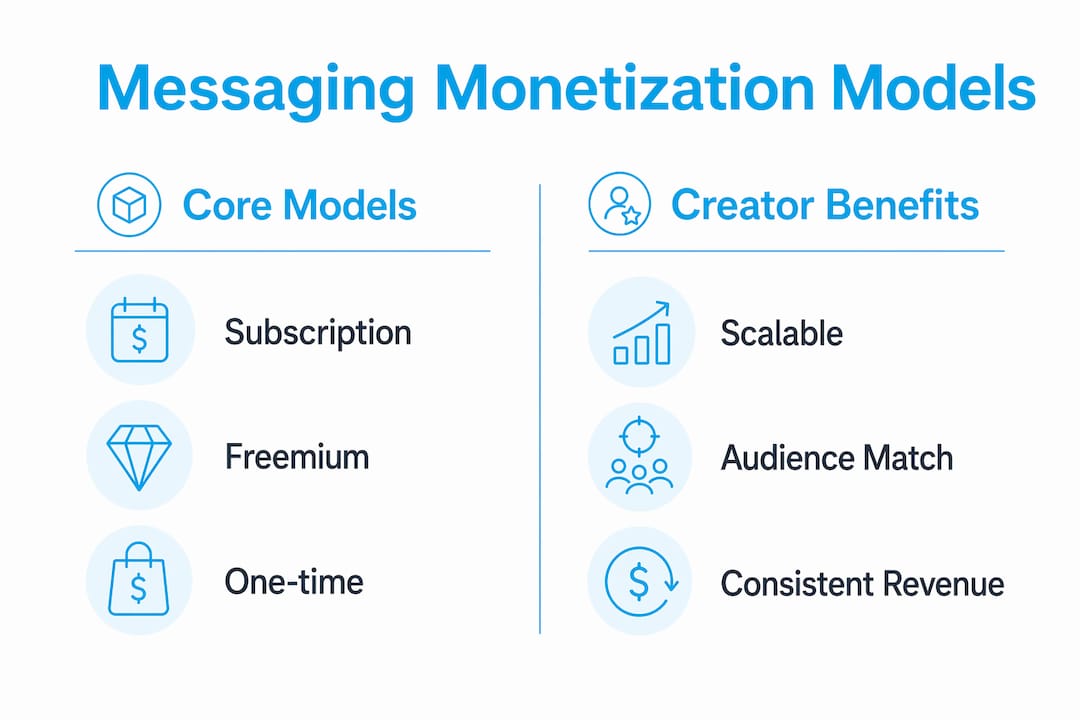
WhatsApp is the clearest example of a platform that has built messaging monetization into its core business model. The WhatsApp Business Platform API is Meta’s primary revenue engine in this space, and its 77% quarterly growth from Q4 2025 to Q1 2026 shows the model is accelerating, not plateauing.
Click-to-WhatsApp ads are one of the most effective tools in this ecosystem. A creator or business runs a paid ad on Instagram or Facebook, and the call to action opens a WhatsApp conversation instead of a landing page. Click-to-WhatsApp ad adoption grew 60% year over year, driven by the fact that a conversation converts at a higher rate than a static page. The ad pays for the lead, and the conversation closes the sale.
Automation and payment infrastructure make this scalable. Without bots and payment gateways, a creator would need to manually respond to every inquiry and collect every payment. APIs and tools like Stripe remove that bottleneck entirely.
| Platform feature | Revenue function | Creator benefit |
|---|---|---|
| Business API | Transactional and promotional messaging | Scalable audience communication |
| Paid channel subscriptions | Recurring subscriber fees | Predictable monthly income |
| Click-to-message ads | Paid acquisition into conversation funnels | High-intent lead generation |
| In-chat payment gateways | Direct sales inside conversations | Frictionless purchase experience |
Pro Tip: Connect your Click-to-WhatsApp ads to an automated welcome sequence. The first message should deliver immediate value, such as a free tip or exclusive piece of content, before any sales offer appears.
The most effective messaging profit strategies share one principle: monetize the value layer, not the conversation itself. Creators who charge for every interaction burn out their audiences fast. The ones who build sustainable income treat paid messaging as a destination their fans choose to enter, not a toll booth they are forced through.
Build a freemium funnel first. Use a free public channel to grow your audience and establish trust. Once you have consistent engagement, launch a paid private channel for your most dedicated fans. This freemium approach separates casual followers from paying subscribers without alienating either group.
Offer exclusive, high-value content in paid channels. Paid subscribers expect something they cannot get anywhere else. That could be early access to content, direct Q&A sessions, personalized advice, or behind-the-scenes material. The exclusivity is the product.
Integrate messaging with your broader social media funnel. Your Instagram or TikTok content should drive traffic into your messaging channels. Once a fan is inside your chat ecosystem, the conversion environment is far more personal than any public platform. Check out pro creator marketing tips for cross-platform strategies that feed this funnel effectively.
Use automation to handle volume without losing personalization. A bot can handle FAQs, deliver paid content, and process payments. A human or a trained chat team handles the relationship-building conversations that actually drive loyalty and upsells.
Avoid monetizing every touchpoint. Creators who charge per interaction see higher churn and lower lifetime subscriber value. The goal is to make the paid channel feel like a premium community, not a paywall.
Track conversion data by channel. Know which messages drive purchases, which content types retain subscribers, and which ad campaigns bring in the highest-value fans. Data makes the difference between guessing and growing.
Understanding chat monetization for creators in depth gives you a clearer picture of how these strategies apply specifically to adult content platforms and subscription-based creator businesses.
The benefits of messaging monetization are real and measurable. Direct messaging delivers superior conversion potential compared to traditional advertising because users value the privacy and intimacy of one-on-one or small-group communication. A fan who messages you directly is already more invested than one who scrolls past your post.
Key benefits:
Key challenges:
Professional chatters solve several of these challenges by handling fan conversations at scale, maintaining consistent engagement, and converting casual fans into paying subscribers without burning out the creator.
Messaging monetization works best when creators build paid value layers around conversations rather than charging per message, using subscriptions, automation, and commerce tools to generate recurring income.
| Point | Details |
|---|---|
| Core definition | Messaging monetization adds revenue layers around conversations, not fees per message. |
| Platform scale | WhatsApp Business API hit $3.54 billion annualized revenue in Q1 2026, proving the model works at scale. |
| Best model for creators | Freemium funnels separate free audience growth from paid subscriber monetization effectively. |
| Platform advantage | WhatsApp’s 10% revenue cut on paid channels beats the 30% standard on most other platforms. |
| Biggest risk | Monetizing every interaction causes audience fatigue and subscriber churn. |
The creators I see winning with messaging in 2026 are not the ones charging for every DM. They are the ones who built a community worth paying to be inside. That shift in thinking is everything.
When messaging monetization first became a topic, the instinct was to put a price on each conversation. That model failed fast. Audiences resented it, and creators burned through their goodwill in weeks. What actually works is treating your paid channel like a membership club. The fee buys access to a better version of you: more exclusive, more responsive, more valuable.
The other thing I have watched creators get wrong is ignoring the infrastructure side. You can have the best content in the world, but if your payment process is clunky or your automation breaks down, fans drop off. The transition to paid messaging funnels via APIs and payment tools is not optional if you want to scale beyond what you can handle manually.
My honest prediction: platforms will continue lowering their revenue cuts to attract creators, the way WhatsApp’s 10% already undercuts the industry standard. Creators who build their messaging infrastructure now will be positioned to capture that growth before the space gets crowded.
— Gjon
Building a messaging revenue channel takes more than a good idea. It takes a trained team, a clear strategy, and consistent execution across every fan interaction.
Only-dreams specializes in exactly that. As a US-based creator management agency, Only-dreams provides 24/7 chat management, dedicated account managers, and data-driven marketing across Instagram, TikTok, and subscription platforms. The trained chat teams build authentic fan relationships that convert casual followers into paying subscribers, handling the volume and consistency that most creators cannot maintain alone. If you are ready to turn your messaging channel into a reliable income stream, explore creator management with Only-dreams and see what professional support actually looks like in practice.
Messaging monetization is the process of generating income through messaging platforms by offering paid subscriptions, exclusive content, or in-chat commerce rather than charging per message.
Yes. Freemium funnels work at any audience size because they separate free growth from paid conversion, letting creators monetize their most engaged fans even with a smaller following.
Creators with 10,000 or more followers on WhatsApp paid channels report monthly earnings between ₹20,000 and ₹200,000, depending on subscription price and engagement rate.
WhatsApp, Telegram, and similar messaging apps all support paid channels, business APIs, and in-chat payment tools that enable creators to build messaging revenue streams.
Charging for every interaction is the most common mistake. It creates audience fatigue and drives churn. The most effective approach charges for access to a premium community or exclusive content, not for individual conversations.