TL;DR:
- White-label agency services allow businesses to outsource work invisibly while maintaining full control over client relationships and branding. They offer cost savings, access to expertise, and scalable service expansion without increasing payroll. Success depends on thorough vetting, clear scope, quality assurance, and ownership of the client experience.
If you have ever wondered what is white-label agency services and whether they belong in your business model, you are not alone. A lot of entrepreneurs assume this is just another word for outsourcing. It is not. White-label agency services are a specific model where a provider executes work and the buying agency presents that work under its own brand, with the provider staying completely invisible. Understanding this distinction matters whether you are a solo entrepreneur building an agency or an established business looking to expand your service offerings without expanding payroll.
| Point | Details |
|---|---|
| White-label means branded invisibility | The provider executes the work, but all deliverables carry your brand, not theirs. |
| Not the same as outsourcing | White-label controls client experience and branding; standard outsourcing does not. |
| Cost savings are significant | Agencies report 30%–70% lower delivery costs compared to building in-house teams. |
| Quality control is your responsibility | You own the client relationship, which means scoping and QA sit with you, not the provider. |
| Scales without hiring | White-label lets you take on more clients and service lines without adding full-time staff. |
The term gets used loosely, so let’s be precise. White-label agency services are digital marketing or operational services delivered by one company for another, with the work rebranded under the buying agency’s logo and identity. The provider executes. The reseller owns the client relationship. The client never knows a third party was involved.
Think of it this way: you run a social media marketing agency. A client asks if you also handle SEO. You say yes, then pass the work to a white-label SEO provider. They do the research, build the links, write the reports, and send everything back to you stripped of their branding. You put your logo on it and deliver it to your client. Your client sees a single, unified agency. That is white-label agency services in practice.
The most common service categories include:
Deliverables are presented under your brand identity at every touchpoint, from PDF reports to dashboard logins to email correspondence. The provider operates entirely behind the scenes.
Pro Tip: Before signing with any white-label partner, request a sample deliverable. Check whether any partner branding or metadata is visible. If it is, that partner does not truly operate white-label.
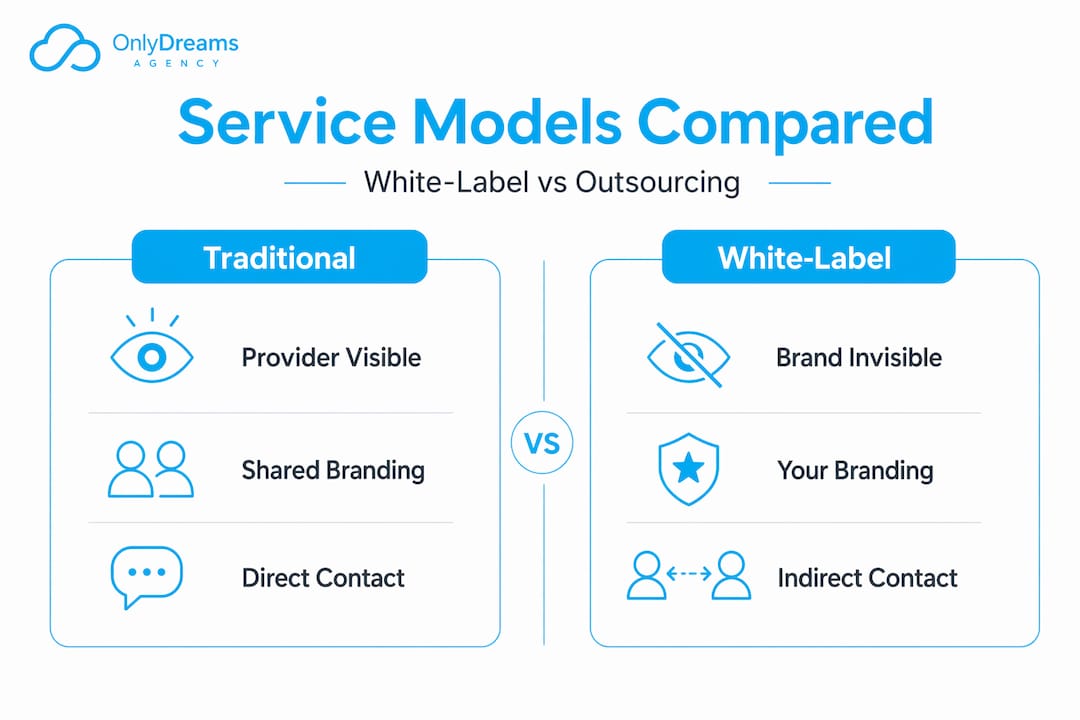
People confuse these two all the time, and the confusion is understandable. Both involve delegating work to an outside party. The difference is in who controls the client experience and how the work is presented.
| Factor | Traditional outsourcing | White-label services |
|---|---|---|
| Brand on deliverables | Provider’s or generic | Your brand only |
| Client communication | Sometimes shared or provider-led | Always reseller-led |
| Provider visibility | Often visible to client | Fully invisible |
| Client relationship ownership | Split or ambiguous | Reseller owns it completely |
| Quality accountability | Shared | Reseller accountable |
With traditional outsourcing, it is common for a client to receive an email from the freelancer you hired, or to see a watermark on a report from the vendor. That is not white-label. Branding and client communications must be fully controlled by the reseller for a model to qualify as white-label.
Reseller models are also related but distinct. Some reseller arrangements involve selling another company’s product at a markup, but the product still carries the original company’s name. White-label removes that entirely. You are not reselling someone else’s brand. You are delivering under your own.
The essential differentiator between white-label and outsourcing is control and invisibility in the client experience, not just the delegation of work. That distinction is what makes white-label valuable at scale.
Pro Tip: Always include a confidentiality clause in your white-label partner contracts that explicitly prohibits the provider from contacting your clients directly or placing their branding anywhere on deliverables.
This is where the model gets genuinely compelling for businesses and entrepreneurs. The advantages of white-label marketing go beyond simple cost savings.
Cost efficiency without sacrificing quality. Building an in-house team for SEO, paid media, and content creation is expensive. Salaries, benefits, software licenses, and training add up fast. White-label partnerships reduce delivery costs by 30% to 70% compared to in-house equivalents for specialist services. You replace fixed overhead with variable fulfillment that scales with client volume.

Access to expertise you do not have internally. White-label service providers are specialists. They run SEO campaigns or paid media accounts all day, every day. You get that depth of knowledge without hiring a specialist full-time or spending months training someone.
The core benefits of white-label agencies include:
One often overlooked advantage: white-label partnerships allow agencies to shift from fixed internal teams to scalable external expert resources without disrupting client relationships. That kind of flexibility is hard to achieve any other way.
Knowing the model is one thing. Running it well is another. Here is how to set it up so it actually works for your clients and your business.
Vet your white-label partners carefully. Look for providers with documented case studies, transparent pricing, and a clear process for removing their branding. Ask how they handle revisions, what their turnaround times are, and whether they have experience with your specific client type.
Own the client relationship completely. You are the only point of contact your client should ever have. White-label partners must avoid direct client contact and any branding on deliverables. Set this expectation in writing before the engagement starts.
Scope the work before passing it on. Do not pass vague briefs to your provider and expect great output. Write detailed scopes that include goals, audience, tone, deadlines, and approval stages. Weak scoping is the most common reason white-label quality fails.
Build a quality assurance process. Every deliverable should go through your review before it reaches the client. Check for provider branding, factual accuracy, brand voice consistency, and formatting. The reseller must manage scoping, QA, and client communications because they own the client experience.
Use white-label platforms for reporting. Some white-label SEO and marketing platforms let you provide clients with dashboards and reports fully branded with your agency’s logo. More than 2,000 agencies use such platforms to deliver branded workflows and reporting, hiding the vendor completely.
Set clear delivery standards upfront. Define what “done” looks like before work starts. Include file formats, word counts, review rounds, and sign-off requirements. Do not leave this to interpretation.
Pro Tip: Run a pilot project with any new white-label partner before committing to a long-term contract. Evaluate quality, communication speed, and branding compliance before scaling the relationship.
White-label solutions for businesses show up in more contexts than most people realize. Here are practical scenarios where the model delivers real results.
Digital marketing agencies expanding their service menu. An agency specializing in paid ads starts getting asked about SEO. Rather than turn away revenue or hire an SEO team, they bring in a white-label SEO provider. Reports go out under the agency’s brand. The client never sees a seam.
Entrepreneurs launching agencies without specialists. A solo consultant building a full-service agency can offer web design, content, and social media from day one by partnering with white-label providers in each area. The business appears full-service immediately.
Software agencies using white-label reporting tools. Instead of building custom reporting infrastructure, a digital agency uses a white-label SEO platform that generates branded dashboards and monthly reports. The client sees polished data with the agency’s logo on it.
Here is a quick look at how common white-label service categories perform for agencies:
| Service category | Typical cost savings vs. in-house | Time to deploy |
|---|---|---|
| SEO | 40%–60% | 1–2 weeks |
| PPC management | 30%–50% | 3–5 days |
| Social media management | 35%–55% | 1 week |
| Content writing | 50%–70% | 2–5 days |
White labeling is fundamentally B2B: one company produces, another brands as its own. This structure helps agencies expand quickly while keeping full brand control over every client interaction. The creator management strategies that work in the content space follow the same logic: someone handles execution behind the scenes while you own the brand experience your audience sees.
I have watched a lot of agencies jump into white-label partnerships with big expectations and walk away frustrated. Most of the time, the problem was not the provider. It was the agency’s assumption that delegating execution also means delegating accountability. It does not.
In my experience, the agencies that make white-label work treat their providers like internal teams, not vendors. They write real briefs. They do real QA. They communicate regularly. The ones that treat it as a set-and-forget solution end up with deliverables that embarrass them in front of clients.
The other misconception I see constantly: people think white-label is only for agencies that cannot afford to hire. That is wrong. Some of the most sophisticated marketing operations I have seen use white-label providers not because they lack resources, but because they recognize that specialists will always out-perform generalists in narrow disciplines. Paying a white-label link-building team to build links will almost always produce better results than asking your in-house social media person to figure out outreach.
White-label is also not a shortcut to scale. It is a tool for scale, and tools require skill to use well. If your processes, communication, and quality standards are weak, white-label will amplify those weaknesses, not hide them. Get those fundamentals solid first, then bring in white-label partners to extend your capacity.
The agencies and entrepreneurs I have seen succeed with this model share one trait: they take full ownership of the client experience, regardless of who is doing the work behind the scenes. That mindset is what separates white-label done right from white-label done badly.
— Gjon
If you are building out a content-driven brand or agency and looking for expert execution behind the scenes, Only-dreams operates on exactly that principle. We handle the operational layer so your brand stays front and center.
Only-dreams specializes in account management, fan engagement, and social media marketing for content creators who want professional results without managing every moving part themselves. From 24/7 chat management to data-driven growth across Instagram and TikTok, we work invisibly in the background so your audience only ever sees you. If you want to understand how a white-label approach to creator management could work for your business, explore our services and get in touch with our team.
White-label agency services are work delivered by one company but branded and presented by another as their own. The provider stays invisible while the reseller owns the client relationship and all deliverables.
With outsourcing, the provider may be visible to the client and share the relationship. With white-label services, the provider is completely invisible and the reseller controls all client communication and branding.
The most common white-label marketing services include SEO, PPC management, social media management, content writing, and web design. All are delivered under the reseller’s brand with no provider branding visible.
Look for providers with documented case studies, clear pricing, fast turnaround, and a strict policy against client contact. Always run a paid pilot project before committing to a longer engagement.
Yes. White-label solutions for businesses of any size reduce delivery costs significantly, provide access to specialists, and allow you to offer a broader range of services without building full-time teams.