Outsourcing chat management is the fastest, most cost-effective way for creators and small businesses to protect response times, capture revenue, and scale without burning out. CRM integration problems are responsible for about 52% of failed outsourcing contracts—the single largest cause of outsourcing failure. This means setup discipline matters as much as the decision to outsource. Industry benchmarks recommend a First Response Time (FRT) under 30 seconds as the baseline for professional chat. And for creators ready to hand off operations, Only-dreams is a purpose-built option.
Three reasons the verdict holds:
Outsourced live chat reduces wait times and stabilizes coverage during spikes without locking you into fixed payroll costs. That operational flexibility is the primary reason creators and small businesses make the switch.
The revenue angle is concrete. Visitors who engage with live chat convert at several times the rate of those who don’t. Every minute of wait time after a chat opens reduces the probability of conversion, which means slow responses aren’t just frustrating — they’re expensive.
Cost shape matters too. Outsourcing converts unpredictable staffing costs into a predictable operating expense, whether that’s a retainer or a revenue-share arrangement. You skip the recruiting, onboarding, and turnover cycle entirely.
Additional benefits that compound over time:
A mature provider also brings workforce management and QA frameworks that most internal teams take years to build on their own.
Use this checklist to self-assess. If two or more apply, outsourcing is the right next step.
Not ready for a full handoff? Start with overflow or after-hours coverage. That model supplements your existing team during peaks and nights without requiring you to relinquish daytime control. It’s a low-risk first step that still closes the most damaging coverage gaps.
Poor CRM integration is the single largest cause of outsourcing failure. Agents without access to subscription status, order history, or prior tickets can’t resolve issues at first contact, and customers feel it immediately.
The other common failure modes:
Pro Tip: Keep internal ownership of goals, escalation authority, and QA standards. Let the vendor own execution, training, and reporting. That split is what separates successful programs from ones that quietly underdeliver.
Dedicated team: Agents work exclusively on your account, building deep product knowledge and brand alignment. Best for high-volume creators where consistency and conversion quality are non-negotiable.

Shared agents: Agents rotate across multiple clients. Cost-efficient for straightforward, lower-volume queues where standardized responses cover most cases.
Hybrid/AI-assisted: Human agents combine with AI tools for routing and knowledge-surfacing while preserving human judgment for complex or high-value conversations. Good for creators who want efficiency without losing the personal touch.
Overflow/after-hours: Supplements your existing team during peaks, nights, and weekends. The lowest-commitment entry point.
On pricing, three structures dominate:
For location, nearshore teams often suit U.S. creators needing bilingual support because of time-zone overlap and language depth. Offshore works for low-complexity after-hours coverage where cost is the priority.
Before any agent goes live, confirm access to: CRM records, subscription and payment status, prior ticket history, and your knowledge base. Without these, first-contact resolution rates drop and escalations spike.
| KPI | Target | Why it matters |
|---|---|---|
| First Response Time (FRT) | Under 30 seconds | Sub-30s FRT correlates with the highest conversion rates |
| Average Handle Time (AHT) | 6–10 minutes | Efficiency without sacrificing resolution quality |
| CSAT | 85%+ | Baseline for professional chat programs |
| Containment rate | Track weekly | Shows how often agents resolve without escalation |
| Conversion per chat | Set per campaign | Ties chat directly to revenue outcomes |
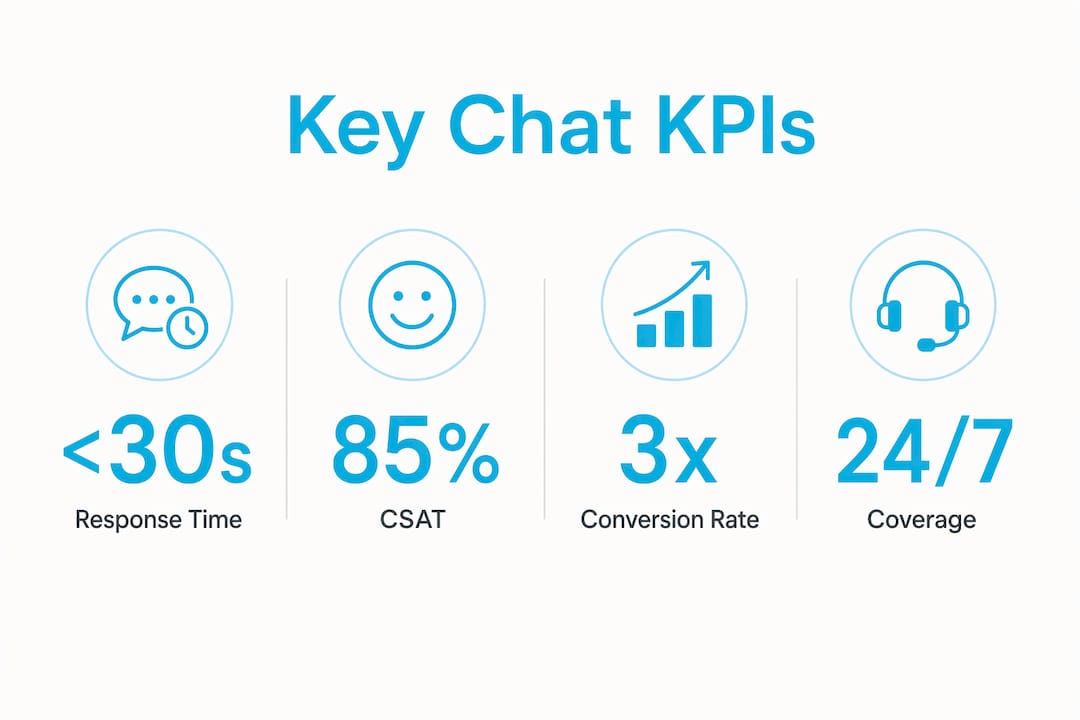
Reporting needs: real-time dashboards for queue health, weekly scheduled reports on volume and CSAT, and transcript access for QA sampling. Require at least monthly business reviews with your vendor.
Days 1–30: Setup and onboarding
Days 31–60: Calibration
Days 61–90: Go-live and optimization
For your scope document, include at minimum: coverage windows, escalation triggers, billing and refund authority limits, prohibited topics, and the name of the internal escalation owner.
A creator earning mid-five figures monthly was personally handling all fan messages, averaging a 4-minute first response during peak hours and losing conversion opportunities overnight when no one was available. After onboarding a dedicated chat team with CRM access and a documented tone guide, first response time dropped to under 30 seconds. The creator reclaimed roughly 15 hours per week previously spent on chat.
Three lessons to apply to your own setup:
U.S. creators handling fan data through outsourced chat teams must address privacy obligations before go-live. Require your vendor to implement access control and least-privilege policies so agents see only the data their role requires. Data retention and deletion policies should align with your platform’s terms and any applicable state privacy laws, including the California Consumer Privacy Act (CCPA) for California-based subscribers.
For creators on platforms that process payment data, confirm your vendor’s PCI DSS compliance posture. Single sign-on with audit trails keeps your IT controls intact while the vendor operates within defined security boundaries. Never grant shared login credentials to an outsourced team.
Outsourcing chat introduces contract and labor law considerations beyond privacy. Your agreement with a vendor should define: scope of work, SLA metrics and remedies for breach, data ownership, confidentiality obligations, and termination terms. U.S.-based vendors are subject to federal and state employment law, but if you use offshore or nearshore providers, confirm their workers are classified correctly under their local jurisdiction.
Intellectual property clauses matter for creators. Confirm that conversation transcripts, fan data, and any content shared in chat remain your property. Include a non-solicitation clause if your vendor has access to your subscriber list. For any creator in a regulated category (health, financial advice, adult content), define explicitly what agents are and are not permitted to say.
Start with these questions in your first call with any vendor:
Red flags to watch for: vendors who can’t share performance data from existing clients, contracts with no SLA remedies, onboarding timelines under two weeks (too fast to build real brand knowledge), and providers who push you to replace your existing tech stack rather than integrate with it.
Reviewing agency vs. self-managed options side by side helps clarify which trade-offs matter most for your specific volume and revenue goals.
Cost drivers for outsourced chat include: chat volume and variability, hours of operation, workflow complexity, language requirements, and integration depth. A simple overflow program covering after-hours for a single-language creator costs significantly less than a 24/7 dedicated team with multilingual support and custom CRM integration.
Pricing structures in practice:
Always request a cost breakdown that separates agent labor, management overhead, technology fees, and any setup or onboarding charges. Hidden setup costs are common and worth negotiating before signing.
Set your baseline before the vendor goes live: current FRT, CSAT, conversion per chat, and hours you spend on chat weekly. After 30 days, compare each metric against baseline and calculate the revenue delta from improved conversion.
A simple ROI frame: (incremental revenue from improved conversion + creator time value recovered) minus monthly vendor cost. If the program is working, the math is positive within 60 days. If it’s not, the QA data will show you exactly where the gap is — tone mismatch, integration failure, or coverage gaps.
For professional chatters specifically, track subscription retention and pay-per-view conversion as separate line items. Those are the revenue levers most directly affected by chat quality.
Outsourcing chat management works when you pair a capable vendor with strong internal governance — scope, tone guides, CRM access, and QA from day one.
| Point | Details |
|---|---|
| CRM integration is the make-or-break factor | Poor CRM access is responsible for about 52% of failed outsourcing contracts; confirm data access before signing. |
| FRT under 30 seconds is the professional standard | Sub-30s first response correlates with the highest conversion rates across chat programs. |
| Start with overflow if you’re not ready for full handoff | After-hours and overflow coverage closes the most damaging gaps at the lowest commitment level. |
| Track conversion per chat from week one | It’s the clearest early signal of whether the program is generating positive ROI. |
| Only-dreams offers dedicated chat teams for creators | Purpose-built for OnlyFans and content creators, with revenue-focused workflows and 24/7 coverage. |
Most creators I talk to underestimate how much revenue is sitting in their unanswered chats. They think of chat as a support function — something to handle when there’s time. The reality is that chat is a sales channel, and every hour it goes unmanaged is an hour of active revenue leakage.
The conventional wisdom says outsourcing is for big businesses with complex support queues. That’s wrong for creators. The creator economy runs on personal connection, and a trained chat team with a good tone guide can maintain that connection at scale — often better than a creator who’s exhausted and answering messages at midnight. The key is treating it as an operating model: you own the goals and the brand standards, the vendor executes. That split is what makes the difference between a program that pays for itself and one that quietly disappoints.
If you’re earning $3k or more per month and losing hours to fan messages, Only-dreams offers a direct path to reclaiming that time without sacrificing revenue. The agency provides dedicated chat teams trained on creator-specific revenue workflows — fan relationship building, pay-per-view conversion, and subscription retention — not generic customer service scripts.
Onboarding runs on a structured 30-day timeline: system access and tone guide delivery in week one, supervised chats and QA calibration in weeks two and three, and full coverage by day 30. Optional AI-enhanced marketing is available as an add-on for creators who want to extend reach on Instagram, TikTok, and Threads without adding to their own workload.
Ready to hand off chat and focus on creating? Learn how Only-dreams works and get started with a consultation today.