
TL;DR:
- Successful subscription growth depends on maintaining low churn and using referral channels.
- Building a strong onboarding, save flows, and offering annual plans increases lifetime value and stability.
Subscription growth is defined as the measurable increase in paying subscribers, recurring revenue, and subscriber lifetime value over time. For content creators and digital entrepreneurs, mastering this process is the difference between unpredictable income and a reliable revenue engine. This guide to subscription growth covers the metrics, pricing models, acquisition channels, and retention tactics that actually move the needle. Tools like Recharge and Bold Subscriptions help operators manage the mechanics, but the strategy behind them determines results. Get the strategy right, and your creator monetization model compounds month after month.
Subscriber growth rate is a leading indicator of revenue health, and it must be tracked separately from average revenue per user (ARPU). A rising ARPU can mask a shrinking subscriber base, which means you could be losing customers while your revenue chart looks flat. Subscriber count reveals foundational growth that price changes cannot fake.
The six metrics every creator and entrepreneur must track are:
The LTV:CAC ratio is the unit economics test that separates sustainable businesses from ones burning cash. A ratio below 3:1 signals you are spending too much to acquire subscribers who do not stay long enough to generate profit.
Pro Tip: Track churn by cohort, not just as a blended average. A cohort that churns at 8% in month one but stabilizes at 2% by month three tells a very different story than your overall churn number.
Email and subscription lists decay 22–30% yearly due to address abandonment and ISP changes. Flat list size often means you are replacing churn, not growing. That distinction matters when you are reading your own dashboards.
Tiered pricing aligned with customer value perception reduces churn and pricing objections. Misaligned pricing, where subscribers feel they are paying more than the value they receive, is one of the fastest routes to cancellation.

The five core subscription model types each serve a different audience:
| Model | Best For | Key Advantage |
|---|---|---|
| Replenishment | Physical consumables | Predictable reorder cycle |
| Curation | Discovery products, content boxes | High perceived value |
| Access-based | Courses, communities, creator content | Scales without inventory |
| Usage-based | Software, API tools | Aligns cost with consumption |
| Hybrid | Bundled digital and physical | Maximizes ARPU |
For content creators, access-based and hybrid models deliver the strongest results because they scale without adding fulfillment costs. A creator charging $9.99 per month for exclusive content can serve 10,000 subscribers with the same infrastructure as 100.
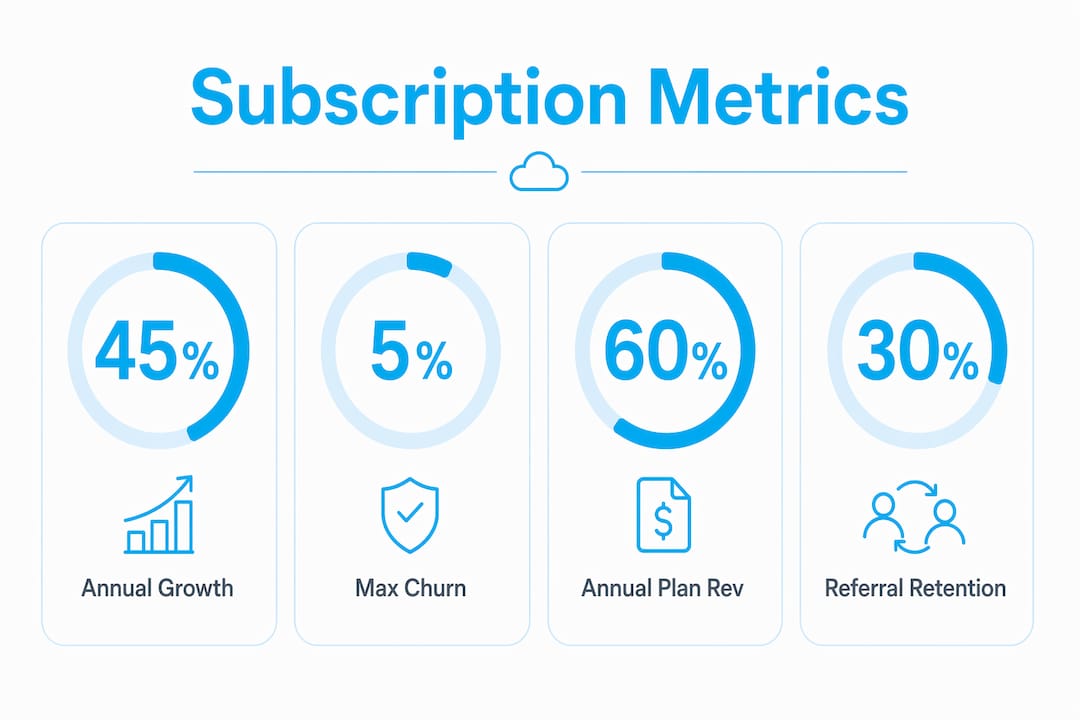
Annual plans are one of the most underused levers in subscription pricing. Annual plans deliver 50–60% higher revenue per user than monthly plans. That uplift comes from both the upfront cash and the dramatically lower churn, since a subscriber who pays annually has 12 months to find value before their next decision point.
Subscription flexibility controls also reduce cancellations before they happen. Giving subscribers the ability to skip a month, pause their account, swap their tier, or change delivery frequency removes the “cancel or stay” binary. When cancellation is the only option, more people cancel.
Pro Tip: Test an annual plan discount of 15–20% against your monthly price. Most subscribers who switch to annual will not switch back, and your churn rate on that cohort drops close to zero.
Referral programs are the most cost-efficient acquisition channel at scale. Referred subscribers have 20–30% lower CAC and churn 15–25% less than subscribers acquired through paid media. Lower CAC combined with lower churn means every referred subscriber is worth significantly more to your business over time.
The acquisition strategies that consistently outperform paid media alone are:
Referral and community channels become the primary acquisition engine when scaling above $40M in subscription revenue. Paid media alone cannot sustain growth at that level without unit economics collapsing.
Paid media still has a role, especially for top-of-funnel awareness. But treating it as your only acquisition channel creates a dependency that gets more expensive every year as ad costs rise.
Retention is where subscription businesses are won or lost. Acquiring a new subscriber costs five to seven times more than keeping an existing one, which means every cancellation you prevent is direct profit.
Save flows are the most effective retention tool available. Save flows convert 35–45% of would-be cancelers through options like skip, pause, swap, and frequency change. Discounts should be the last option offered, not the first. A subscriber who pauses for one month is far more valuable than one who cancels after receiving a discount they will expect every time.
The proven retention sequence works like this:
Pro Tip: Build your save flow in this exact order: skip, pause, swap tier, change frequency, then discount as a last resort. Offer each discount only once per subscriber lifetime to protect your pricing integrity.
Monthly churn must stay below 5% for at least three months before you scale marketing spend aggressively. Scaling acquisition into a leaky retention model accelerates losses, not growth. Fix the floor before you raise the ceiling.
Strong retention also compounds your creator retention strategy over time. Subscribers who stay longer refer more, spend more on upsells, and cost less to serve.
Sustainable subscription growth requires stable retention below 5% monthly churn before scaling acquisition, annual pricing to maximize LTV, and referral channels to reduce CAC.
| Point | Details |
|---|---|
| Track subscriber growth separately | Subscriber count reveals real growth that ARPU changes can mask. |
| Annual plans lift revenue significantly | Annual subscribers generate 50–60% more revenue per user than monthly subscribers. |
| Referral channels lower acquisition cost | Referred subscribers have 20–30% lower CAC and churn 15–25% less than paid-media subscribers. |
| Fix retention before scaling spend | Monthly churn must stay below 5% for three months before increasing acquisition budgets. |
| Save flows beat discounts | Offering skip, pause, and swap options converts 35–45% of would-be cancelers without eroding pricing. |
The most common mistake I see creators and entrepreneurs make is treating acquisition and retention as separate problems to solve in sequence. They spend months building a subscriber base, then panic when churn climbs, and only then start thinking about retention. By that point, they have already burned budget acquiring subscribers who were never going to stay.
The businesses that scale past $1M in recurring revenue almost always do the opposite. They obsess over the first 30 days of the subscriber experience before they run a single paid ad. They know their save flow conversion rate before they know their Facebook ROAS. That discipline is not natural for creators who are used to thinking about content and audience. It requires a shift toward thinking like an operator.
The other thing I have seen consistently is the undervaluation of organic channels. Paid media feels fast and measurable, so it gets the budget. But referral programs and community-led growth compound in ways that paid media never does. A referred subscriber who refers two more subscribers creates a growth loop. A paid subscriber who churns in month three creates a hole.
My honest advice: build your referral program before you need it. Set up your save flows before your churn climbs. And if your revenue stacking strategy is not yet diversified beyond one subscription tier, that is the first thing to fix.
— Gjon
Only-dreams works directly with established content creators to handle the operational side of subscription growth, from fan engagement and chat management to cross-platform marketing on Instagram and TikTok.
The Only-dreams team manages 24/7 chat operations, builds authentic fan relationships that convert to paid subscriptions, and runs data-driven campaigns designed to grow your subscriber count without adding to your workload. Creators who work with Only-dreams keep their focus on content while a dedicated team handles the revenue mechanics. If you are ready to scale your subscription earnings with professional support, visit Only-dreams to see how the agency works.
Subscriber growth is the net increase in paying subscribers over a defined period. It is tracked separately from revenue metrics because price changes can inflate revenue while the actual subscriber base shrinks.
Monthly churn must stay below 5% for at least three months before increasing acquisition spend. Build save flows with skip, pause, and swap options to convert would-be cancelers before they leave.
Annual plans deliver 50–60% higher revenue per user than monthly plans and dramatically reduce churn. Most subscribers who switch to annual do not switch back, making them the highest-LTV cohort in your business.
Referred subscribers have 20–30% lower CAC and churn 15–25% less than paid-media subscribers. Referral and community channels can generate 30–40% of new subscriber volume organically at scale.
Define your pricing tier, build a 72-hour onboarding sequence that delivers clear value, and set up a save flow before you run any paid acquisition. Getting those foundations in place first prevents the most expensive mistakes.