TL;DR:
- Creator portfolio management involves organizing and diversifying content, revenue streams, and audience segments to build resilience and sustainable growth. It applies investment principles like risk allocation and runway management to protect creators from platform or market shifts. Regular, data-driven rebalancing and strategic infrastructure support help creators maintain stability and reduce burnout.
Creator portfolio management is defined as the deliberate system of organizing and diversifying a creator’s content, accounts, and revenue streams to build sustainable growth and resilience against market volatility. The concept borrows directly from institutional investment principles: risk allocation, diversification, and runway management. These are not abstract finance ideas. They are practical tools that help you avoid the trap of depending on a single platform, a single sponsor, or a single viral moment. Whether you run one account or ten, portfolio management for creators is the framework that turns content creation from a hustle into a business.
Creator portfolio management applies institutional investment principles such as risk allocation, diversification, and runway management to creator businesses. That means you treat your content formats, revenue streams, and audience segments as assets with different risk and return profiles, just like a fund manager treats stocks and bonds.

The goal is not to maximize revenue from one source. The goal is resilience. Creators who balance high-variance and low-variance income streams absorb platform shifts and viral slumps far better than those who rely on a single channel. A sponsorship deal can disappear overnight. A membership subscription does not.
This framework also gives you a language for decision-making. Instead of asking “what should I post next?” you ask “which asset in my portfolio needs attention?” That shift in thinking is what separates creators who scale from creators who stall.
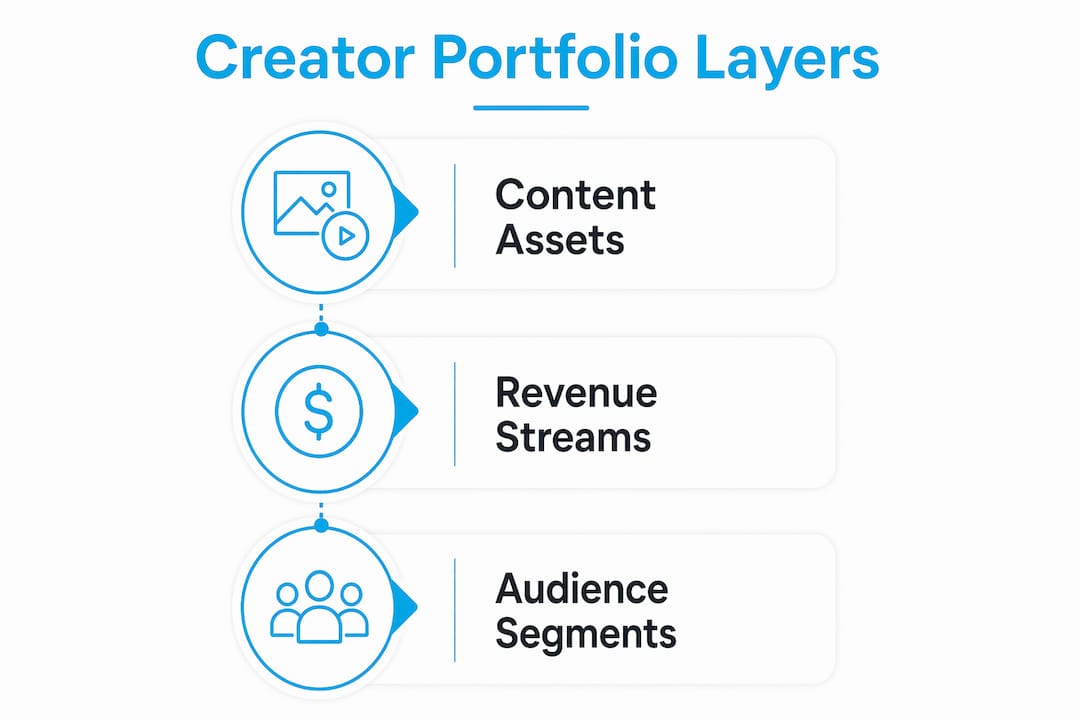
A well-structured creator portfolio has three layers: content assets, revenue streams, and audience segments. Each layer carries its own risk profile and requires its own allocation strategy.
Effective content portfolios allocate roughly 70% to proven, revenue-generating assets, 20% to optimized variations of those assets, and 10% to experimental projects. Quarterly review of this 70/20/10 split keeps your portfolio both reliable and adaptable. The 70% is your income engine. The 10% is your R&D lab.
A healthy revenue mix typically includes:
No single stream should dominate. Aim for no revenue source to exceed 40% of your total monthly income during early growth stages. That ceiling protects you when one stream underperforms.
Spreading your audience across platforms reduces your exposure to algorithm changes. A creator with 100,000 followers on one platform is more vulnerable than a creator with 40,000 followers across three platforms. Cross-platform presence also opens doors to platform-specific monetization tools.
| Asset type | Risk level | Role in portfolio |
|---|---|---|
| Subscription content | Low | Stable income base |
| Sponsorships | High | Growth and upside |
| Digital products | Moderate | Scalable passive income |
| Experimental formats | High | Innovation and future assets |
| Affiliate programs | Low to moderate | Compounding passive revenue |
Infrastructure is the force multiplier that lets a solo creator manage 5–10 accounts without burning out. Content batching combined with platform-specific automation turns manual post scheduling into efficient pipelines, separating creative work from distribution entirely.
The operational setup matters as much as the content itself. Here is a practical workflow for managing a multi-account portfolio:
Pro Tip: Treat your content calendar like a production schedule, not a to-do list. Block time for creation, editing, and review as separate tasks. Mixing them in the same session kills both quality and speed.
Infrastructure is not just about efficiency. It protects your creative energy. Creators who separate the creative phase from the distribution phase report fewer burnout episodes and higher content quality over time.
Financial runway is the number of months you can operate before running out of cash. Startup founders target 12–18 months of runway. Creators should target the same discipline. Plan for 6–12 months of operating expenses as a buffer when building new monetization streams.
Runway management for creators has two dimensions:
Protecting both types of runway requires discipline in how you allocate time and money. Key practices include:
Quarterly rebalancing separates lasting creator businesses from luck-dependent ones. The discipline is in reviewing your portfolio on a schedule, not in response to a bad month.
Pro Tip: Set a calendar reminder for the first week of every quarter. Review your top three revenue sources, your content performance by format, and your monthly cost base. Adjust allocations based on data, not on how you felt last week.
Avoid emotional rebalancing. Pulling resources from a format after two slow weeks is the creator equivalent of panic-selling stocks. Short-term volatility is normal. Structural underperformance is what requires a response.
Diversification is a risk management tool, not a growth strategy. The best approach to scaling is to concentrate first, then diversify after you have 3–5 consistent wins in a format. Scaling prematurely increases operational overhead without increasing resilience.
Charlie Munger’s principle applies directly here: focus on proven advantages rather than busy activity. Creators often confuse activity with advantage. Running five formats simultaneously without a repeatable demand signal in any of them is not a portfolio. It is scattered effort.
The sequencing that works looks like this:
| Approach | Advantage | Risk |
|---|---|---|
| Concentration | Deep expertise, faster growth in core asset | High exposure if core asset underperforms |
| Diversification | Resilience, multiple income sources | Diluted effort, slower growth per channel |
| Staged diversification | Balances both | Requires discipline and patience |
The best portfolio structure combines one stable base income channel, one growth channel, and one hedge for risk reduction. The mix you choose depends on your current stage, not on what works for creators at a different level than you.
Creator portfolio management is the most direct path from content creator to sustainable business owner, built on diversification, runway discipline, and data-driven rebalancing.
| Point | Details |
|---|---|
| Define assets clearly | Treat content formats and revenue streams as assets with distinct risk and return profiles. |
| Use the 70/20/10 split | Allocate 70% to proven content, 20% to variations, and 10% to experiments each quarter. |
| Cap any single revenue stream | No income source should exceed 40% of monthly revenue during early growth stages. |
| Build infrastructure first | Automate distribution before scaling accounts to protect creative energy and reduce burnout. |
| Rebalance on a schedule | Review your portfolio quarterly based on data, not in reaction to short-term performance dips. |
Most creators I talk to think diversification means doing more things. It does not. It means doing the right things in the right proportion at the right time. That distinction is where most people go wrong.
The creators who struggle are usually the ones who launched a podcast, a newsletter, a TikTok, and a merchandise store all in the same quarter. None of those channels had time to prove itself. None of them got the attention they needed. The result was mediocre performance across the board and a creator who was exhausted and confused about what was actually working.
The creators who build real businesses do the opposite. They find one format that converts, they build a system around it, and they protect it. Then they add one thing. Then they review. Then they add another. It is slower at first. It compounds faster later.
The other mistake I see constantly is reactive rebalancing. A creator has a slow month on subscriptions and immediately pivots to chasing sponsorships. That is panic, not strategy. A slow month is data. Three slow months in a row is a signal. Know the difference before you move resources.
Infrastructure is the piece most creators undervalue until they are already burned out. Separating creation from distribution is not a luxury for big creators. It is a basic operating requirement for anyone managing more than one account or more than two revenue streams. Build the systems early. They pay back every single week.
Portfolio thinking transforms content from a hobby into a business. It gives you a framework for decisions, a language for risk, and a structure for growth. That is not just reassuring. It is the foundation everything else is built on.
— Gjon
Growing a creator portfolio is one thing. Managing it without losing your mind is another. Only-dreams handles the operational side of your business so you can stay focused on creating.
Only-dreams provides dedicated account managers, trained chat teams, and data-driven marketing across Instagram, TikTok, and other platforms. The team manages fan engagement, subscription revenue, and cross-platform growth as a full-service operation. For creators ready to scale, Only-dreams also offers AI-enhanced marketing to extend reach without adding to your workload. If you want to see what professional creator management looks like in practice, or you are ready to grow your revenue with a team behind you, visit Only-dreams to learn more about what is possible.
Creator portfolio management is the practice of treating your content formats, revenue streams, and platforms as assets to be organized, balanced, and reviewed over time. The goal is sustainable income and resilience, not just short-term earnings.
Most creators benefit from three to five distinct revenue streams. No single stream should exceed 40% of monthly revenue during early growth stages, as concentration in one source increases risk significantly.
Diversify only after you have 3–5 consistent wins in your core format or platform. Launching multiple channels before validating demand in one dilutes your effort and slows overall growth.
Separating content creation from distribution through batching and scheduling tools lets you protect creative energy. Solo creators managing multiple accounts without automation face unsustainable workloads that lead directly to burnout.
Quarterly rebalancing is the standard for professional creator portfolio management. Reviewing your income mix and content performance every three months keeps decisions data-driven and avoids reactive changes based on short-term volatility.