
TL;DR:
- Data-driven marketing uses customer data and performance metrics to make campaign decisions. Agencies applying these practices see higher customer acquisition, better retention, and reduced wasted spend. It fosters stronger client partnerships by providing measurable results and evidence-based decision-making.
Data-driven marketing is defined as the practice of using customer data, behavioral signals, and performance metrics to guide every campaign decision. This is the core reason why agencies embrace data-driven marketing: it replaces guesswork with evidence, producing measurable results that gut-feel strategies simply cannot match. Agencies using tools like Adobe Analytics, Google Analytics, and Tableau now build campaigns around what customers actually do, not what marketers assume they want. The result is better budget allocation, faster optimization, and stronger client retention. At Only-dreams, we apply this same evidence-based thinking to creator marketing across Instagram, TikTok, and beyond.
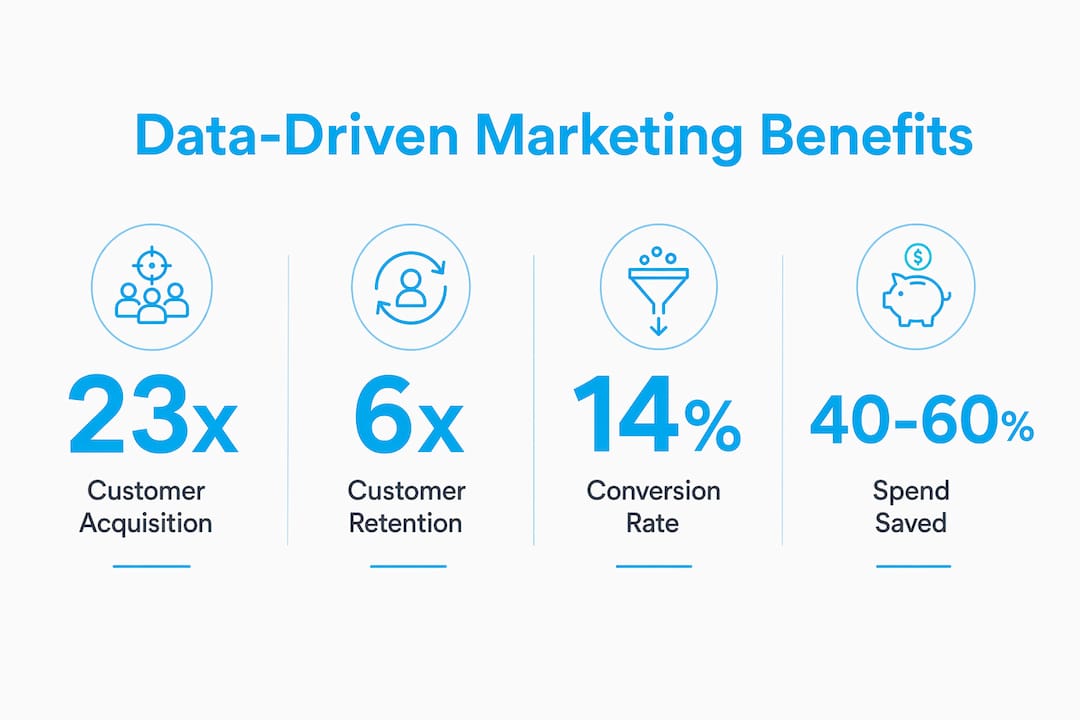
The business case for data-driven decision making is not theoretical. Organizations using data-driven marketing are 23 times more likely to acquire customers and 6 times more likely to retain them compared to agencies still running on instinct. Those numbers represent a structural advantage, not a marginal improvement.
Conversion rates follow the same pattern. Agencies applying measurement best practices see a 14% average observed conversion uplift. That uplift comes from connecting fragmented signals, such as email opens, paid clicks, and on-site behavior, into a single performance picture. You can read more about how connecting those signals produces real results in this guide on content optimization.
The cost savings are equally significant. Between 40% and 60% of marketing spend is wasted in agencies that lack evidence-based decision making. Eliminating that waste is often the fastest way to improve a client’s ROI without increasing their budget.
The key metrics agencies should prioritize include:
Pro Tip: Start with CAC and CLV together. If CLV is at least three times CAC, your acquisition model is healthy. If not, fix retention before scaling spend.
The difference between a data-driven agency and a traditional one is not just about the tools they use. It is about how decisions get made and who is accountable for outcomes.

Traditional agencies often operate in silos. Creative teams build campaigns. Media buyers place ads. Analytics teams report results. Nobody connects those three functions in real time. A data-driven agency breaks those silos down. Creative, media buying, and analytics work from the same dashboard, and every asset is tagged with metadata so performance can be tracked automatically. Tagging creative assets with metadata allows automated performance tracking and accelerates learning cycles across integrated teams.
The cultural shift is harder than the technical one. Fewer than 30% of enterprises successfully translate data insights into marketing action. The obstacle is rarely a lack of data. It is organizational resistance, misaligned incentives, and leadership that still rewards creative awards over conversion rates.
| Practice | Traditional agency | Data-driven agency |
|---|---|---|
| Decision basis | Creative intuition | Performance data |
| Team structure | Siloed by function | Integrated across disciplines |
| Budget allocation | Experience-based estimates | Attribution-backed evidence |
| Campaign iteration | End-of-campaign review | Real-time optimization |
| Client reporting | Vanity metrics | Revenue-linked KPIs |
| Success measure | Impressions, reach | Conversions, CLV, ROI |
Pro Tip: The biggest cultural barrier is the fear of being proven wrong by data. Address it directly in team meetings. Reward people for changing course based on evidence, not for defending original ideas.
A useful reference for agencies making this shift is the 2026 marketing checklist, which maps out the operational steps in practical terms.
Technology does not create a data-driven agency. It enables one, but only if the underlying processes are already in place. Success requires decision-making infrastructure, not just a subscription to the right software.
That said, the right technology stack makes a significant difference. Here is how a functional data-driven agency technology workflow operates:
Real-time dashboards are the connective tissue in this stack. They give every team member a shared view of what is working right now, not what worked last quarter.
The most underrated benefit of data-driven marketing is what it does to the client relationship. Agencies that can show exactly which campaign decisions drove which revenue outcomes stop being vendors. They become partners.
Data-driven agencies move marketing from a cost center to a revenue engine by making budget allocation defensible. When a client asks why you spent more on TikTok than Instagram, you can point to attribution data, not a hunch. That kind of accountability builds trust faster than any creative pitch.
The practical benefits for agencies that operate this way include:
83% of marketers identify timely translation of data into actionable insights as critical to success. Agencies that build this capability into their workflow do not just serve clients better. They become harder to replace. You can see how this plays out in practice through the lens of agency support for creators, where data-backed decisions directly increase earnings.
Agencies that adopt data-driven marketing gain a measurable structural advantage over traditional models, with higher acquisition rates, lower wasted spend, and stronger client retention.
| Point | Details |
|---|---|
| Acquisition and retention gains | Data-driven agencies are 23x more likely to acquire customers and 6x more likely to retain them. |
| Conversion uplift | Agencies using measurement best practices see a 14% average observed conversion lift. |
| Waste reduction | Between 40% and 60% of marketing spend is wasted without evidence-based decision making. |
| Cultural shift required | Fewer than 30% of enterprises translate data insights into action, making culture the real barrier. |
| Client relationship value | Data-backed reporting moves agencies from vendor status to strategic partner, justifying premium fees. |
Most agencies that fail at data-driven marketing do not fail because they lack data. They fail because they collect data and then do nothing with it. I call this “data wallpaper.” The dashboards look impressive in client presentations, but nobody on the team actually changes a decision based on what they show.
The agencies that get it right do one thing differently: they tie data to consequences. If a creative format underperforms for three consecutive weeks, it gets pulled. If a channel delivers a lower CAC than expected, budget moves there immediately. The data is not a report. It is a trigger.
The second mistake I see constantly is treating data-driven marketing as a technology purchase. A team buys Tableau or Adobe Analytics, sets up some dashboards, and calls itself data-driven. But the tools are only as useful as the culture around them. Leadership has to reward people for changing course based on evidence. If the incentive structure still favors the person who defends their original idea, no software will fix that.
The mindset shift that actually works is moving from counting clicks to measuring conversion quality. A campaign that drives 10,000 clicks but zero purchases is not a success. A campaign that drives 200 clicks and 40 purchases is. Agencies that internalize this distinction stop chasing vanity metrics and start building the kind of results that clients renew contracts for.
— Gjon
Only-dreams builds every creator campaign around performance data, not assumptions. Whether it is tracking which content formats drive the most subscription revenue or identifying the fan engagement patterns that predict long-term retention, the approach is the same: measure first, then act.
If you are an agency owner or marketing professional looking to apply these principles to your own client work, the Only-dreams team works directly with creators and agencies to build data-backed growth strategies across Instagram, TikTok, and other platforms. From content planning to fan engagement optimization, every service is tied to measurable outcomes. Visit Only-dreams to learn how a data-driven approach can change what your campaigns are capable of delivering.
Data-driven marketing is the practice of using customer data and performance metrics to guide campaign decisions. It replaces assumption-based planning with evidence from tools like Google Analytics, Adobe Analytics, and Tableau.
Data-driven agencies are 23 times more likely to acquire customers and 6 times more likely to retain them compared to agencies using traditional approaches. The performance gap is too large to ignore.
Between 40% and 60% of marketing spend is wasted in agencies without evidence-based decision making. Eliminating that waste is often faster than increasing a client’s budget.
The biggest barrier is cultural, not technical. Fewer than 30% of enterprises successfully translate data insights into marketing action, primarily because of organizational resistance and misaligned incentives.
It moves agencies from vendor status to strategic partner by making every budget decision defensible with attribution data. Clients who see measurable ROI stay longer and approve larger budgets.