TL;DR:
- Professional management enhances creators’ revenue by building strategic business infrastructure and optimizing engagement, content, and monetization.
- It involves measurable metrics like conversion rates, churn, and revenue per fan, instead of vanity metrics like followers and likes.
- Careful contract review ensures clear scope, data ownership, and legal protections, which are essential for sustained growth and compliance.
You’re earning $3k or more per month and you’ve worked hard to get there. But if you’re still measuring success by follower counts and likes, you’re leaving real money on the table. The creators who push past that ceiling aren’t just posting better content — they’re running their business with a professional team behind them. This guide breaks down exactly what professional management delivers, which metrics actually drive revenue, what your contract must protect, and how to tell a strong management partner from one that just talks a big game.
| Point | Details |
|---|---|
| Revenue-first management | Professional managers help creators shift from vanity metrics to strategies that drive actual earnings. |
| Full-funnel optimization | A good manager focuses on every handoff in your engagement and monetization pipeline, plugging revenue leaks. |
| Smart KPI tracking | Measuring the right metrics prevents wasted effort and ensures your growth translates to sustainable income. |
| Contract clarity is critical | Every management deal must spell out boundaries, scope, and compliance to protect your brand and income. |
Most creators start out handling everything themselves. Content creation, fan messages, scheduling, marketing — it’s a lot. And at early income levels, that DIY approach can work. But once you’re earning at scale, managing everything solo means you’re trading time for money in a way that caps your growth. Professional management changes that equation entirely.
So what does professional management actually include? It’s far more than someone answering your DMs or reposting your content on social media. The creator account management benefits at this level are operational and strategic. A real management team builds and runs the full business infrastructure behind your creator brand.
Here’s what professional management typically covers:
The difference between a professional manager and informal help is accountability to outcomes. Professional management for creators includes measurement and optimization of engagement beyond vanity metrics — comment rates, watch time, saves — all tied to conversion funnels that turn engagement into real revenue. Informal help rarely thinks in those terms.
Understanding what is creator management at this level is the first step toward making a smart decision about who handles your business.
“The best managers aren’t just reactive. They’re strategic operators who understand that every fan interaction is a data point in your revenue engine.”
Pro Tip: When evaluating a potential manager, skip asking about their follower count track record. Instead, ask specifically how they improve conversion rates and reduce churn. Those numbers reveal whether they’re focused on your income or just optics.
With this strategic context in mind, let’s examine how a professional manager touches every step of your business and where their expertise can unlock revenue that most creators miss.
A strong management framework treats your creator business as a complete pipeline — not a series of disconnected tasks. The RevOps methodology makes this clear: treat the system as end-to-end, moving from strategy through content to community operations, monetization, and retention, while identifying the “handoff leak points” where revenue drops between steps. Most solo creators lose money at those handoff points because no one is watching them closely enough.
Here’s how the end-to-end pipeline maps to real creator results:
| Pipeline stage | What solo creators often do | What professional management does |
|---|---|---|
| Strategy | Post based on trends or intuition | Data-driven content calendar tied to revenue goals |
| Content | Create and upload without testing | A/B test formats, lengths, and pricing for max conversion |
| Engagement | Respond to fans when time allows | 24/7 trained chat team building relationships and generating revenue |
| Monetization | Set a flat subscription price | Dynamic PPV, tiered pricing, timed offers based on fan behavior |
| Retention | Hope fans stay subscribed | Proactive win-back messages, loyalty rewards, and churn tracking |
The management best practices that separate top earners from the rest come down to how rigorously each stage is monitored and optimized.
Here’s how a professional manager tracks and improves each stage:
The role of professional chatters growing your creator revenue is especially powerful at the engagement and monetization stages, where genuine fan relationships directly translate into higher spend.
Pro Tip: During your first conversation with a prospective management team, ask them to walk you through their pipeline framework and specifically name the leak points they would look for in your current setup. If they can’t answer that clearly, they’re not operating at the level you need.
To understand if your management is actually moving the needle, we need to get specific about which metrics actually matter — and which are distractions.
Likes and follower count feel good to watch grow. But they don’t pay your bills. The creators who scale reliably are obsessed with a different set of numbers. Mis-measurement is a real risk in creator management — over-optimizing for visible metrics instead of revenue-impact metrics is one of the most common ways professional management underdelivers despite good intentions.
The metrics your manager should be tracking and reporting every month:
Compare these against the vanity metrics that too many managers still prioritize:
| Vanity metric | Why it’s misleading | Revenue metric to use instead |
|---|---|---|
| Total followers | Doesn’t measure paying intent | Subscriber conversion rate |
| Post likes | Engagement can be passive | Comment-to-purchase conversion |
| Profile views | Views don’t pay | Cost per acquisition |
| Total subscribers | Doesn’t account for churn | Net subscriber growth |
| Reach/impressions | Broad awareness without intent | Revenue per 1,000 impressions |
The right approach to maximizing creator monetization is funnel-based measurement. As the Adobe Business Blog confirms, engagement metrics like comments, saves, and watch completion should be connected to downstream conversion and repeat purchase behavior — not treated as end goals in themselves.
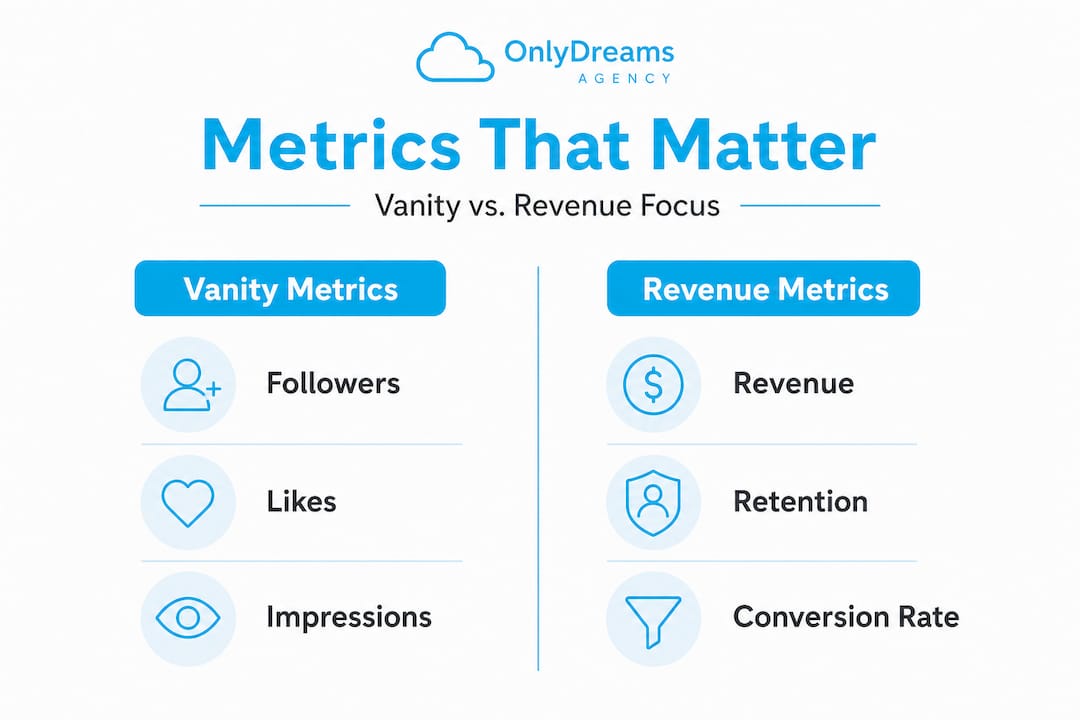
Boosting creator growth sustainably means your management team is building toward numbers that compound over time. Revenue per subscriber and resubscription rate are the clearest indicators of long-term business health.
A useful benchmark: when creators shift from tracking vanity metrics to revenue-based KPIs, most identify at least two or three specific areas where they were over-investing effort for poor return. That reallocation alone often produces meaningful revenue gains within 60 to 90 days.
After metrics and operations, your most important safeguard is a contract that supports — and does not sabotage — your growth.

A lot of creators skip the legal details when they’re excited about a new management partnership. That’s an expensive mistake. Your contract is the document that determines what your manager can and can’t do, who controls your account data, how you get paid, and what happens if things go wrong.
First, understand the legal distinction between a manager and an agent. According to guidance on bulletproofing creator management contracts, a professional manager provides guidance, marketing, and brand development services. An agent, by contrast, books deals and negotiates contracts on your behalf — a role that typically requires licensing in many jurisdictions. When a manager crosses into agent territory without the appropriate legal standing, you’re both exposed to risk.
Your management contract must clearly cover these elements:
Platform-specific and territory ambiguity in contracts is a primary driver of payout freezes and legal disputes between creators and their managers. Vague clauses feel harmless at signing but become critical when something goes wrong.
“Ambiguous service scope is the number one contract issue we see when creators come to us after a bad management experience. Always define what ‘management’ actually means in writing, down to the platform level.”
Review your account management for higher earnings setup with this contract lens. The best management relationships are the ones where both parties know exactly what success looks like, how it’s measured, and what protections are in place when the business hits a rough patch.
Here’s where we step back from the frameworks and get honest. After working with established creators who earn at real scale, the pattern we see most often isn’t a lack of knowledge. It’s a reluctance to ask hard questions before signing anything.
Many creators are drawn to managers who promise fast follower growth or dramatic engagement spikes in the first 30 days. Those promises are easy to make and nearly impossible to connect to actual income. The managers worth working with are the ones who ask you uncomfortable questions first — about your churn rate, your content backlog, your pricing history — because they’re diagnosing before prescribing.
What separates a strong management partner from a flashy one is transparency on three specific things. First, they should be able to show you exactly where your current revenue is leaking and explain precisely how they’ll fix it. Second, they should be clear about what happens to your business if the platform changes its algorithm or terms of service. Automation for creator management is part of the answer here — smart systems reduce your exposure to single points of failure.
Third, and most importantly, ask them about their own incentive structure. Are they paid on flat fee or revenue share? If they’re on revenue share, their interests align with yours. If they’re on flat fee with bonuses tied to follower count, you can see immediately where their attention will go.
Pro Tip: Vet every management candidate by asking three questions: How do you handle a platform policy change that affects my content? What data do I own and take with me if we part ways? What would you say is the biggest risk in my current setup? Their answers reveal their transparency, their expertise, and whether their priorities match yours.
The uncomfortable truth is that most management relationships that disappoint creators start with too much excitement and not enough due diligence. Treat this like any major business partnership — because it is one.
Having covered what to look for, it’s time to align your team and contract with a management group that puts your needs and revenue at the center.
At OnlyDreams Agency, we work specifically with established female creators in the US who are already earning and want to earn more — without burning out trying to do everything themselves. We provide dedicated account managers, 24/7 trained chat teams, and data-driven marketing across Instagram, TikTok, and beyond. Contract clarity, engagement optimization, and compliance support are built into how we operate, not afterthoughts.
If you’re ready to stop managing the operational side of your business alone and start scaling with a professional team that measures itself by your revenue growth, Only Dreams professional management is built for exactly where you are right now. Let’s talk about where your business can go.
A professional manager handles your engagement optimization, monetization funnel, and business operations — including metrics like watch time and conversion rates tied to revenue — so you can focus on creating content.
A manager guides your growth and brand development while an agent books deals and negotiates contracts. This distinction matters legally and for compliance, as explained in guidelines on creator management contracts.
Focus on conversion rate, retention, churn, and revenue per fan rather than likes and follower counts. MIT Sloan Management Review warns against fixating on visible metrics that don’t connect to actual income.
Your contract should explicitly define service scope, platform and territory boundaries, exclusivity terms, and compliance and data handling provisions. As research on creator legal standards confirms, ambiguous clauses are the leading cause of payout freezes and disputes.