
TL;DR:
- Most creators treat their fanbase as buyers rather than long-term relationships. Agencies focus on personalized engagement and data-driven strategies to generate predictable, recurring revenue. Building genuine, two-way connections with fans significantly boosts loyalty, monetization, and overall account growth.
Most creators treat their fanbase as a collection of buyers. Someone subscribes, unlocks a pay-per-view, maybe tips once, and then either stays or leaves. That’s the transactional mindset, and it caps your earning potential more than almost any other mistake you can make. Agencies that consistently scale creator revenue think differently. They see fans as long-term relationships that can be personalized, measured, and commercialized across every stage of a creator’s growth. The result is not just more revenue per fan, but more predictable, recurring income that compounds over time.
| Point | Details |
|---|---|
| Engagement builds loyalty | Prioritizing fan engagement turns fans into repeat supporters for predictable income. |
| Monetization improves | Fans who are engaged respond better to offers, leading to higher conversion and lower churn. |
| Authenticity is essential | Tech solutions alone are not enough—real relationship building drives long-term results. |
| Economic incentives drive strategy | Agencies invest in engagement because it directly increases spending and retention. |
The core difference between a solo creator and an agency-managed account is not content quality. It’s how each one thinks about the value of every fan interaction.
A transaction-focused creator asks: “How do I get this fan to buy something right now?” A relationship-focused agency asks: “How do we make this fan feel so valued that they keep coming back and spend more over six months?” That one shift changes everything from messaging scripts to content strategy to how you handle a fan who goes quiet for two weeks.
Agencies design systems specifically to support this relationship model. That means collecting first-party data (things like fan preferences, favorite content types, response patterns, and purchase history) and using it to personalize every touchpoint. When a fan reaches out, your chat team already knows what they’ve bought, what they respond to, and what offers are most relevant to them. That’s not magic. It’s structure. Start by understanding fan engagement as a strategic system rather than just a communication task.
“Engagement turns one-time consumption into durable fan relationships that can be personalized, measured, and commercialized over time.” That’s the foundation every successful agency builds on.
Here’s how the two approaches compare in practice:
| Strategy area | Transactional approach | Relationship-oriented agency approach |
|---|---|---|
| Fan messaging | Generic broadcast messages | Personalized outreach based on history |
| Upselling | Random PPV blasts | Timed offers based on fan engagement data |
| Churn handling | No re-engagement system | Automated win-back sequences with human follow-up |
| Data use | None or minimal | First-party data used for segmentation and targeting |
| Fan loyalty | Low, driven by novelty | High, driven by ongoing connection and recognition |
| Revenue predictability | Volatile | Stable and growing |
Agencies treat mastering fan relationships as an operational discipline, not just a creative one. Every interaction is logged, reviewed, and improved. That kind of structure turns engagement into a measurable business asset, not just a feel-good activity.
Key operational behaviors agencies use to shift from transactional to relational:
Now that you understand why agencies view engagement differently, let’s examine the specific revenue benefits of prioritizing fans.
The economic argument for fan engagement is straightforward. Fans who feel a real connection with a creator spend significantly more than passive subscribers who are just browsing. Fans spend 27% more on streaming and content services than non-fans do. That 27% is not trivial when you apply it to a subscriber base of even a few hundred paying members.
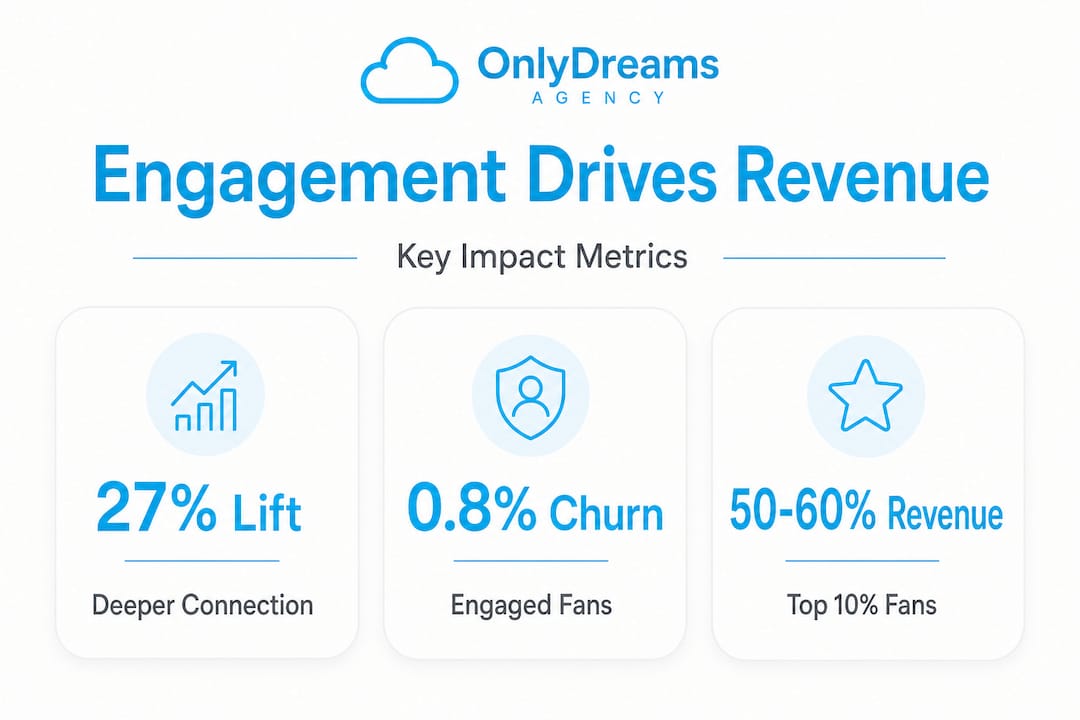
Consider what that looks like at scale. If your average subscriber currently spends $30 per month, a 27% lift from deeper engagement brings that to about $38. Across 500 engaged fans, that’s an extra $4,000 per month, every month, without adding a single new subscriber. Agencies understand this math well, which is why they allocate resources to chat management, fan relationship workflows, and personalized outreach rather than just marketing spend to acquire new fans.
| Fan type | Average monthly spend | Churn rate | 6-month lifetime value |
|---|---|---|---|
| Non-engaged subscriber | $22 | 18% monthly | ~$88 |
| Engaged fan | $38 | 5% monthly | ~$214 |
| Superfan (top 10%) | $95+ | 2% monthly | $550+ |
The difference in lifetime value is significant. A superfan over six months is worth more than six times a passive subscriber. That’s why streamlining your fan engagement workflow is not a luxury for established creators. It’s a financial priority.
Here are the primary revenue streams that agencies directly enhance through deeper engagement:
Pro Tip: Your top 10% of fans likely generate 50 to 60% of your total revenue. Identify them, treat them differently, and create exclusive touchpoints just for them. Every campaign you run will perform better when your superfans are activated first.
Engagement does not just keep fans subscribed longer. It directly improves how well your monetization efforts convert. And that’s where agencies earn a significant part of their value.
When a fan already trusts you, feels seen, and looks forward to hearing from you, they respond to offers in a completely different way. Sponsors and brands have started to recognize this too. Engaged audiences are more receptive to activations that feel like a natural extension of a creator’s content rather than an obvious ad. Sponsor activations must blend creativity, relevance, and scalability to deliver real commercial value in today’s competitive attention environment.

Natural vs. disruptive monetization: knowing the difference matters.
Natural monetization activations (high conversion):
Disruptive monetization activations (low conversion, high churn risk):
The data on native conversion paths is compelling. Creator-led engagement programs have shown churn rates of just 0.8% among engaged community members compared to 1.9% in non-engaged groups, and trial-to-paid conversion outperforming standard brand creative by 2.3 times. Those are agency-level results, achieved specifically because trust was built before the ask was made.
Pro Tip: The best chatting strategies for OnlyFans are not about pushing sales constantly. They’re about creating enough genuine connection that when you do make an offer, the fan is already primed to say yes.
A well-designed account management checklist always includes conversion triggers tied to engagement milestones, not just scheduled broadcasts. That’s how agencies consistently outperform solo creator averages on revenue per subscriber.
Not every agency gets this right. And many creators who decide to “focus on engagement” end up doing it in ways that actually hurt their results. The reason is simple: engagement can be faked on the surface while being completely hollow underneath.
The most common mistakes:
The hard truth about fan engagement is that technology can support it, but it cannot replace it. As some industry commentary has noted directly, executives often over-invest in software and instrumentation while neglecting the actual mechanics of listening, participation, and co-creation that make fans feel genuinely valued.
The agencies that get consistent results combine the right technology with real human interaction. Their chat teams are trained to listen actively, flag patterns in fan feedback, and report insights back to the creator and account manager. That feedback loop is what lets them continually improve the fan experience and keep engagement quality high over time.
When evaluating any agency, understanding red flags in agency operations is essential. Any agency that relies exclusively on automated messages and never involves you in strategy decisions is prioritizing their efficiency over your fan relationships. And learning what good agency support looks like helps you set the right expectations from day one.
Here’s the thing that separates good agencies from great ones: the best operators don’t just deliver engagement to fans. They invite fans into the process.
Most creators and agencies think about engagement as something they create and push out. “We’ll message fans more often.” “We’ll post better content.” “We’ll run a re-engagement campaign.” All of those are valuable tactics. But the creators with the most loyal, highest-spending fanbases don’t just deliver more. They give fans a role.
That means asking top fans for input on upcoming content ideas. It means running polls that genuinely influence what you create next. It means acknowledging a loyal fan publicly or privately in a way that makes them feel recognized, not just marketed to. It means treating your top-tier subscribers as collaborators, not just customers.
Real authority in this space comes from owning more of the fan value chain. Agencies that build listening loops, track fan-specific feedback, and create genuine co-creation moments are building something that no competitor can easily replicate: a fanbase that feels personally invested in a creator’s success.
Pro Tip: Identify your top five to ten most active fans this month. Send each one a personal message that references something specific they said or did. Then ask them a genuine question about the content they want to see next. That single practice, done consistently, does more for retention than any automation campaign.
The mistake most people make is treating engagement as a checkbox. You send the messages, you post on schedule, you tick the boxes, and you wonder why churn is still high. Real engagement is an evolving relationship, and like any relationship, it requires attention, adaptation, and genuine interest. Agencies that understand this, like what we apply through creator management best practices, are the ones that build accounts that grow year over year rather than plateau.
Applying agency-level engagement strategies on your own is possible, but scaling them while also creating content is where most creators hit a wall.
At OnlyDreams Agency, we work with established creators to build the fan engagement systems that drive consistent, growing revenue. Our trained chat teams manage authentic fan interactions 24/7, and our dedicated account managers ensure every campaign, offer, and conversation is optimized for conversion. We also bring data-driven social media strategy across Instagram, TikTok, and other platforms to expand your reach and attract higher-value subscribers. If you’re earning $3k or more per month and ready to scale without burning out, explore what working with OnlyDreams Agency looks like for your account.
Agencies track retention rates, fan lifetime value, and conversion rates on native offers to measure engagement ROI. As PwC notes, ROI measurement has shifted from static channels to dynamic audience engagement metrics that reflect real relationship depth.
Engaged fans feel a genuine connection with the creator, which builds loyalty and increases the frequency and size of purchases. Research shows fans spend 27% more on content services than non-fans, a difference that compounds significantly at scale.
A transactional strategy focuses on individual sales events, while an engagement strategy builds ongoing relationships that generate recurring revenue through retention, repeat purchases, and deeper loyalty. Turning one-time consumption into durable fan relationships is the defining goal of the engagement approach.
The best agencies balance technology with real human interaction, using software to support logistics while ensuring actual conversations, feedback loops, and co-creation remain human-driven. Over-investing in tech without genuine fan-centric strategy is one of the most common ways engagement efforts fail.