
TL;DR:
- Fan retention measures the percentage of fans who remain subscribed over time, influencing predictable revenue. Creators should track retention and churn using cohort analysis, distinguishing voluntary from involuntary loss to improve ongoing engagement. Building effective onboarding, payment recovery, and personalized communication systems is essential for sustainable growth and higher earnings.
Even the most successful content creators lose fans every single month, and the reasons are rarely what you’d expect. The assumption is that churn signals a content problem, but that’s only part of the story. Churn rate and retention rate are measurable, data-driven metrics that respond to your processes, systems, and communication strategies just as much as your actual content. If you’re earning $3k or more per month and want to push your revenue higher without burning out, understanding fan retention at a professional level is one of the smartest moves you can make. This article breaks it all down.
| Point | Details |
|---|---|
| Retention is measurable | Your fan retention rate shows exactly how well you’re keeping your audience. |
| Churn has many causes | Fans may leave due to both content preferences and technical/payment issues. |
| Cohort tracking reveals insights | Measuring retention by signup cohorts uncovers onboarding and engagement gaps. |
| Professional systems drive results | Automated billing, onboarding, and ongoing engagement boost revenue and loyalty. |
Fan retention is the percentage of fans who remain subscribed to your page over a defined time period. It’s a business metric, not a feeling. You can track it, benchmark it, and systematically improve it. That’s what separates creators who scale sustainably from those who run on a content treadmill forever.
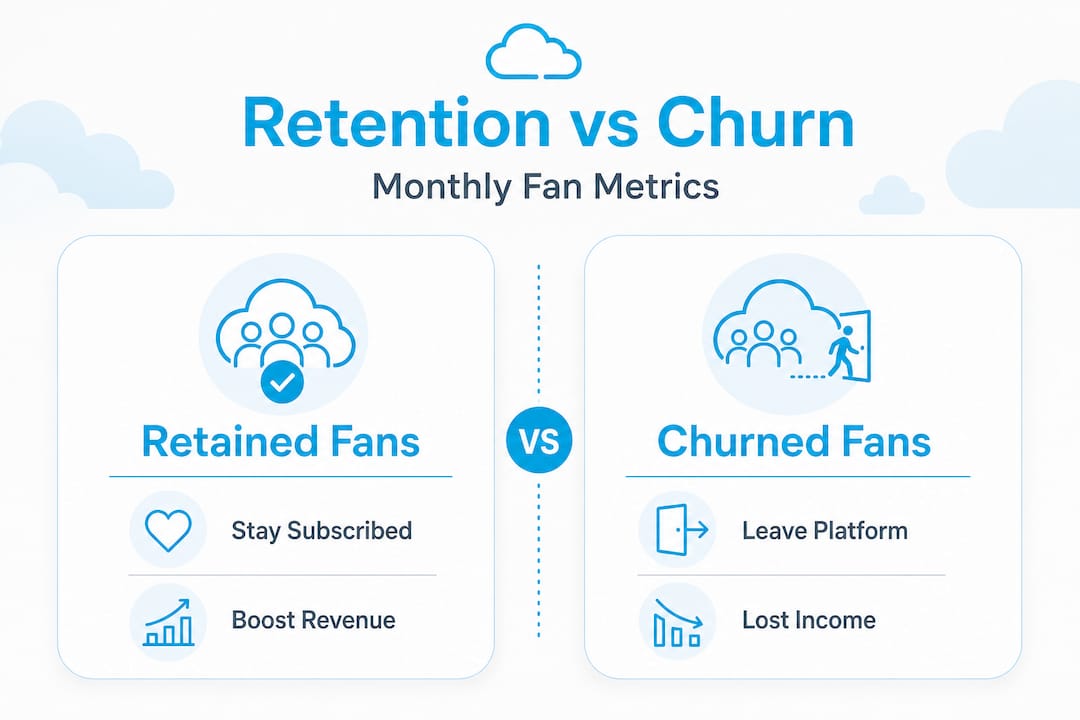
Here’s how fan retention and churn relate to each other:
“Retention is measured with metrics like churn rate and member/subscriber retention rate calculated over defined time windows.” — Tell-tale Signs of Member Churn
One of the most common misconceptions is that every fan who leaves is disappointed in you. That’s simply not accurate. Fans churn for dozens of reasons: financial changes, content overload, platform fatigue, payment failures, and even just forgetting they subscribed. Strong fan engagement practices address many of these root causes directly, but you need to know what you’re dealing with first.
For established creators, retention is also a revenue multiplier. Keeping one current fan is almost always cheaper than acquiring a brand new one. When your retention rate climbs, your revenue becomes more stable, more predictable, and easier to scale. Think about it this way: a creator with 500 fans and 85% monthly retention keeps 425 fans automatically, while a creator with the same count but 65% retention needs to replace 175 fans just to stay flat.
Understanding retention’s importance is one thing. Actually measuring it is where most creators fall behind. Let’s look at the formulas and time windows that professionals use.
The basic formulas:
These two numbers always add up to 100%. If your monthly retention rate is 78%, your monthly churn rate is 22%.
Recommended measurement windows:
According to cohort-based retention analysis, you should track retention in consistent time windows to spot patterns accurately.
| Window | What it tells you |
|---|---|
| Monthly (30 days) | Overall subscription health, month-over-month trend |
| 60-day retention | Whether fans who stayed past month one are engaged |
| 90-day retention | Long-term fan loyalty and content satisfaction |
| First-month cohort | Onboarding effectiveness for new subscribers |
Worked example:
Say you start January with 100 fans. By February 1st, 82 of those original fans are still subscribed. That means your January retention rate is 82% and your churn rate is 18%. Now run this same calculation for every month and compare the results. That trend line tells you far more than a single number.
Cohort analysis is the real power move here. Rather than measuring your entire fan base at once, you group fans by when they subscribed. Fans who joined in March get tracked as their own group. This approach, consistent with retention measurement best practices, helps you separate early onboarding problems from later engagement issues. If your 30-day retention is low but your 90-day retention is strong, the problem is likely your welcome experience, not your content.
Pro Tip: Always separate voluntary churn from involuntary churn in your tracking. Involuntary churn (failed payments, expired cards) is often fixable with automated tools and shouldn’t be lumped together with genuine unsubscribes. Review your account management checklist regularly to make sure billing and process issues aren’t quietly draining your numbers. For deeper insights into revenue structures, explore creator monetization strategies to see how retention fits into your bigger financial picture.
Once you know your numbers, it’s crucial to dig into the “why” behind your churn rates. Not all churn is created equal, and treating it all the same way leads to wasted effort and missed revenue recovery.
Voluntary churn happens when a fan actively chooses to leave. The main triggers include:
Involuntary churn is where a lot of creators leave money on the table without realizing it. This is churn that happens not because a fan chose to leave, but because of technical or billing issues. As retention optimization research shows, not all churn is voluntary user disappointment. Some churn is completely involuntary, driven by failed payments or card expiration, and it requires billing and payment “dunning” workflows alongside content and community fixes.
Involuntary churn can account for 20-40% of total subscriber losses in subscription-based businesses. That’s revenue you’re losing without anyone actively deciding to leave you.
Common pitfalls creators make:
Pro Tip: Set up an automated process to catch failed payments before they result in a full cancellation. Even a simple notification or retry sequence can recover a meaningful percentage of those subscribers. Streamlining your fan engagement workflow tips to include billing recovery checkpoints is a professional move that pays off fast.
With root causes in mind, let’s cover proven methods professional creators use to boost retention and revenue. These aren’t generic tips. They’re actionable systems that established creators can implement right now.
Top 5 retention strategies:
Build a structured onboarding flow. The first 7 days after someone subscribes are critical. Send a personalized welcome message, highlight your best content, and set clear expectations about your posting schedule. First impressions shape whether a fan becomes a loyal long-term subscriber or a quick churner.
Create anti-churn content cadences. Identify which types of content drive your highest retention and prioritize those. Exclusive content, behind-the-scenes material, and time-limited posts all create a reason to stay subscribed. Regularly review your content performance data to spot patterns.
Implement payment recovery workflows. This is non-negotiable for professional creators. Set up retry logic for failed payments and send friendly reminders to fans with expiring cards. As retention optimization requires, both dunning workflows and content fixes work together to reduce churn.
Invest in personalized fan engagement. Fans who receive direct, personal communication are significantly more likely to renew. This doesn’t mean you reply to every single message yourself. It means your chat strategy feels personal and genuine, not automated or generic. Strong chatting strategies for creators make a measurable difference in retention rates.
Review your retention data monthly and iterate. Retention improvement is a cycle, not a one-time fix. Set aside time each month to check your cohort metrics, identify your highest-churn period, and test one new strategy. Consistent review paired with action is what separates top earners from creators who plateau. Use insights from fan relationship strategies and creator management best practices to refine your approach over time.
Preventative vs. reactive retention strategies compared:
| Strategy type | Examples | When to use |
|---|---|---|
| Preventative | Onboarding flows, consistent content schedule, proactive communication | Ongoing, built into your workflow |
| Reactive | Win-back campaigns, payment recovery, re-engagement messages | After churn signals appear |
| Hybrid | Monthly data review, cohort tracking, A/B testing offers | Scheduled, combines both approaches |
Preventative strategies reduce churn before it happens. Reactive strategies recover fans or revenue after a problem occurs. The most effective creators use both, but they always prioritize preventative work because it’s cheaper and more efficient than trying to win fans back after they’ve already left.

A note on measurement cycles: Don’t wait until something feels wrong to check your numbers. Build retention reviews into your monthly business routine. Look at your 30-day cohort, check your involuntary churn percentage, and compare this month to the previous three. Spotting a trend early gives you time to respond before it becomes a revenue problem.
Here’s the perspective that most articles won’t tell you. Top earners don’t just create better content. They build better systems. And that distinction is everything when it comes to sustainable retention.
The creator who treats a retention dip as purely a content problem will keep chasing the perfect post, the perfect series, the perfect niche angle. But if the real issue is a broken onboarding message, a confusing payment recovery gap, or a chat experience that feels cold, then no amount of amazing content will fix the underlying leak.
Retention is a business system. It involves billing, communication, content delivery timing, fan psychology, and data review working together. When we work with established creators at OnlyDreams, one of the first things we examine isn’t what they’re posting. It’s what happens around the content. What does a new subscriber experience in their first week? What happens when a payment fails? How personal does the chat feel at scale?
Creators who think in systems instead of one-off solutions tend to outperform consistently. A creator with 70% content quality and 90% process quality will outperform a creator with 95% content quality and 50% process quality almost every single time. The systems compound. The content, as good as it is, can only do so much alone.
Investing in managing creator accounts with professional-level attention means treating your retention metrics the same way a SaaS company treats its churn dashboard. You check it, you act on it, and you build processes that make improvement repeatable, not random. That’s the mindset shift that separates creators earning $5k per month from those earning $30k per month.
Retention strategy works best when you have the right infrastructure behind it. Knowing the formulas and tactics is a strong start, but executing them consistently while still creating content is where things get complicated fast.
At Only Dreams, we help established creators build exactly that infrastructure. Our team handles fan engagement, chat management, and data-driven strategy so your retention numbers improve without adding more to your plate. From onboarding flows that hook new subscribers in their first week to payment recovery processes that quietly recapture lost revenue, we cover the operational side so you can focus on your content. If you’re ready to turn your retention metrics into a real competitive advantage, we’re ready to help you get there.
Fan retention measures how many fans stay subscribed over a defined period, while engagement tracks how actively fans interact with your content through messages, likes, and purchases. A fan can be subscribed but not engaged, so both metrics matter for a complete picture of audience health.
A good retention rate varies by niche and platform, but many successful creators aim to retain over 70% of fans month-to-month. Consistently hitting above 80% puts you in a strong position for predictable revenue growth.
Review your payment data regularly for failed transactions or expired cards, as these are direct signals of involuntary churn. Most platforms provide this data in your analytics dashboard, and setting up payment retry notifications can help recover a portion of these subscribers automatically.
Absolutely. Cohort-based tracking consistently shows that early retention is shaped by the onboarding experience, and fixing it improves overall retention numbers more efficiently than other interventions. A strong first week sets the tone for long-term fan loyalty.