
TL;DR:
- Reducing subscription churn depends on fixing payment failures and improving engagement strategies.
- Implementing automated payment retries, annual plans, and milestone rewards significantly increases retention.
Subscription retention is defined as the percentage of your subscribers who stay active and renew over time. For content creators and agencies, it is the single most reliable indicator of revenue stability. Knowing how to increase subscription retention separates creators who build lasting income from those who constantly chase new sign-ups. Up to 40% of subscription churn is caused by payment failures alone. That means a large share of your losses are recoverable before a subscriber ever consciously decides to leave.
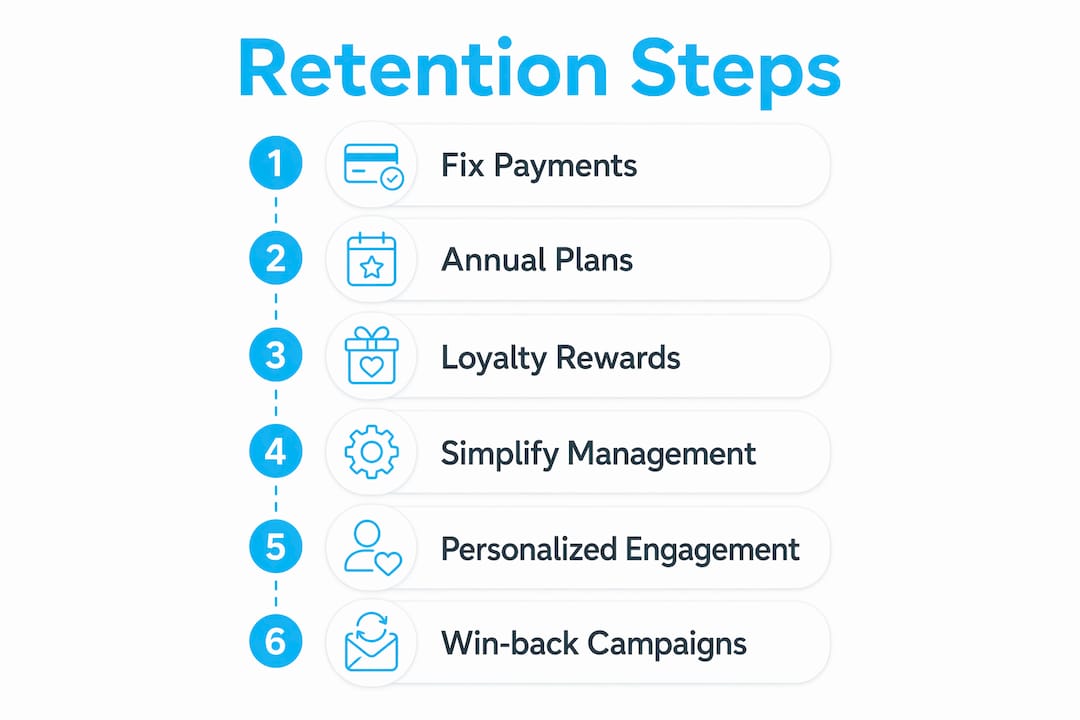
Reducing churn starts with fixing the problems subscribers never even tell you about. Payment failures are silent killers. Smart dunning systems use automated retry logic to recover failed transactions before they become cancellations. This single technical fix addresses what is often the largest single source of involuntary churn.
Annual plans reduce churn by 51% compared to monthly plans and increase lifetime value by 2.4 times. That is not a marginal improvement. Offering a meaningful discount or exclusive bonus to nudge subscribers toward annual billing is one of the highest-return moves you can make. Creators who frame the annual plan as a VIP tier rather than just a cheaper option see stronger uptake.

Milestone rewards at specific subscription lengths grow customer lifetime value by over 30% within six months. The psychology here is straightforward. When subscribers feel recognized for their loyalty, they have a reason to stay beyond the content itself. A creator who sends a personal thank-you message or unlocks exclusive content at the 3-month, 6-month, and 12-month marks creates emotional checkpoints that make cancellation feel like a loss.
Pro Tip: Set up milestone triggers inside your account management workflow so rewards go out automatically. Manual follow-through breaks down at scale.
| Tactic | Retention impact |
|---|---|
| Smart dunning and payment retry | Recovers up to 40% of involuntary churn |
| Annual plan migration | Reduces churn by 51%, raises LTV by 2.4x |
| Milestone loyalty rewards | Grows LTV by over 30% within six months |
| Personalized win-back sequences | Outperforms generic discount offers |
Friction kills subscriptions. When a subscriber cannot easily pause, skip, or adjust their plan, they cancel instead. Self-service portals that let subscribers manage their own accounts reduce cancellations significantly. The rule of thumb is that any account change should take fewer than five seconds to complete. Anything slower creates frustration that tips a hesitant subscriber toward leaving.
The design of your pause feature matters more than most creators realize. Fixed-duration pause options with automated resume reminders recover far more subscribers than indefinite pauses. An indefinite pause is functionally a slow cancellation. A fixed pause with a clear end date and an automated reminder keeps the subscriber in your ecosystem and gives them a reason to return.
Transparent communication around billing and renewal also reduces voluntary churn. Subscribers who are surprised by a charge cancel at higher rates than those who receive a clear renewal reminder a few days in advance. A simple pre-renewal email that highlights what they are getting next month reframes the charge as an investment rather than a surprise.
Pro Tip: Treat your subscription management portal like a retention tool, not just an admin panel. Every option you add that is not “cancel” is a potential save.
Emotional loyalty is what keeps subscribers paying when a competitor offers a lower price. Personalized communication triggered by subscriber actions creates stronger retention than batch messaging sent to everyone at once. A subscriber who gets a message referencing their specific behavior, such as a fan who always engages with a certain type of content, feels seen. That feeling is worth more than any discount.
Behavioral segmentation is the practice of grouping subscribers by their engagement patterns and sending targeted messages to each group. Highly active subscribers need different messaging than subscribers who have gone quiet. Sending the same renewal reminder to both groups wastes the opportunity to re-engage the at-risk segment before they churn.
Community building adds another layer of retention that pure content cannot replicate. Exclusive forums and subscriber-only groups create social bonds between fans that make leaving feel like losing a community, not just unsubscribing from a feed. This is especially powerful for creators with a niche audience where fans share a strong common identity.
“Subscription brands should view loyalty programs as emotional engagement tools rather than only financial incentives.” — Nector.io
Here is a practical sequence for building personalized engagement into your retention workflow:
Sequence discounts outperform flat discounts because they create a sense of earned status. A subscriber who knows their loyalty is worth more over time has a financial and emotional reason to stay. Flat discounts feel transactional. Graduated rewards feel like recognition.
The first 14 days after sign-up are the most critical window for long-term retention. A prompt welcome sequence that sets expectations, delivers immediate value, and invites engagement predicts whether a subscriber will still be active at 90 days. Creators who nail new subscriber onboarding see measurably lower early churn.
Not every churned subscriber is gone for good. The key is distinguishing between involuntary churn (payment failure) and voluntary churn (active cancellation). Each requires a different response. Involuntary churn needs an immediate automated payment retry and a friendly notification. Voluntary churn needs a reason to return, not just a discount code.
Automated win-back sequences at 30, 60, and 90 days post-cancellation outperform single-message campaigns. Each touchpoint should offer something specific. A generic “we miss you” email with 10% off rarely works. A message that references what the subscriber is missing, such as a new content series or an exclusive update, performs significantly better.
Here is a proven win-back sequence structure:
Measure win-back success by tracking reactivation rate, not just open rate. A campaign with a high open rate but low reactivation is telling you the offer is wrong. Adjust the incentive before running the next cycle. Creators who treat win-back as an ongoing program rather than a one-time blast see compounding returns over time. For a broader view of improving creator retention, the principles of win-back apply across every stage of the subscriber lifecycle.
Subscription retention improves most when creators combine technical fixes like smart dunning with emotional strategies like milestone rewards and personalized engagement.
| Point | Details |
|---|---|
| Fix payment failures first | Smart dunning recovers up to 40% of involuntary churn before subscribers notice. |
| Migrate to annual plans | Annual billing reduces churn by 51% and raises lifetime value by 2.4 times. |
| Use milestone rewards | Loyalty rewards at key subscription lengths grow lifetime value by over 30% in six months. |
| Simplify account management | Self-service pause and swap options reduce cancellations by removing friction. |
| Run structured win-back campaigns | Targeted sequences at 30, 60, and 90 days outperform generic discount offers. |
Most creators I work with focus almost entirely on acquisition. They obsess over new subscriber counts while their existing base quietly churns in the background. The math never works in their favor when they do that.
The creators who build durable income treat retention as a separate discipline from marketing. They audit their payment recovery setup before they run a new promotion. They check whether their pause feature is fixed-duration or indefinite. They look at their 30-day and 90-day retention curves before they plan their next content drop. These are not glamorous tasks. They are the operational foundation that makes everything else work.
What surprises most creators is how much involuntary churn they are losing. When you fix your dunning logic and add a proper payment retry sequence, you often see an immediate improvement in active subscriber count without changing a single piece of content. That is money that was already yours.
The emotional side matters just as much, though. Subscribers who feel like part of a community do not cancel the way subscribers who feel like passive viewers do. Building that community takes time, but the retention payoff compounds. A creator who has 500 deeply loyal subscribers will consistently outperform one with 2,000 passive ones.
My honest advice: run a retention audit before your next growth campaign. Fix the leaks before you pour more water in the bucket.
— Gjon
Retaining subscribers at scale requires both the right strategy and the operational capacity to execute it consistently. Only-dreams works with established creators to handle the day-to-day work that keeps fans engaged and subscriptions active.
From 24/7 chat management that builds real fan relationships to data-driven content strategies that keep subscribers coming back, Only-dreams covers the operational side so you can focus on creating. The agency’s trained chat teams know how to turn passive subscribers into loyal, high-value fans. If you are ready to put these subscription revenue strategies into practice with professional support, visit Only-dreams to learn how the team can help you grow.
Subscription retention is the percentage of subscribers who stay active and renew over a given period. High retention means stable, predictable revenue without constantly replacing churned subscribers.
Up to 40% of subscription churn is caused by payment issues. Most of this is recoverable with automated retry logic and smart dunning systems.
Yes. Annual subscriptions reduce churn by 51% compared to monthly plans and increase subscriber lifetime value by 2.4 times.
Send automated win-back messages at 30, 60, and 90 days after cancellation. Each message should offer a specific reason to return, not a generic discount.
Add a self-service pause option with a fixed duration and an automated resume reminder. Subscribers who can pause instead of cancel are far more likely to return than those who cancel outright.