
TL;DR:
- Outsourcing creator operations involves delegating repetitive tasks to external specialists to focus on content growth.
- Effective outsourcing starts with a task audit, clear SOPs, a controlled pilot, and role-specific KPIs to maintain quality.
Outsourcing creator operations is the process of delegating repetitive, time-consuming tasks to external specialists or virtual assistants so you can focus on creating content and growing revenue. Creators who scale like an enterprise shift their focus from doing everything themselves to building systems, SOPs, and vendor relationships that handle execution for them. This guide walks you through exactly how to outsource creator operations, from auditing your workflow to running a 30-day pilot and managing a full outsourced team. Whether you run a solo OnlyFans account or a multi-creator agency, the steps below apply directly to your situation.
The most effective starting point for outsourcing creator operations is a one-week task audit. You track every task you complete, how long each one takes, and how much you enjoy doing it. This gives you real data instead of guesswork.

Track task time and enjoyment over one full week by logging each activity with a duration and a simple enjoyment rating from 1 to 5. Tasks that consume the most time and score lowest on enjoyment become your outsourcing list. That combination tells you exactly where delegation creates the most value.
Common tasks that meet this criteria include:
The goal is not to outsource everything. You want to outsource repeatable capacity work and keep strategic decisions internal. Creators who hand off their positioning, content direction, or brand voice to contractors quickly end up with generic output that does not convert.
Pro Tip: Build your outsourcing list before you hire anyone. A clear list of tasks with time estimates makes it far easier to write job briefs and set realistic expectations with contractors.
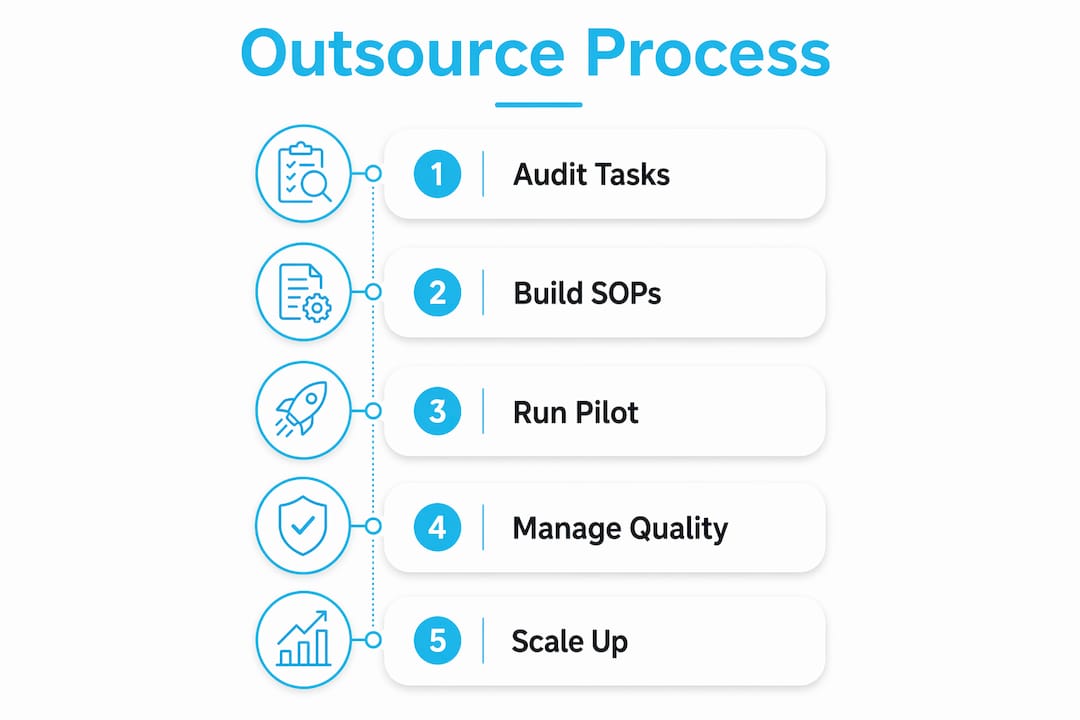
A practical outsourcing order that works well is to start with operations roles first. Hire a virtual assistant or coordinator to handle admin. Then move to content production support like editing. Only after those workflows are stable should you bring in monetization or community roles. Reducing admin burden early improves quality before you scale revenue-generating functions.
Standard operating procedures (SOPs) are the backbone of any outsourced workflow. Without them, contractors make assumptions, ask constant questions, and produce inconsistent results. A good SOP removes all of that friction.
Every effective SOP for outsourced creator operations includes six components:
Usable SOPs are clear enough that contractors ask few follow-up questions after reading them. If your contractor is constantly messaging you for clarification, the SOP is not ready. That is the test.
For fan engagement, a good SOP specifies response time targets, approved message templates, tone guidelines, and escalation paths for sensitive conversations. For content editing, it defines file naming conventions, export settings, revision limits, and turnaround times. The more specific the SOP, the less time you spend managing the person doing the work.
Pro Tip: Record a short Loom video walkthrough the first time you complete a task, then use that video as part of the SOP. Contractors learn faster from watching than from reading alone.
You can find a practical framework for building creator workflow SOPs that covers the specific needs of adult content teams and multi-creator agencies. The same principles apply across platforms.
A phased pilot approach is the safest way to test outsourced workflows before committing to them at scale. Skipping the pilot phase is the most common mistake creators make when they first delegate creator tasks.
Here is a proven four-step pilot process:
The table below shows what to define before the pilot starts:
| Pilot Element | What to Define |
|---|---|
| Task scope | Specific deliverables, volume per day or week |
| Turnaround time | Hard deadline for each task completion |
| Quality standard | Criteria for acceptable vs. rejected work |
| Revision limit | Maximum number of revisions per deliverable |
| Escalation path | Who to contact when a problem arises |
| Review date | Day 28–30 leadership review and go/no-go decision |
Starting with a contained workflow and reviewing weekly before expanding is the approach that reduces risk and builds trust with contractors at the same time. Creators who skip this step often find themselves managing chaos instead of reducing it.
Managing outsourced creator teams requires clear role separation, defined KPIs, and a compliance layer built into every workflow. Without structure, accountability disappears fast.
The standard role breakdown for a creator operations team looks like this:
Agencies benchmark KPIs like response time, conversation quality, and conversion rates, with layered training and SOP enforcement at every level. That structure is what separates a professional operation from a loose group of freelancers.
Quality control requires more than just reviewing output. You need measurable service level agreements (SLAs) for every role. Response time targets for chat, turnaround benchmarks for editing, and weekly error logs for QA reviewers all create accountability without micromanagement.
Compliance is non-negotiable. FTC disclosure requirements apply to any promotional content your team publishes on your behalf. Disclosures must be clear and visible, and your contracts should include a pre-publish approval step for any sponsored or promotional material. Build this into your SOP, not just your contract.
Pro Tip: Create a shared escalation document that lists who handles what type of problem. Chat issues go to the chat lead, compliance questions go to the creator manager, and technical problems go to a designated support contact. This one document eliminates most confusion.
For creators managing fan engagement at scale, outsourcing fan engagement roles with proper QA structures in place is what keeps revenue consistent without requiring your direct involvement in every conversation.
Outsourcing digital operations fails most often because of unclear ownership, not because of bad contractors. When no one knows who is responsible for a decision, work stalls or gets done wrong.
The most common mistakes creators make when they delegate creator tasks include:
The creators who scale without losing quality are the ones who treat outsourcing as a system, not a shortcut. Every task you hand off needs a process behind it before it leaves your hands.
Clear communication channels matter as much as clear SOPs. Set a weekly check-in cadence with your outsourced team, use a shared project management tool like Trello, Asana, or Notion, and define response time expectations for internal communication. These habits prevent small problems from becoming expensive ones.
Outsourcing creator operations works when you audit your tasks first, build clear SOPs, run a contained pilot, and manage teams with defined roles and measurable KPIs.
| Point | Details |
|---|---|
| Audit before you hire | Track task time and enjoyment for one week to build a prioritized outsourcing list. |
| SOPs prevent confusion | Every outsourced task needs a trigger, owner, steps, tools, and quality standard before delegation. |
| Pilot before scaling | Run a 30-day pilot with daily QA and a formal review at day 28–30 before expanding any workflow. |
| Role clarity drives quality | Separate creator manager, chat lead, acquisition lead, and QA reviewer roles to maintain accountability. |
| Keep strategy internal | Outsource repeatable execution only. Brand voice, content direction, and monetization decisions stay with you. |
Most creators I see try to outsource fan chat first because it feels like the most time-consuming task. That instinct makes sense, but it is usually the wrong move. Chat is revenue-critical and brand-sensitive. Handing it off before you have a working SOP and a trained QA reviewer in place is how you lose subscribers and damage fan relationships.
The right order is boring but effective. Start with admin. Get a virtual assistant handling your inbox, scheduling, and file management before you touch anything that touches your fans. Once that workflow is stable and documented, move to content production support. Only after both of those are running cleanly should you bring in a chat team or engagement specialists.
The other mistake I see constantly is treating SOPs as a one-time task. You write the SOP, hand it to a contractor, and assume it is done. In practice, SOPs need a review every 30–60 days, especially in the first six months. Platforms change, fan behavior shifts, and what worked in January may not work in June. The creators who build a habit of reviewing and updating their processes are the ones who scale without the chaos that usually comes with growth.
Start small, document everything, and measure before you expand. That is the only approach that actually holds up at scale.
— Gjon
Scaling your creator business does not have to mean managing a growing team on your own. Only-dreams specializes in handling the operational side of creator businesses, from 24/7 fan chat management to account strategy and cross-platform growth.
Only-dreams provides trained chat teams, dedicated account managers, and data-driven marketing support so you can delegate creator tasks without losing quality or control. Every engagement is backed by SOPs, QA processes, and compliance standards built specifically for the creator economy. If you are ready to outsource account management and grow your revenue without adding more hours to your day, Only-dreams is the partner built for exactly that. Visit only-dreams.com to learn more about how we work with creators and agencies.
Outsourcing creator operations means delegating repetitive and time-consuming tasks like fan chat, editing, scheduling, and inbox management to external specialists or virtual assistants. The goal is to free up your time for content creation and strategic decisions.
Start with operations roles like virtual assistants and coordinators to reduce admin burden before outsourcing content production or fan engagement. This order improves quality before you scale revenue-critical functions.
A 30-day pilot with daily quality checks and a formal leadership review at day 28–30 is the standard approach. This gives you enough data to decide whether to scale, adjust, or exit the arrangement.
Every SOP needs a trigger, a named owner, step-by-step instructions, required tools, quality standards, and an escalation path for exceptions. If contractors still ask frequent questions after reading it, the SOP needs more detail.
Set measurable KPIs for every role, run weekly error log reviews, and assign a dedicated QA reviewer to audit output. Compliance requirements like FTC disclosures should be written into contracts and SOPs, not handled case by case.