TL;DR:
- An effective messaging strategy defines what a brand says, how it communicates, and why it resonates with its audience. Consistent messaging across channels increases revenue, builds trust, and improves search and AI visibility. Using clear, emotional, and focused messages with one call to action enhances campaign success and audience engagement.
A messaging strategy is a structured plan that defines what your brand says, how it says it, and why it resonates with a specific audience. Without one, your campaigns produce noise instead of results. Brands that maintain consistent messaging across channels see up to 33% higher revenue than those that communicate inconsistently. That single statistic explains why messaging strategy development is not optional for serious marketers. It is the foundation every campaign, post, and customer conversation sits on.
A messaging strategy is the deliberate framework that governs how your organization communicates its core value to the people it wants to reach. The industry term for this practice is “message design,” which goes beyond copywriting to include audience psychology, channel selection, and behavioral triggers. Both terms describe the same discipline: building communication that moves people from awareness to action.

Effective messaging creates clarity first. It helps audiences quickly understand what a company does, who it serves, and why it matters. Without that clarity, even a well-funded campaign fails to convert. Clarity is not just a creative preference. It is the mechanism that builds trust and drives engagement.
The importance of messaging strategies shows up across every industry. Airbnb’s remote work policy announcement generated 800,000 views because the message was specific, timely, and written for a clearly defined audience. That kind of reach does not happen by accident. It happens when a brand knows exactly what it wants to say and to whom.
Messaging strategies also affect your visibility in search and AI tools. Clear, consistent language aligned with brand positioning improves how search engines and AI platforms interpret and surface your content. That means a strong messaging framework does double duty: it converts readers and attracts new ones.
Strong messaging strategies share five core components. Each one plays a specific role in making communication land with the right audience.
Pro Tip: Write your core message in one sentence before you write anything else. If you cannot summarize your offer in a single clear sentence, your audience will not be able to either.
Messaging alignment across these five components is what separates campaigns that build brand equity from those that just fill a content calendar. Each component reinforces the others. Remove one, and the whole structure weakens.
Knowing the components is one thing. Applying the right techniques is where most marketers either pull ahead or fall behind. These five techniques produce measurable results.
Design for the audience, not the sender. Communication fails mainly because messages are built from the sender’s viewpoint rather than shaped around audience needs. Start every message by asking: what does this person already know, feel, and want? Then write from that starting point.
Optimize for scanning, not reading. Readers do not read marketing messages word for word. Messages optimized for scanning, using whitespace, visual hierarchy, and clear calls to action, convert significantly better than dense paragraphs. Use short sentences, bold key phrases, and one clear next step per message.
Apply loss aversion framing. People experience losses about twice as strongly as equivalent gains. Framing a message around what someone misses by not acting is more persuasive than listing benefits alone. “Don’t leave money on the table” outperforms “Earn more money” in most contexts.
Use social proof strategically. Numbers, testimonials, and named results reduce skepticism. A message that says “Trusted by 10,000 creators” carries more weight than one that says “Trusted by many.” Specificity signals honesty.
Follow the rule of one. Every communication should request exactly one clear action. Multiple calls to action create decision paralysis and reduce conversion rates. Pick one action per message and make it impossible to miss.
Pro Tip: Before publishing any campaign message, ask: “What is the one thing I want the reader to do right now?” If your answer includes the word “or,” cut one option.
These techniques apply across channels, from SMS campaigns to social media posts to direct fan messages. Marketers who apply advanced social media messaging techniques consistently see stronger engagement than those who rely on volume alone.
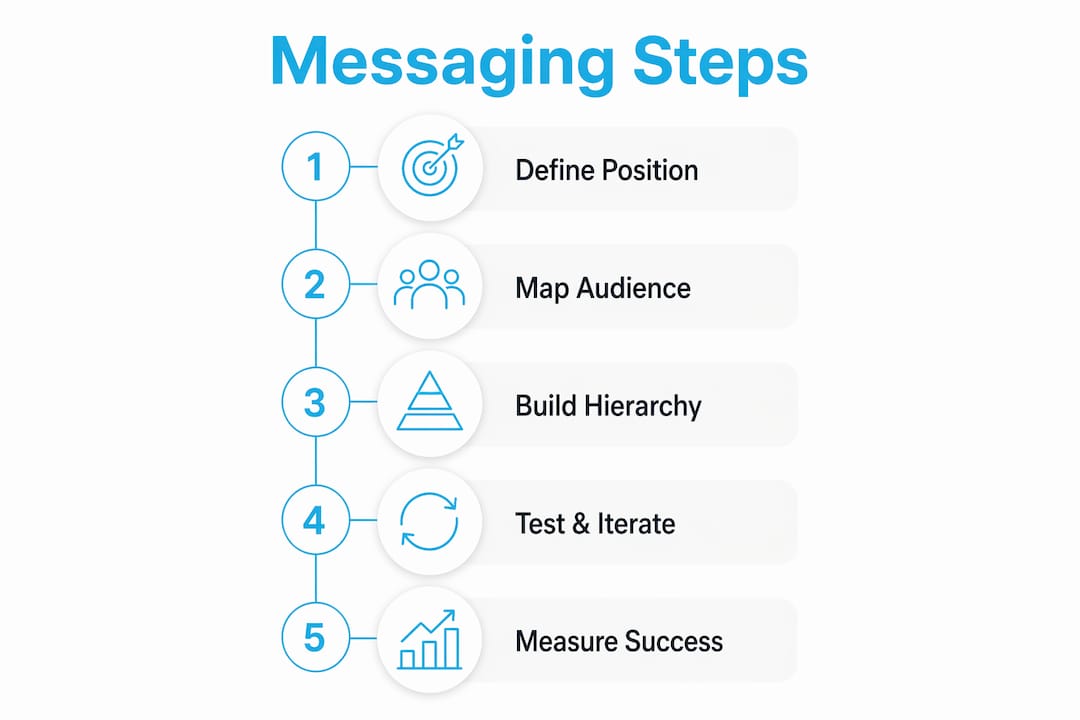
A messaging framework is the document that captures your strategy and keeps every piece of communication aligned. Building one follows a clear process.
Start with one sentence that states what you do, who you serve, and what makes your approach different. This is your positioning statement. Every message you write should be traceable back to it.
List the distinct groups you communicate with. For each segment, note their primary concern, their level of awareness, and the emotional state they are in when they encounter your message. A creator building a personal brand has different audience segments than a B2B software company, but both need this map.
| Message level | Purpose | Example |
|---|---|---|
| Core message | States the primary value proposition | “We help creators earn more without working more.” |
| Supporting messages | Prove the core claim with specifics | “24/7 chat management, dedicated account managers.” |
| Channel messages | Adapt tone and format for each platform | Short and visual for Instagram; detailed for email. |
No framework survives first contact with the audience unchanged. Run A/B tests on subject lines, CTAs, and opening sentences. Track which messages generate clicks, replies, and conversions. Update your framework every quarter based on what the data shows.
Measurement is where most messaging strategies stall. Marketers build the framework, launch the campaign, and then move on without checking whether the message actually worked. The brands that win treat messaging as a living system, not a one-time document.
Most messaging failures trace back to a short list of recurring mistakes. Recognizing them is the first step to avoiding them.
The fix for most of these mistakes is the same: write the message for the reader, not for yourself. Read it back as if you are the audience. If it does not answer “what’s in it for me” within the first two sentences, rewrite it.
A strong messaging strategy is the single most reliable way to turn consistent communication into consistent revenue growth.
| Point | Details |
|---|---|
| Consistency drives revenue | Brands with consistent messaging across channels earn up to 33% more than inconsistent ones. |
| Clarity beats cleverness | Effective messages answer what, who, and why within the first two sentences. |
| One action per message | The rule of one prevents decision paralysis and increases conversion rates. |
| Loss aversion outperforms gain framing | Framing around what audiences miss is twice as persuasive as listing benefits alone. |
| Frameworks need iteration | Test, measure, and update your messaging framework every quarter based on real data. |
I have reviewed hundreds of marketing campaigns across creator brands, e-commerce, and service businesses. The pattern that separates the ones that work from the ones that do not is almost never budget or creative quality. It is whether the message starts with the audience or with the brand.
Most marketers write the headline they wish their audience would read. The best marketers write the headline their audience is already thinking. That gap is where most campaigns lose. Starting a message with a self-referencing, personally relevant sentence increases memorability and engagement. That is not a creative opinion. It is a behavioral science finding.
The other thing I see consistently underused is the loss aversion frame. Marketers default to benefit lists because they feel positive and professional. But positive framing is weaker than loss framing in almost every tested context. “You are leaving revenue on the table” hits harder than “You could earn more.” Use it deliberately, not as a scare tactic, but as an honest statement of what inaction costs.
My practical advice: build your framework, test your messages, and treat every campaign as a data point. The marketers who refine their messaging based on real audience response always outperform those who rely on intuition alone.
— Gjon
Only-dreams works with established content creators who want professional-grade communication strategies without managing every detail themselves.
The Only-dreams team handles fan engagement, chat management, and cross-platform marketing so your messaging stays consistent and your revenue keeps growing. Every interaction is designed around the principles covered in this article: clarity, emotional relevance, and one clear action per message. If you want to see what a professional creator strategy looks like in practice, the Only-dreams team is ready to walk you through it. Consistent messaging at scale is what separates creators who plateau from those who grow.
A messaging strategy is a structured plan that defines what a brand communicates, to whom, and how, across every channel and campaign. It aligns tone, language, and calls to action with audience needs and brand positioning.
A good messaging strategy combines a clear core message, audience segmentation, channel consistency, and a single call to action per communication. Brands with consistent messaging earn up to 33% more revenue than those without a defined strategy.
Start with a one-sentence positioning statement, map your audience segments, build a three-level message hierarchy (core, supporting, and channel messages), then test and update the framework quarterly based on performance data.
The rule of one states that every message should request exactly one clear action. Multiple calls to action create decision paralysis and reduce the likelihood that the reader acts at all.
People experience losses roughly twice as strongly as equivalent gains. Framing messages around what the audience misses by not acting is consistently more persuasive than listing benefits alone.