TL;DR:
- Dedicated support for creators extends beyond quick help responses to include personalized strategic guidance, account management, and early access to platform features. It offers proactive assistance during critical moments like launches or migrations, helping creators grow faster and protect revenue. Access typically requires meeting specific criteria, but proactive and strategic use maximizes its benefits for long-term success.
Most creators assume dedicated support means getting a faster reply to a help ticket. That assumption costs them real growth. What is dedicated support for creators goes far beyond expedited email responses. It covers personal account managers, strategic business reviews, white-glove migration assistance, and early access to platform features that most creators never even hear about. This guide breaks down what dedicated support actually is, how different platforms structure it, and how you can use it to grow faster and earn more.
| Point | Details |
|---|---|
| More than customer service | Dedicated support means personalized strategic guidance, not just faster help desk responses. |
| Multiple support models exist | Platforms use personal managers, technical teams, and revenue specialists to serve creators at different levels. |
| Critical moments matter most | The highest-value support kicks in during launches, migrations, and revenue transitions when creators are most at risk. |
| Eligibility varies widely | Some programs require an invitation, while others are tiered by audience size or revenue threshold. |
| Proactive use pays off | Creators who actively engage their support contacts grow faster and gain influence over platform product decisions. |
When people search for what is dedicated support for creators, they usually expect a simple definition. The reality is more specific and more useful. Dedicated support refers to creator-specific help resources that go well beyond reading a FAQ page. It means having an assigned person or specialized team whose job is to help you succeed on a platform, not just resolve technical complaints.
YouTube routes creator help differently depending on what a creator needs. Channel management questions go through one pathway. Monetization and partner support go through another. That distinction matters because it signals something important: dedicated support is structured around your role and goals, not just your problem.
Here is what separates dedicated support from a standard help desk:
Substack’s Partnership team is a strong example. When a creator applies to migrate their paid subscriber list, a dedicated Partnerships team member works with them hands-on. They do not just hand over a migration checklist. They guide the move, protect subscriber momentum, and advise on pricing and positioning for the new platform.
“Dedicated support is not a contact point. It is a proactive partnership built around your business stage and goals.”
The difference is real. One model answers questions. The other helps you avoid the questions entirely by getting ahead of problems.
Creator support services do not look the same across every platform or agency. They come in several distinct models, each serving different creator needs.
| Support model | What it includes | Best for |
|---|---|---|
| Personal success manager | Account reviews, goal alignment, strategy guidance | Mid-to-large creators on major platforms |
| Technical support team | App store submissions, onboarding, troubleshooting | Creators launching products or apps |
| Revenue optimization specialist | Ad yield, subscription pricing, business reviews | Monetized creators focused on earnings |
| White-glove migration team | Subscriber transfers, list management, revenue guarantees | Creators switching platforms |
| Community Partner Manager (CPM) | Feature access, events, product feedback channels | Established YouTube creators |
YouTube’s Community Partner Managers represent the personal manager model at scale. CPMs are assigned to creators inside YouTube’s invite-only Creator Community program. They guide creators through platform updates, connect them to events, provide early feature access, and open direct feedback lines to YouTube’s product teams. That last part is genuinely rare. Most creators never speak to anyone at a platform who can influence what gets built next.
Raptive’s Platinum Elite tier shows how the revenue model works. Creators at that level get a personal partnerships manager and a dedicated ad specialist. They receive seven-day-a-week support plus formal business reviews that align ad strategy to the creator’s specific revenue goals. That is not generic advice. It is a structured service cadence built around a creator’s numbers and growth trajectory.
Pro Tip: When evaluating a platform’s dedicated support, ask specifically whether your contact is assigned to you or rotates. A rotating support rep starts from scratch every conversation. An assigned manager builds context over time, and that context is where the real value lives.
Passion.io demonstrates the technical model well. Their white-glove app submission service targets creators launching apps on iOS and Android. The team handles store submission, manages reviewer feedback, and guarantees a 30-day launch window with two-business-day response times on rejections. That kind of time-bounded, hands-on support is what separates dedicated resources for creators from a help article about app submission rules.
The real payoff from dedicated creator support shows up across four areas: speed, access, strategy, and protection at high-stakes moments.
Faster and smarter problem resolution. When you work with someone who knows your account, issues get resolved in context. You are not re-explaining your situation from scratch. Your dedicated contact already knows your monetization setup, content categories, and growth history. That context compresses resolution time significantly.

Access to insider knowledge. Proactive engagement with CPMs enables creators to access early product features and participate in shaping platform updates before they go public. Most creators find out about major algorithm changes in a blog post after the fact. Creators with dedicated support relationships often get that information weeks earlier, with enough time to adjust strategy.
Strategic guidance aligned to your goals. Dedicated support is operationalized through defined roles and service cadences, not vague goodwill. That means your success manager is not winging it during your review call. They are working from a framework designed to identify your revenue gaps and recommend specific actions.
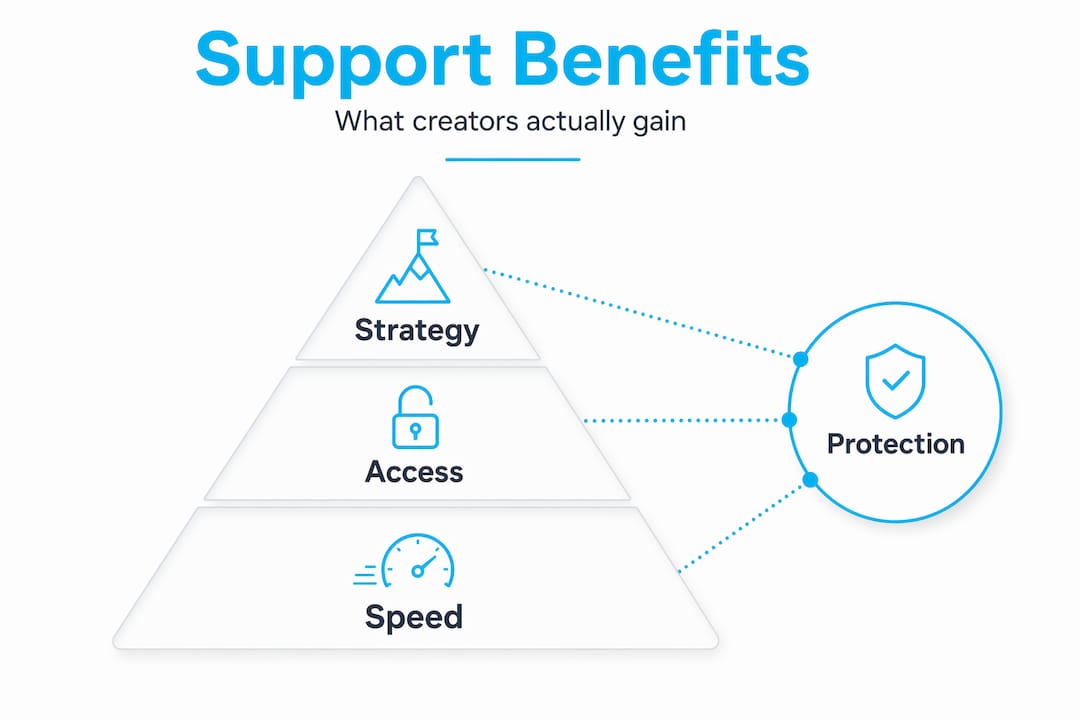
Protection during critical transitions. This is where dedicated support pays for itself most visibly. Substack’s dedicated Partnerships team focuses specifically on migration and launch moments because those are the points when creators risk losing subscribers and revenue momentum. A white-glove migration can be the difference between retaining 90% of your paid subscribers and watching a third of them drop off because the handoff was confusing.
Creator assistance programs also deliver benefits that compound over time:
These advantages are not minor perks. Over a 12-month period, early algorithm access alone can shift a creator’s growth curve substantially.
Getting access to dedicated creator support usually requires meeting specific criteria. Then using it well requires a deliberate approach.
Understand the eligibility requirements. Most dedicated programs are tiered by audience size, engagement rate, or revenue. YouTube’s Creator Community is invite-only. Raptive’s Platinum Elite tier requires reaching a defined revenue or traffic threshold. Check each platform’s creator levels page and know exactly where you stand.
Treat your first contact as a strategy session. Do not open with a complaint or a technical problem. Come prepared with your top three goals for the next 90 days. Your dedicated manager can only help you effectively if they understand what you are trying to accomplish.
Use support during launches, not after. The best time to engage your dedicated contact is before a major launch or transition. If you are launching a new subscription tier, moving platforms, or releasing a large content push, loop in your support team two to three weeks in advance. Dedicated support at critical transition points is built specifically to protect your momentum during high-risk periods.
Ask about early access programs explicitly. Many creators do not know these exist until they ask. Your manager may be able to add you to beta features, feedback groups, or event lists that do not appear in any public documentation.
Document your conversations. Keep a running log of commitments, timelines, and recommendations from your support contacts. This creates accountability and helps you track whether the support is actually producing results.
Pro Tip: If you are on a platform that assigns a Community Partner Manager or success manager, schedule a recurring check-in at least once per quarter. Relationships with support contacts that go dormant for months produce far less value than ones maintained with regular, goal-focused conversations.
Avoid the common mistake of only contacting dedicated support when something breaks. That reactive pattern leaves most of the value on the table. The creators who benefit most treat their support contact as an advisor they report progress to, not a repair service they call in emergencies.
Understanding where dedicated support fits means comparing it honestly to the alternatives most creators use.
| Resource type | Response time | Personalization | Strategic value | Cost to creator |
|---|---|---|---|---|
| Self-service help docs | Immediate | None | Low | Free |
| Community forums | Hours to days | Peer-level | Moderate | Free |
| Chatbot or automated support | Immediate | Low | Minimal | Free |
| Dedicated platform support | Same day to 48 hours | High | High | Earned via threshold |
| Agency support | Defined SLA | Very high | Very high | Fee or revenue share |
Self-service help docs answer known questions well. They fall apart when you are dealing with a nuanced situation, a new feature without documentation, or a business decision that requires context. Automated chat tools are fast but limited to pre-defined paths. They cannot review your content strategy or advise on pricing.
Agency support and platform dedicated support actually overlap in useful ways. Agency support helps creators optimize earnings by handling the operational layer that platform managers do not. A platform CPM can tell you about an upcoming feature. An agency manager can execute the strategy around it. The two roles are complementary, not competing.
The key distinction is that dedicated platform support is reactive to platform-specific opportunities, while agency-level support covers your entire creator business. For creators at scale, both working together produce the strongest outcomes.
I have worked with creators across multiple platforms, and I will tell you the most consistent pattern I see: creators treat dedicated support like a VIP customer service tier. They hold onto contact information and only use it when something goes wrong. That is a significant misread of what these programs actually offer.
In my experience, the most valuable thing a Community Partner Manager or success manager provides is not faster problem-solving. It is early signal. When a platform is about to change how it surfaces content, or when a new monetization feature is in beta, the creators who know first get to position themselves ahead of everyone else. That edge is not small. I have watched creators double subscription revenue in a quarter partly because they were in a beta program that most creators found out about three months later.
I also think many creators misinterpret the relationship. They see manager relationships as mostly social, valuable for networking at events but not much else. That is leaving real strategic value behind. These managers can escalate issues internally, advocate for your account during policy reviews, and connect you directly to product teams who are actively shaping features that affect your earnings.
The creators I see growing most consistently are the ones treating dedicated support as a business partnership they actively maintain. They come to check-ins with data, ask specific questions, and follow through on recommendations. Passive creators in the same program get a fraction of the benefit.
If you have access to dedicated creator support and you are not using it proactively, start now.
— Gjon
If you want dedicated support that goes beyond what any platform offers on its own, Only-dreams was built for exactly that.
Only-dreams is a US-based creator management agency that gives established content creators a dedicated account manager, a trained 24/7 chat team, and data-driven marketing across Instagram, TikTok, and beyond. The team handles fan engagement, subscription revenue optimization, and content strategy so you can stay focused on creating. If you are ready to scale your creator earnings with professional support behind you, explore what Only-dreams can do for your business. You can also learn more about creator management best practices that help creators like you grow subscriptions and maximize revenue.
Dedicated support for creators is a structured service where a platform or agency assigns a specific team or manager to provide personalized guidance, strategic advice, and hands-on assistance tailored to a creator’s business goals. It goes well beyond standard help documentation or general customer service.
Regular customer service handles general issues for any user. Dedicated support involves an assigned contact who knows your account, proactively reaches out with opportunities, and helps you make strategic decisions. It is built around your growth and monetization goals, not just resolving tickets.
No. Most dedicated creator support programs are invite-only or tiered by audience size and revenue. YouTube’s Creator Community requires an invitation, and platforms like Raptive reserve their dedicated tiers for creators who meet defined traffic or earnings thresholds.
The highest-value time to engage dedicated support is before major transitions, not after problems arise. Launches, platform migrations, and new monetization rollouts are exactly when Substack’s Partnerships team and similar programs focus their energy, protecting subscriber and revenue momentum during high-risk periods.
Yes. Agency-level support and platform-based dedicated support serve complementary roles. A platform manager advises on platform-specific features and opportunities. An agency team like Only-dreams handles the operational and revenue side of your entire creator business, including fan engagement, chat management, and cross-platform growth strategy.