
TL;DR:
- Operational management involves planning, controlling, and improving business processes to enhance efficiency and competitiveness. It connects strategy with daily activities through production planning, control, and continuous improvement, which collectively maximize resource use and reduce waste.
Operational management is defined as the strategic practice of planning, executing, and controlling internal business processes to maximize efficiency, profitability, and resource use. Also called operations management (OM), it covers everything from production planning and quality control to supply chain coordination and workforce scheduling. If you run a business or manage a team, understanding what is operational management gives you a direct path to better results, lower costs, and a stronger competitive position.
Operations management is the practice of turning inputs, such as labor, materials, and capital, into finished goods or services as efficiently as possible. It sits at the center of every business function, connecting strategy to daily execution.

The field covers three core stages: production planning, production control, and continuous improvement. Each stage has a distinct purpose, and skipping any one of them creates gaps that compound over time.
Production planning sets the foundation. Production planning spans long-term decisions covering 3–5 years, medium-term decisions around 2 years, and short-term decisions within 1 year. These decisions cover product volumes, facility location, layout design, and resource allocation. Getting planning right means you never scramble for capacity when demand spikes.
Production control keeps operations on track once the plan is in motion. This stage includes quality management, scheduling, cost control, and performance monitoring. Without production control, even the best plan falls apart during execution.
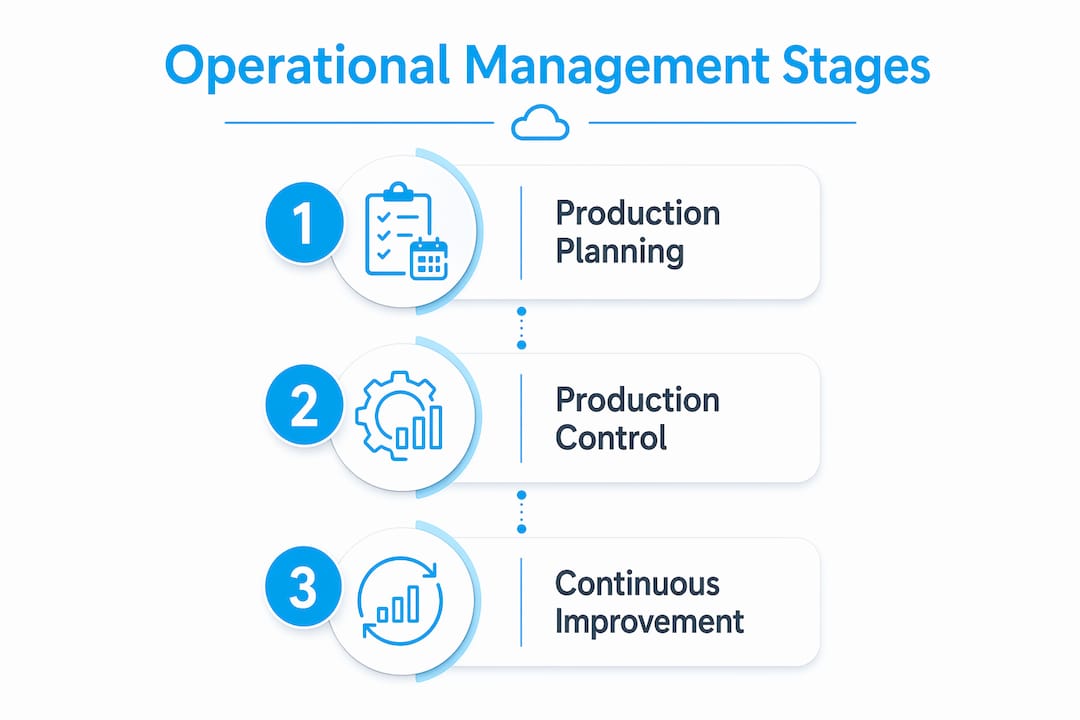
Continuous improvement closes the loop. Operations managers review what worked, identify inefficiencies, and adjust processes before problems repeat. This is where organizations build lasting competitive advantage.
| Stage | Key activities | Primary goal |
|---|---|---|
| Production planning | Capacity decisions, site selection, resource forecasting | Align resources with demand |
| Production control | Scheduling, quality checks, cost tracking | Maintain output standards |
| Continuous improvement | Process audits, performance reviews, waste reduction | Increase efficiency over time |
Pro Tip: Map your current processes before making any changes. You cannot improve what you have not measured.
Operations management enhances productivity and competitive advantage by delivering goods and services on time, at reasonable cost, and to customer specifications. That combination is what separates profitable businesses from struggling ones.
The importance of operational management shows up across four areas that directly affect your bottom line:
Operations management integrates strategy with daily actions to keep organizations efficient, competitive, and focused on value. This means OM is not a back-office function. It is a primary driver of margin control and risk reduction at the executive level. Treating it as administrative overhead is a costly mistake.
Operations managers control large portions of a firm’s assets, and their decisions ripple across every department. The role is broader than most people expect.
Here are the core responsibilities in order of frequency and impact:
The collaboration piece is often underestimated. Synchronizing marketing promises with production capacity prevents two of the most common operational failures: inventory buildup and missed delivery deadlines. When marketing commits to a launch date without checking production capacity, operations pays the price.
Pro Tip: Effective operations managers review the sales pipeline weekly, not just when a deadline is already missed. Anticipating demand changes before they hit the floor saves time and money.
For a practical look at how these responsibilities apply in a creator business context, the operational management for creators guide breaks down the role in detail.
The best operational management strategies share one trait: they are proactive, not reactive. Effective OM prioritizes proactive coordination of information and resources to prevent bottlenecks rather than fight them after they form.
Marketing and operations must share a single source of truth on capacity. When marketing promises customers a delivery window that production cannot meet, you lose money twice: once on rush costs and again on customer trust. Build a regular sync between both teams into your weekly schedule.
Reactive planning means you hire, order, or schedule only after demand arrives. Predictive allocation means you anticipate resource needs based on historical data and pipeline signals. This reduces overtime costs, supplier rush fees, and quality errors caused by rushed work.
These three factors form a triangle. Pushing one too hard weakens the others. The goal is not to maximize any single factor but to find the right balance for your specific market. A premium product line tolerates higher costs for better quality. A high-volume commodity business prioritizes speed and cost. Know which triangle you are operating in.
You cannot manage what you do not track. Set clear metrics for production output, defect rates, delivery times, and cost per unit. Review them on a fixed schedule, not just when something breaks.
Common pitfalls to avoid:
Strong content optimization practices follow the same logic: consistent measurement and iteration produce better results than one-time fixes.
Operational management is the practice of planning, controlling, and improving business processes to maximize efficiency, reduce waste, and sustain competitive advantage.
| Point | Details |
|---|---|
| Core definition | OM covers production planning, production control, and continuous improvement as a unified practice. |
| Business impact | Small efficiency gains compound over time, directly increasing profitability and reducing costs. |
| Manager’s role | Operations managers coordinate inventory, scheduling, quality, and cross-departmental alignment. |
| Proactive approach | Effective OM prevents bottlenecks through predictive planning rather than reactive problem-solving. |
| Strategic integration | OM connects high-level business goals to measurable, repeatable daily processes. |
Most organizations I have seen treat operations management as the department that fixes things when they break. That framing is the root cause of most efficiency problems I encounter.
Operations management is recognized at the executive level as a primary factor for margin control, risk reduction, and competitive advantage. Yet in practice, operations teams are often the last to hear about a new product launch or a marketing campaign that will spike demand. The result is predictable: missed deadlines, rushed orders, and quality problems that damage the brand.
The businesses that get this right treat their operations manager as a strategic partner, not a logistics coordinator. They include OM in planning meetings, share pipeline data early, and build feedback loops between production and customer-facing teams. That alignment is what turns a good product into a profitable one.
The creator economy is a clear example of this principle in action. Creators who treat content production, fan engagement, and revenue tracking as separate activities constantly feel behind. Those who apply OM thinking, planning output, controlling quality, and measuring results, build sustainable income instead of chasing it.
— Gjon
Running a creator business means managing content production, fan engagement, revenue tracking, and platform growth at the same time. That is a full operations function, and most creators handle it alone.
Only-dreams takes on the operational side so you can focus on creating. The agency provides dedicated account managers, trained 24/7 chat teams that build real fan relationships to grow subscription and messaging revenue, and data-driven marketing across Instagram, TikTok, and other platforms. AI-enhanced marketing is available as an add-on to extend your reach without adding to your workload. If you want a professional team managing your creator operations, Only-dreams is built for exactly that.
Operational management is the strategic practice of planning, executing, and controlling business processes to maximize efficiency and profitability. It covers production planning, quality control, scheduling, and continuous improvement.
Day-to-day OM includes scheduling production, monitoring quality, managing inventory, coordinating with other departments, and tracking performance metrics against set targets.
Project management focuses on delivering a specific, time-bound outcome. Operational management governs ongoing, repeatable processes that keep a business running continuously.
The most effective practices are proactive resource planning, aligning marketing commitments with production capacity, continuous performance measurement, and regular process reviews to eliminate waste.
Small businesses have fewer resources to absorb inefficiencies, so OM has an outsized impact. Even minor improvements in scheduling, inventory, or quality control directly increase profit margins and customer retention.